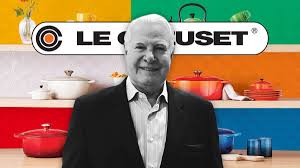
Paul van Zuydam, owner and president of iconic cookware brand Le Creuset, has joined the ranks of the world’s dollar-billionaires, earning a place on Forbes’ real-time billionaires list and cementing his status as one of South Africa’s wealthiest business figures.
Founded in 1925 in the small French town of Fresnoy-le-Grand, Le Creuset began life far from the global spotlight. Its location, however, was strategic, sitting along key shipping routes for iron, coke, and sand, the essential materials for cast-iron production. From the outset, the company distinguished itself by applying colourful enamel to cast-iron cookware, a bold innovation at the time. Its first standout product, the now-iconic “Volcanic Flame” orange pot, would later become synonymous with the brand.
Using traditional sand-casting techniques, each Le Creuset product was, and still is, painstakingly hand-finished and coated with multiple layers of enamel. The process is technically demanding, as enamel and cast iron expand at different rates when heated. Every piece undergoes strict quality control, and any item that fails inspection is melted down and recast. Nearly a quarter of production is recycled this way, resulting in zero waste.
YOU CAN ALSO READ: Why Lagos’ Detty December Feels Like the World’s Ultimate Holiday — Odera Okwuosa
After surviving the disruptions of World War II, Le Creuset entered a period of rapid expansion. The company acquired local competitors and broadened its product range to include grills, fondue sets, and in 1958, its first casserole pot. That casserole would become the brand’s defining product, combining durability with vibrant colour. By the mid-20th century, Le Creuset had evolved into a cultural icon, famously featured by early television chefs such as Julia Child.
However, by the mid-1980s, the company’s fortunes had begun to unravel. Internal family disputes and mounting debt weakened the business, leaving it vulnerable. Around this time, South African businessman Paul van Zuydam, then chairman and CEO of homeware group Prestige, learned that the French manufacturer was in trouble.
Van Zuydam quietly visited the Fresnoy-le-Grand factory and was immediately struck by the craftsmanship and uncompromising quality standards. He later recalled being impressed by the meticulous inspection process, where every cast-iron product is measured and scrutinised before approval. Convinced that the brand’s foundations were strong despite its financial distress, he made a bold decision.
In a move that stunned colleagues, Van Zuydam negotiated a deal to acquire Le Creuset on Prestige’s behalf without even reviewing the company’s financial statements. Although management approved the acquisition, the deal collapsed when Prestige itself was bought by an American tobacco company. The proposed American ownership triggered a strike by French workers, who strongly opposed the takeover.
In 1988, Van Zuydam resigned from Prestige, secured approval from the French government, and personally purchased Le Creuset. It was a defining moment that would reshape both the company and his legacy.
Under his leadership, Le Creuset was rebuilt around its core strengths. Van Zuydam consolidated production in Fresnoy-le-Grand, shutting down scattered facilities, cutting costs, and investing heavily in automation. These changes reduced staff overheads by about 10 percent while preserving craftsmanship. Production capacity doubled, daily output rose to more than 20,000 items, and the company accelerated its global expansion, particularly into the United States and Asia.
While Le Creuset diversified into ceramics and other cookware lines, cast-iron production remained firmly rooted in France, reinforcing the brand’s heritage and quality promise. Since 2001, the company has expanded without taking on external debt, a rarity in global manufacturing.
Today, Le Creuset generates more than $850 million (about R14 billion) in annual revenue. At 87 years old, Paul van Zuydam remains actively involved in the company’s day-to-day operations as president.
As of December 2025, Forbes ranks Van Zuydam as the world’s 2,186th richest person, with an estimated net worth of $1.7 billion (R28.4 billion). His inclusion brings the number of South African dollar-billionaires to eight, with Van Zuydam now the oldest among them.
The list also includes luxury goods magnate Johann Rupert, former De Beers boss Nicky Oppenheimer, media tycoon Koos Bekker, mining executive Patrice Motsepe, Capitec founder Michiel le Roux, retail heavyweight Christo Wiese, and investment veteran Jannie Mouton.
YOU CAN ALSO READ: How Selling 40 Cars in One Month Changed My Life — Chief Michael Adeojo
Johann Rupert remains South Africa’s richest individual and the second richest person in Africa, behind Nigerian industrialist Aliko Dangote, with a fortune estimated at $16 billion (R268 billion). Nicky Oppenheimer, despite slipping 22 places to 292nd globally, saw his net worth rise by $1 billion, underscoring the resilience of his investment strategy.
Patrice Motsepe, Africa’s first Black billionaire, added roughly $900 million to his fortune, maintaining his influence in the global mining sector. Meanwhile, Koos Bekker, Michiel le Roux, and Christo Wiese collectively recorded significant gains, climbing a combined 680 places in the global rankings.
Van Zuydam’s journey from spotting a struggling French manufacturer to building a debt-free, globally admired brand stands as a masterclass in long-term vision, disciplined leadership, and belief in craftsmanship over shortcuts.