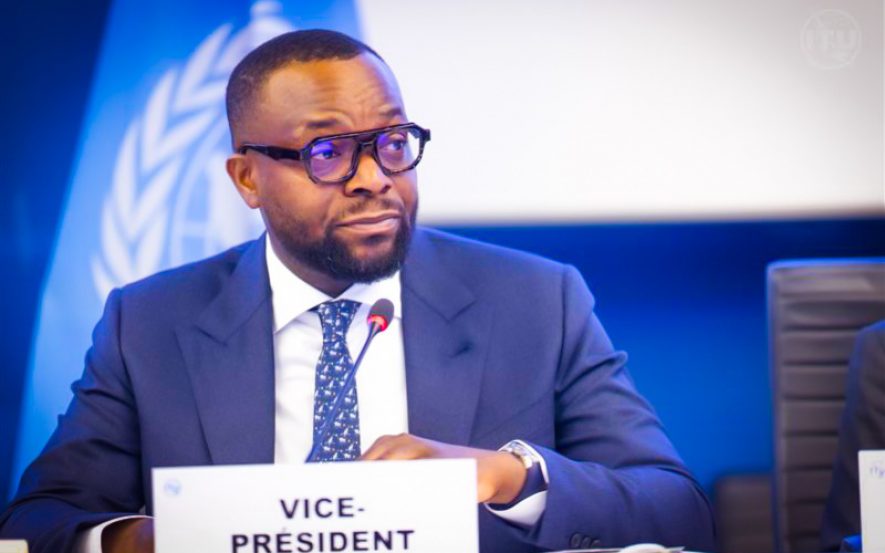
In a country where ambition often races ahead of infrastructure, Nigeria’s Minister of Communications, Innovation and Digital Economy, Bosun Tijani is pursuing a bold and deliberate vision to build not only the pipes of a digital economy, but the thinking that sustains it.
Nigeria’s digital journey carries its own rhythm, uneven, energetic, and still evolving. It is heard in the irritation of dropped connections and stalled downloads, in the quiet accumulation of underutilized academic research, and in the urgency of a young population determined to find relevance in a global, technology driven world. At the center of this shifting landscape stands Tijani, aligning infrastructure, talent, and policy into what he hopes will become a coherent engine for national growth.
The ambition is sweeping. Through Project Bridge, the federal government is advancing a $2 billion plan to deploy 90,000 kilometers of fiber optic cable across Nigeria, an undertaking that could transform connectivity from a privilege into a basic utility.
YOU CAN ALSO READ: How Mark Zuckerberg Is Using AI to Reshape Executive Leadership
The analogy is simple. Where connectivity today often feels like rationed droplets, fiber promises a steady, abundant flow. For Tijani, this is foundational. No modern economy can function without reliable connectivity. Commerce, education, governance, and media now depend on digital access as much as they once depended on physical infrastructure.
Yet Nigeria’s digital reality has been shaped by imbalance. Over the past decade, data consumption has surged dramatically, driven by mobile banking, social media, and digital commerce. Infrastructure, however, has not kept pace. The result is a widening gap between expectation and experience. Project Bridge is designed to close that gap.
Importantly, it is not a purely government driven effort. The model is structured to attract private sector participation, with government contributing up to 49 percent of the required capital while operational control remains in private hands. It is a calibrated blend of public intent and private efficiency. But infrastructure alone, Tijani argues, is not enough.
What sets his approach apart is the parallel investment in knowledge. Alongside the rollout of fiber, the ministry has introduced the National Digital Economy Research Clusters Programme, an effort to reconnect academic research with real world policy and economic outcomes.
For years, Nigerian academia has produced volumes of research that rarely translate into practical impact. Tijani’s intervention seeks to reverse that pattern.
The programme is structured around six priority areas including connectivity and usage, digital public infrastructure, artificial intelligence, online safety, skills development, and livelihoods. Each is funded, coordinated, and expected to deliver actionable insights, not theoretical outputs destined for archives.
The expectation is clear. Research must move beyond intellectual exercise to become a tool for problem solving, policy design, and even commercialization.
Even with infrastructure and research in place, a more fundamental issue remains, usage.
What does meaningful connectivity look like for a trader in a rural community. How can small businesses convert internet access into tangible income. Can older populations adapt to digital systems. And how does a society ensure safety in an increasingly complex online environment.
These are not abstract concerns. They are the real determinants of whether digital transformation delivers value or merely expands access without impact.
For Tijani, solutions must be grounded in local realities. Imported models, no matter how successful elsewhere, cannot fully address Nigeria’s unique socio economic landscape.
Because in the end, access without utility is not progress. It is unrealized potential.
The third pillar of this strategy is human capital.
Nigeria’s 3 Million Technical Talent programme reflects an ambition to build one of the largest technology talent pipelines in the world. With participants drawn from all 774 local government areas, the initiative signals a deliberate effort to democratize opportunity and decentralize innovation.
Talent in this context is both a means and an outcome. It drives the digital economy while also ensuring that its benefits are retained within the country.
Still, public skepticism persists.
For many Nigerians, the digital economy is experienced less as a promise and more as a daily frustration. Failed transactions, slow connections, interrupted communication. In that context, long term strategies can feel distant.
Tijani does not dismiss these concerns. Rather, he frames them as symptoms of deeper structural deficiencies, deficiencies that Project Bridge is designed to address.
The timeline, however, is measured. Transforming a nation’s digital backbone is not instantaneous. It requires sustained investment, coordination, and execution over several years.
What ultimately defines Tijani’s approach is its long term orientation.
He speaks of building systems that will outlast immediate political cycles, of planting structures that will continue to yield value over time. The research clusters alone are expected to engage hundreds of researchers over a three year period, creating a sustained pipeline of expertise in the digital economy.
It is an investment not just in infrastructure, but in institutional memory and intellectual capacity. The true test of this vision will not lie in kilometers of fiber installed or funds disbursed, but in lived outcomes.
YOU CAN ALSO READ: Not Just Business but Legacy : John Momoh Inspires Founders to Build for Generations
When reliable connectivity becomes ordinary rather than exceptional
When research begins to influence policy in visible ways
When digital tools translate into jobs, businesses, and inclusion
When Nigeria’s digital economy shifts from promise to performance
For now, Bosun Tijani stands at a critical intersection between ambition and execution, between expectation and delivery, working to transform a fragmented digital landscape into a functional ecosystem.
Talk may be easy. But building infrastructure is not. Neither is building systems that endure.
And in this moment, Nigeria is attempting both.