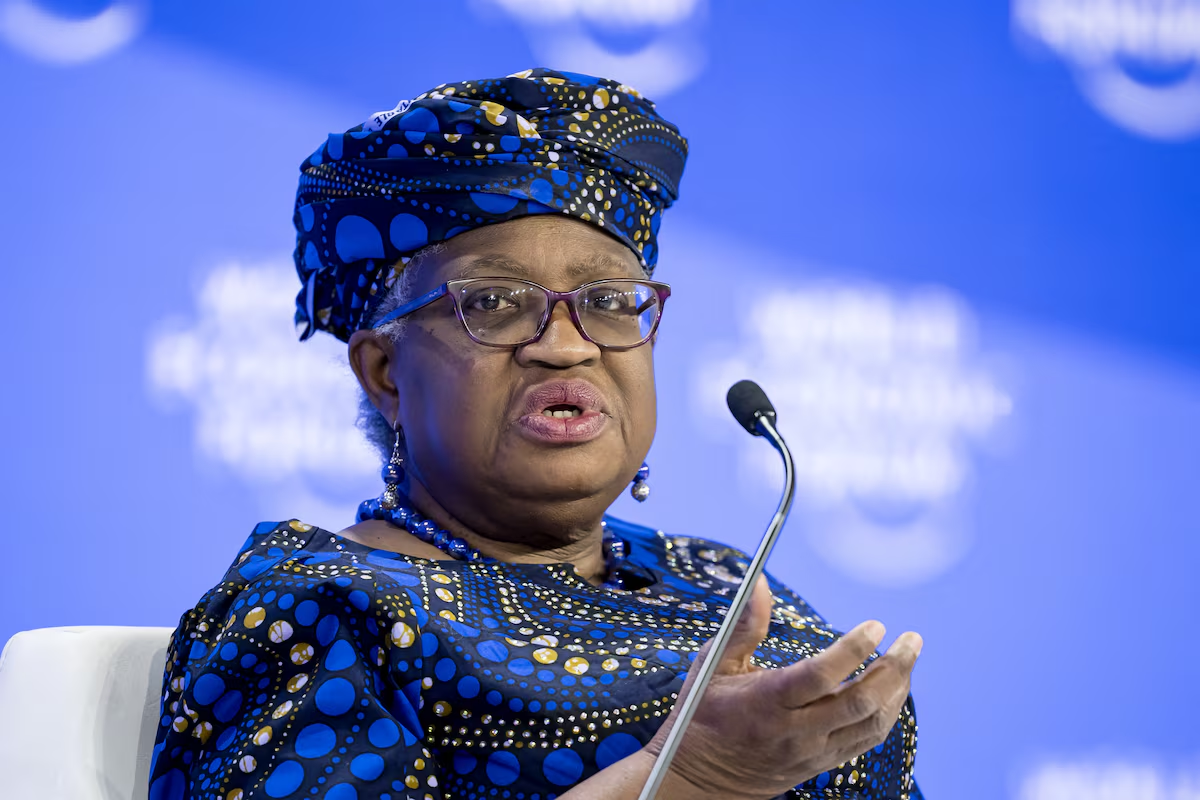
At the glittering Future Investment Initiative (FII) summit in Riyadh, where world leaders and financial heavyweights converged to map out the future of global commerce, one of Nigeria’s most respected voices offered a message of cautious optimism.
Dr. Ngozi Okonjo-Iweala, Director-General of the World Trade Organization (WTO), speaking in an exclusive conversation with Arise News, acknowledged that the global economy is undergoing its most severe disruption in 80 years. Yet, she said, the resilience of the global trading system and the emerging stability of Nigeria’s economy signals hope amid uncertainty.
“We’ve seen the biggest disruption in 80 years, but the global trading system is proving surprisingly strong,” she said.
Okonjo-Iweala revealed that despite the recent surge in reciprocal tariffs among major economies, world trade growth has rebounded faster than expected, rising from 0.9% in August to 2.4% by year-end. She attributed this turnaround to preemptive import strategies by U.S. firms and the accelerating influence of artificial intelligence, which now drives almost half of global trade growth.
However, she lamented Africa’s limited participation in this AI-driven growth, emphasizing that most of the trade occurs between the United States and East Asia. “Africa is not yet a major player,” she said, though she celebrated an 8% surge in South-South trade, noting that developing nations are increasingly building self-reliant trade networks outside traditional Western frameworks.
Turning to industrial policy, the WTO chief offered a pragmatic take on the controversial subject of subsidies, an issue that has long shaped Nigeria’s economic debates. “Subsidies shouldn’t be ideological,” she said. “Some are good if they make economic sense.”
She urged Nigeria to support technology-driven enterprises, startups, and green innovation through smart subsidies, describing such investments as essential for sustainable development. At the same time, she cautioned against “bad subsidies” that sustain inefficiency and drain public funds.
Reflecting on Nigeria’s economy, Okonjo-Iweala said recent efforts to stabilize the exchange rate and restore fiscal discipline are beginning to yield results. “You need a stable exchange rate and sound fiscal management. Without that, growth is impossible,” she stated.
She urged the government to channel its next phase of reforms toward growth, especially by empowering small and medium-sized enterprises, modernizing agriculture, and strengthening the creative economy. “We have the land and capacity to feed ourselves and export,” she said, while noting that Nigeria’s creative industries, once barely one percent of GDP, are now among the nation’s fastest-growing sectors.
On the global stage, Okonjo-Iweala reiterated the need to reform the WTO to make it more agile. With 166 member nations, the organization often struggles to achieve consensus. “We need to make consensus more practical; let willing members move ahead on new agreements,” she argued.
She also underscored Africa’s potential as the next frontier of global growth. “The world has become overdependent, not just interdependent,” she said. “Africa, with its rich minerals, vast market, and young population, offers an alternative. By 2050, one in every five working-age people will be African. The world must pay attention.”
From Riyadh, her message resonated far beyond the summit hall: despite turbulence in global trade and economic headwinds, Nigeria is finding its footing, and Africa’s time on the global stage is fast approaching.