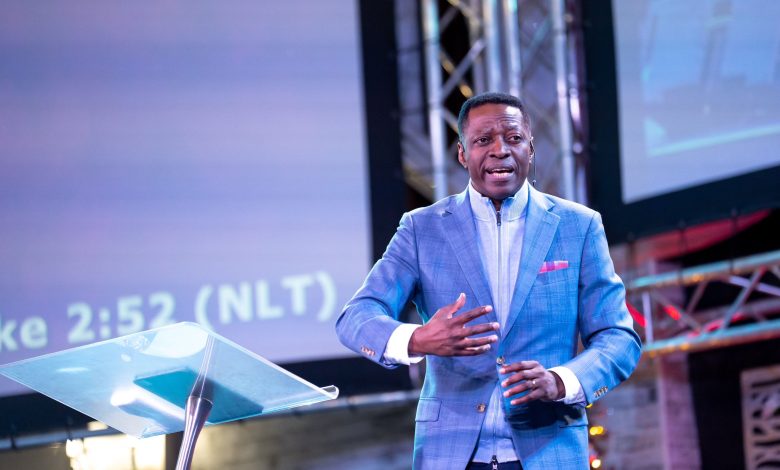
When asked about the “science of church growth” that one of his mentees said he learned and successfully replicated after leaving to start his own church, Dr. Sam Adeyemi smiled and admitted that the answer could fill an entire conference. Yet, he summarized it with remarkable simplicity and depth.
Between 1998 and 2001, a transformation began in his ministry as a quest to find a biblical system that truly worked for growth. Around that time, he was denied a U.S. visa for the second time. While standing at the embassy, the Holy Spirit told him, “You may not get this visa today.” He replied, “Lord, if I don’t get it, then I’ll know it’s You, not the devil.” True enough, he was denied again, but unlike before when it felt like being refused entry into heaven, he walked out smiling.
That night, he said, the Holy Spirit confronted him with a question: “Look at your plans. You want to travel and abandon the work I gave you. You have to stay and build it.” He complained, “But Lord, it’s not growing. The Bible says You added daily those being saved. Why not us?” The reply changed everything: “Why do you want the church to grow?”
YOU CAN ALSO READ: Stop Blaming Leaders, Start Leading Yourself” – Sam Adeyemi’s Bold Call to Nigerians
That question revealed the flaw in his motive. He wanted growth for comfort, not for impact. “The Holy Spirit told me,” he recalled, “‘I didn’t send people to you for your comfort. Until you help them succeed, you won’t find the meaning of success in ministry.’ That was the foundation, the shift in motive.”
A few days later, he had a dream. He saw the church transformed and a massive crowd rushing in. When he prayed about it, God instructed him to lead the church in 21 days of fasting and prayer. During that period, they discovered the property where Daystar Christian Centre now stands. At the end of the fast, someone gifted him a copy of The Purpose Driven Church by Rick Warren. From the introduction alone, he knew he had found what they were searching for. He gathered his pastors and said, “Let’s study this book together.” For weeks, they went page by page, and out of that came the blueprint for Daystar.
The first revelation from that book was a question: “What is the purpose of your church?” When he asked his team, everyone gave a different answer. That was the beginning of transformation, realizing that leadership must be united on purpose before the church can grow. They clearly defined their vision and began studying their immediate community within a five-kilometer radius to understand who lived there and what their needs were. The most common answer they found was poverty.
Then came another revelation. “I realized that all I had been teaching about finances was giving,” he said. “The Holy Spirit told me, ‘How can you teach people to give when they don’t even have?’” That moment birthed his teaching series Start with What You Have, inspired by the story of the widow in 2 Kings 4. From there, he began to teach entrepreneurship and organized business classes.
They also defined their target audience, what they called “Lagos Andy and Lagos Angie.” Every aspect of the church, including the music, environment, and programs, was designed with them in mind. That clarity changed everything. But what truly became the game-changer was the training system that evolved into Daystar Academy, a structured program that moved people from one level of commitment to another.
He recalled starting with 30 classes, and from the first two, he noticed transformation. When some participants began arriving late, he addressed them firmly: “I’m not raising civilians; I’m raising soldiers for Christ. You can’t serve on your own terms.” By the following Sunday, people were running to class. He noted that many pastors fail to demand commitment because they believe that since workers are unpaid, they can’t demand much. “Wrong,” he said. “Commitment determines impact. As commitment rose, so did finances. People invest where their hearts are.”
YOU CAN ALSO READ: Bill Gates on AI’s Future: “This Is Not Tulips – This Is the Internet All Over Again”
Later, from Ephesians 4:11–12, he discovered another powerful truth that members, not pastors, are called to do the work of ministry. “Our job as pastors,” he said, “is to equip them.” That insight led to their slogan, “Every member a minister.”
By the end of the year 2000, he said, God told them to start two services. Within six weeks, both were full. Soon they added a third and then a fourth, all within 10 months. The training system, he said, was the replicable science of growth, a structure that builds people, aligns purpose, and releases every member into ministry.
Reflecting on the principles that guide his life, Dr. Adeyemi said that every person must learn to prioritize what truly matters. “There are four categories of activities in life,” he explained: urgent and important, not urgent but important, urgent but not important, and not urgent and not important. The most productive people, he noted, spend more time on the second category, things that are not urgent but important, where planning, creativity, and strategy happen. “If you focus on the most important things,” he said, “you’ll find satisfaction. The Pareto Principle tells us that 20 percent of what we do produces 80 percent of our results. The key is prioritizing.”
Speaking on personal strengths, he described himself as a thinker and an introvert whose strength lies in reading, acquiring knowledge, and simplifying complex ideas for others. “That’s why people listen to me,” he said. “I invest most of my time developing that talent. You must align with your genius, do what gives you the greatest value, and helps you make your biggest contribution.”
He advised people to identify their door-opening gift, the one that creates opportunities for others. “For Joseph, it was interpreting dreams,” he said. “For me, it’s teaching. That’s why I intentionally brand and project that gift.”
YOU CAN ALSO READ: Sam Adeyemi on the $19 Billion Lesson Hidden in Rejection
On women’s progress when faced with unsupportive husbands, Dr. Adeyemi advised wisdom, courage, and alignment with God’s purpose. “Your first allegiance is to God, not your husband. Don’t turn him into an idol,” he said. “Communicate wisely, not in anger, and if peace efforts fail, remember that God did not call you into bondage.”
He also offered a balanced perspective on understanding the will of God. “When Abraham faced famine, he relocated and prospered. When Isaac tried the same, God told him to stay, and he also prospered. God’s will differs for everyone. When heaven is silent, use wisdom. Sometimes clarity only comes after motion.”
Dr. Adeyemi concluded with a strong message about Christians and influence in politics. “Christians must engage politics if we want lasting change, but it begins with building credibility,” he said. “Build your personal brand. Branding is simply your identity and promise of value. What problem are you here to solve? Be consistent with that message.”
He shared how his own visibility through his radio program Success Power opened doors. “Before then, people didn’t know me or my message. You can’t expect angels to advertise you. Visibility is your responsibility,” he said. “Build trust, serve your audience, and stay consistent. Over time, that’s how influence grows in business, in ministry, and in politics.”