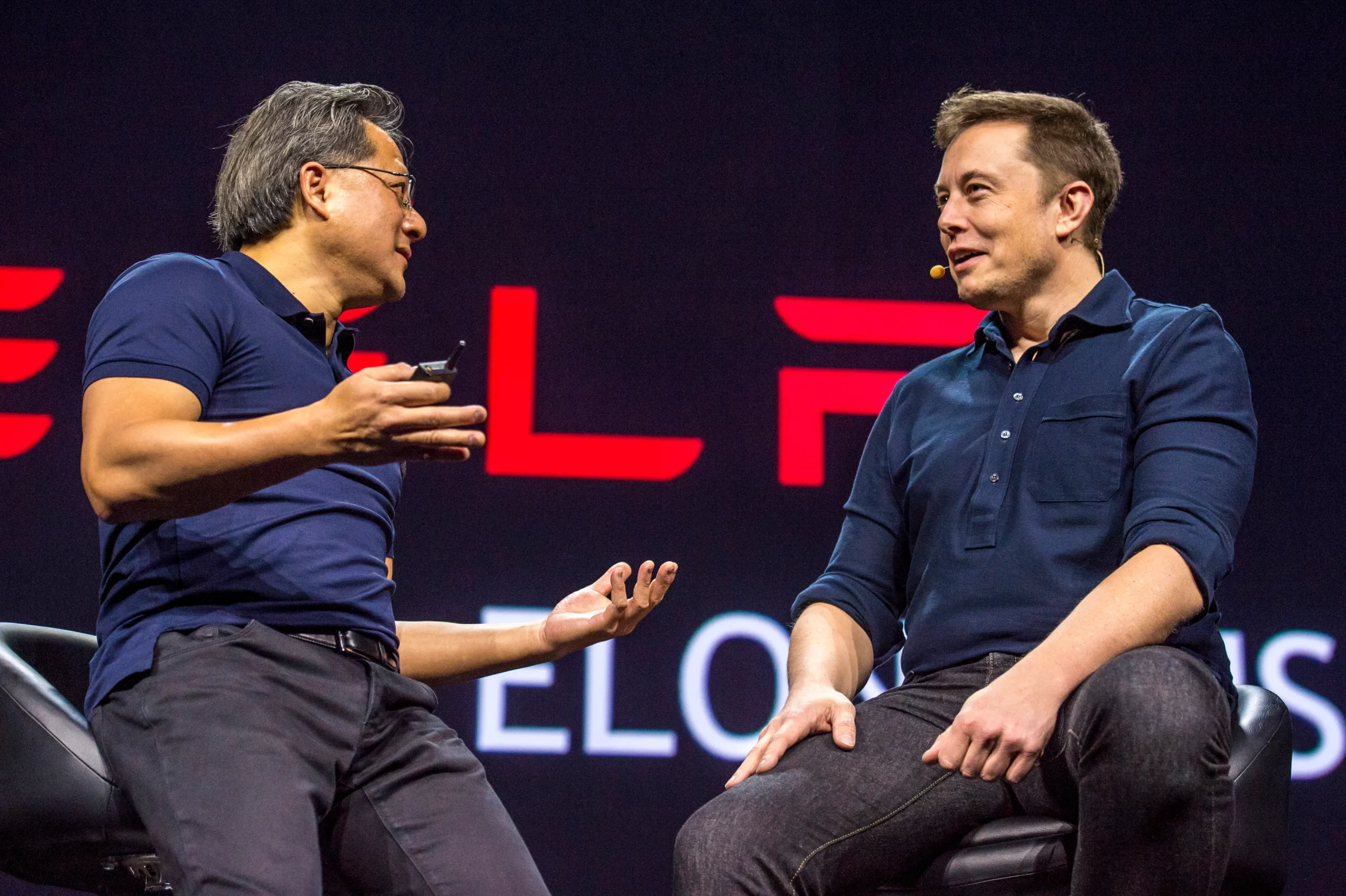
The atmosphere was electric as global technology leaders gathered for what many now describe as one of the defining conversations of the digital era. In a room filled with innovators, investors, and policymakers, two of the world’s most influential technology visionaries, Elon Musk and Jensen Huang, sat side by side to unpack the future humanity is racing toward. It was more than a fireside chat. It felt like a blueprint for tomorrow.
The session opened with a warm introduction that set the tone for an extraordinary conversation. As applause settled, Musk and Huang, each driving breakthroughs that shape global industries, prepared to explore what comes next in robotics, artificial intelligence, and the infrastructure powering the intelligence age.
YOU CAN ALSO READ: The Power of Yes: Inside Bella Disu’s Journey to Reinvention and Leadership
At the outset, the moderator captured the magnitude of the moment when he noted that the global economy has shifted from the industrial era to a new frontier. “You helped us build an energy based economy that powered the industrial age. Now, we are moving into the intelligence age, fueling AI factories, robotics, EVs, and more.” With that, Musk and Huang began to articulate a future that felt both technically ambitious and deeply human.
Musk was the first to take the audience into his world. Known for transforming entire sectors, from electric vehicles to space travel, he spoke candidly about innovation as an act of creation, not disruption. “Reusable rockets did not really exist until SpaceX,” he said. “Electric cars barely existed until Tesla pushed the limits. Now we are doing the same with humanoid robots. At this point, there are no useful humanoid robots in the world, only prototypes. Our goal is to build the first ones that are genuinely useful.”
Then he delivered the line that instantly became the moment’s headline: “Humanoid robots will be the biggest product category in history, bigger than smartphones.” Musk insisted that beyond industry, robotics could help solve one of humanity’s oldest challenges, which is poverty. “AI and robots can create an era of abundance,” he said, suggesting that technological productivity, not charity, will reshape economic inequality. He referenced the Culture series by Iain Banks, a universe where advanced AI helps eliminate poverty, war, and scarcity, hinting that elements of that future may not remain fiction for long.
When it was Jensen Huang’s turn, he offered an equally compelling view rooted in the infrastructure behind the coming transformation. He described AI as the world’s newest and most essential utility, explaining how global systems have shifted from retrieval based computing to real time generative intelligence. “Everything we used before, search engines, databases, cloud apps, was built on retrieval,” Huang noted. “We stored information and software, and the computer retrieved it. Now, AI creates content in real time. Every answer is new. Every output is unique. This requires a completely new kind of infrastructure.” He then delivered the line that crystallized his vision: “The world now needs AI factories everywhere to generate this real time intelligence.”
The conversation soon turned to a topic many worry about, the future of work. Musk predicted that within 10 to 20 years, most work would become optional. “Work will feel like playing a sport or tending a garden, something you choose, not something you must do,” he said, hinting at a world where human creativity replaces economic necessity. Huang, while agreeing on the long term outlook, provided a near term perspective. He argued that jobs will evolve rather than disappear, as AI frees people from repetitive tasks and unlocks higher value roles. He pointed to radiology, where AI enhanced accuracy and speed, ultimately increasing the demand for radiologists instead of replacing them.
The conversation also highlighted Saudi Arabia’s ambition to position itself as a global AI powerhouse. Through strategic partnerships, expansive land allocation, and significant energy capacity, the Kingdom is investing heavily in becoming one of the most AI enabled nations in the world. The moderator described this as a historic moment for the United States and Saudi Arabia AI ecosystem, reinforcing the geopolitical significance of the dialogue.
YOU CAN ALSO READ: Motsepe Paints a Pan-African Future Powered by Innovation and Long-Term Capital
As the session drew to a close, it became clear that this was more than a panel discussion. It was a glimpse into a future where robotics, AI factories, and human ingenuity converge to reshape every part of life. Elon Musk’s drive to build useful humanoid robots, Jensen Huang’s mission to industrialize intelligence at scale, and a world rapidly transitioning from energy to intelligence as its primary resource all painted a picture of profound transformation.
If the industrial age built the foundations of modern society, the leaders on that stage suggested that the intelligence age will redefine it. For everyone in the room, and those watching globally, it felt like history unfolding in real time.