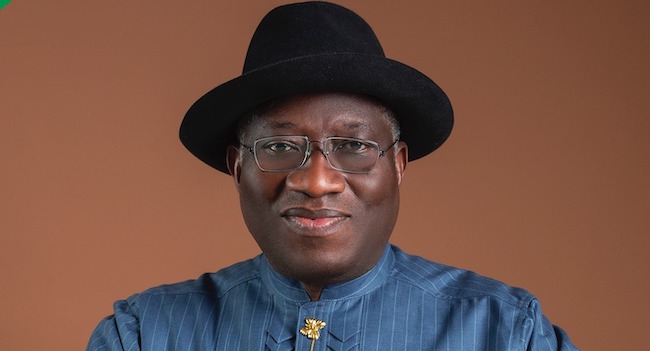
Former President Goodluck Jonathan has offered a candid reflection on his journey after leaving office and the work of the Goodluck Jonathan Foundation, emphasizing the need for responsible leadership and stronger democratic values across Africa.
Speaking at a gathering of private sector leaders, diplomats and public officials, Jonathan began by expressing gratitude for their support. “Many of you greeted me personally today, and I appreciate it,” he said, adding that he preferred to speak from the heart rather than read a prepared speech.
Jonathan recounted the period following the 2015 presidential election, which he lost and famously conceded even before the vote tally was concluded. He revealed that the idea of establishing a foundation came from suggestions by close associates, including entrepreneur Tony Elumelu. “When people came to me with different proposals, Tony was among those who encouraged me to start a foundation,” he explained. “I told him I had never worked in civil society and did not know how foundations function.” That conversation led to the involvement of Angel, who helped structure the early plans for what would become the Goodluck Jonathan Foundation.
YOU CAN ALSO READ: Leadership Is About Service, Not Power – Jonathan
Initially, Jonathan envisioned a broad approach that would cover women, children, poverty alleviation, hunger and environmental concerns. However, an adviser who had previously worked with Elumelu encouraged a more streamlined focus. “He told me that many leaders start foundations with too many goals and end up achieving very little,” Jonathan said. “He suggested we focus on democracy and public sector reform, areas where the public already recognized my contributions.” Jonathan agreed, and these themes now sit at the center of the Foundation’s mission. Even so, insights from people close to him, such as his childhood friend King Turner, reminded him of the importance of environmental issues given his Niger Delta background. “We had to reflect deeply on how best to balance our priorities,” he noted.
One of the Foundation’s most prominent initiatives is the West African Elders Forum, a platform that brings together former presidents and former ECOWAS leaders committed to preventive diplomacy. Jonathan explained that his time in office exposed him to the ways unresolved electoral disputes often trigger larger national crises. “When I was in office, I observed that many crises in West Africa were rooted in poorly managed elections,” he said. “Look at Mali. The crisis there started from a parliamentary election dispute.” Through the forum, Jonathan and other statesmen visit countries before and during elections to identify and defuse early signs of political tension. “Our goal is to prevent problems before they escalate,” he emphasized. Membership in the forum is limited to leaders who are no longer active in partisan politics, a rule that also influences Jonathan’s decisions about his own political future. “Some of my friends want me to return to politics,” he said with a smile. “But if I must return, I would have to resign from the West African Elders Forum.”
Jonathan also spoke about the Foundation’s Annual Democracy Dialogue, which brings together influential voices to discuss democracy and governance on the continent. The most recent edition was held in Accra, Ghana, and he hinted that future editions may take place in East Africa, Southern Africa or Nigeria. “We produce documentaries, conduct stakeholder engagements and intervene around elections,” he said. “Our work continues to evolve, but democracy and governance remain our core.”
His remarks took an emotional turn as he addressed the recent kidnapping of 25 schoolgirls and the killing of security and school officials. The event, he noted, brought back painful memories of the 2014 Chibok schoolgirls’ abduction. “This is a sad moment for our nation,” he said solemnly. “We sincerely pray for the rescue of these girls and mourn with the families of those who lost their lives.”
YOU CAN ALSO READ: ‘Bold Leadership, Smart Investment Can Solve Nigeria’s Hunger’ – Ada Osakwe
Jonathan then delivered one of the most striking lines of his address. “Politics must be played responsibly. Politics is not for rascals,” he said firmly. He referenced an observation once made by Bishop Matthew Kukah at a Democracy Day event, where the cleric noted that every profession requires formal training except politics. “Someone can declare themselves a politician today and become a governor tomorrow,” Jonathan said. “This lack of preparation is a major problem.” He urged political actors to conduct themselves with integrity, reminding them that leadership carries responsibilities that directly affect the lives of citizens.
Jonathan concluded his remarks by thanking his supporters, former ministers, governors and professional colleagues in attendance. He also reminded the audience that the anniversary of the Foundation coincides with his birthday, since it was launched in 2015 with proceeds from his book titled The Transition Hours. “Thank you all for your warm words,” he said. “We will continue to do our best for democracy, for governance and for Africa.”