Kingsley Moghalu
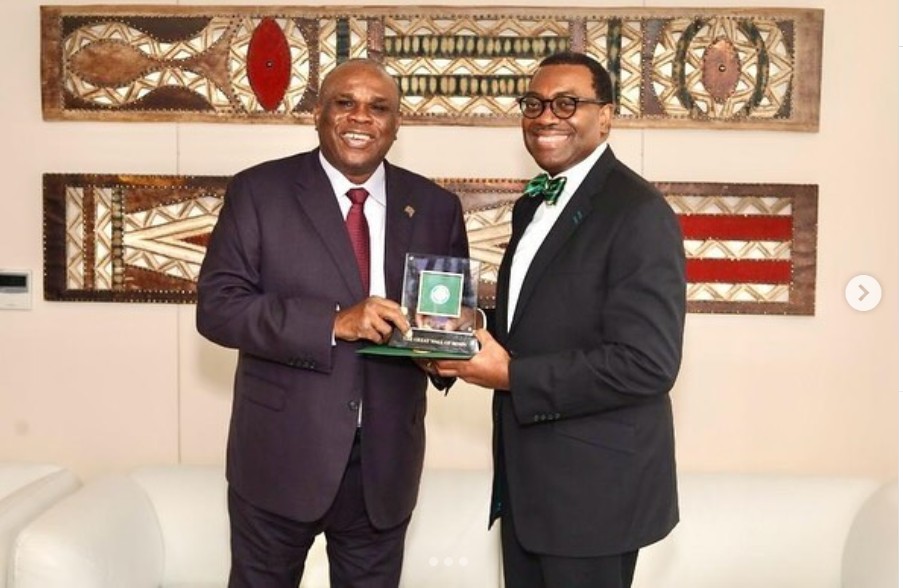
In reflecting on Africa’s development trajectory, I often point to leaders who embody the competence, clarity of vision, and institutional discipline required to drive real transformation. Two individuals who exemplify these qualities are Akinwunmi Adesina and Benedict Okechukwu “Okey” Oramah. Both men, Nigerians by origin, recently concluded their tenures at the helm of major continental development finance institutions, and they did so with distinction.
Akinwunmi Adesina, who served as President of the African Development Bank Group from 2015 to 2025, left behind a legacy that is nothing short of remarkable. Under his leadership, the Bank’s capital base expanded from $93 billion to an impressive $318 billion. This expansion positioned the AfDB as a central driver of Africa’s infrastructure renewal. During his tenure, the Bank deployed $50 billion towards transformative projects, including the $3.2 billion Tanzania DRC Burundi railway, which is projected to boost regional trade by 400 percent. Other landmark achievements include the Kazungula Bridge connecting Zambia, Botswana, Namibia, and Zimbabwe, the Senegambia Bridge linking Senegal and The Gambia, and major transport corridors such as the Addis Ababa Nairobi Mombasa route.
YOU CAN ALSO READ: Inside the Money Game: Wesley Ogude’s Blueprint for Generational Wealth
Adesina’s “High 5s” Agenda, which focused on powering Africa, feeding Africa, industrializing Africa, integrating Africa’s markets, and improving the quality of life on the continent, served as a coherent strategic framework that attracted billions of dollars in investment across key sectors. Despite facing politically motivated headwinds during his re election bid in 2021, including allegations of governance malpractice, he was ultimately re elected and fully vindicated after an independent investigation requested by non African shareholders. His tenure closed in September with a smooth handover to Mauritania’s Sidi Ould Tah.
Professor Okey Oramah, who recently completed a decade as President of the African Export Import Bank, presided over one of the most dramatic institutional transformations in modern African finance. Under his stewardship, Afreximbank grew from a relatively modest institution into Africa’s premier trade finance powerhouse. The balance sheet expanded from $6 billion to $44 billion, with assets reaching $42.7 billion by early 2025. The Bank maintained strong liquidity, consistent profitability, and low non performing loans. Oramah, like Adesina, holds a doctorate in Agricultural Economics.
One of his most consequential contributions was supporting the operationalization of the African Continental Free Trade Area. Afreximbank’s $1 billion commitment to the AfCFTA Adjustment Fund and the launch of the $3 billion backed Pan African Payment and Settlement System, which enables cross border payments in African currencies, have begun reshaping Africa’s trade ecosystem. I had the privilege of delivering the 30th Anniversary Founder’s Day Lecture at the Bank’s headquarters in Cairo at his invitation, an occasion that underscored the strategic importance of the institution he helped reshape.
Despite these achievements, Western credit rating agencies recently downgraded Afreximbank, in my view unjustly, citing an increase in non performing loans from 2.33 percent to 2.44 percent, a marginal shift that does not reflect the Bank’s strong fundamentals. This episode underscores a broader problem in how global financial gatekeepers assess African institutions, often through frameworks that fail to capture their contextual strengths and developmental mandates.
YOU CAN ALSO READ: The Chew Brothers: From No Degrees to a $1.3 Million Enterprise
The accomplishments of Adesina and Oramah demonstrate something important: nothing prevents Africa from achieving transformative prosperity on its own terms. The continent possesses the talent, the institutional capacity, and the visionaries needed to drive progress. What we must continue to cultivate are the core ingredients of sustainable development: a clear worldview, the competence to execute it, and the institutional capacity to sustain it.
Africa’s rise will not be handed to us. It will be built by leaders who understand the continent’s needs, mobilize resources with purpose, and create systems that endure. The examples set by these two Nigerian leaders show that such a future is not only possible, it is already taking shape.
Professor Kingsley Moghalu, a globally recognized leader in governance, public policy and economic transformation, is the inaugural President of the African School of Governance (ASG), a pan-African, graduate-level public policy university that aims to shape governance solutions for Africa’s needs in the 21st century.