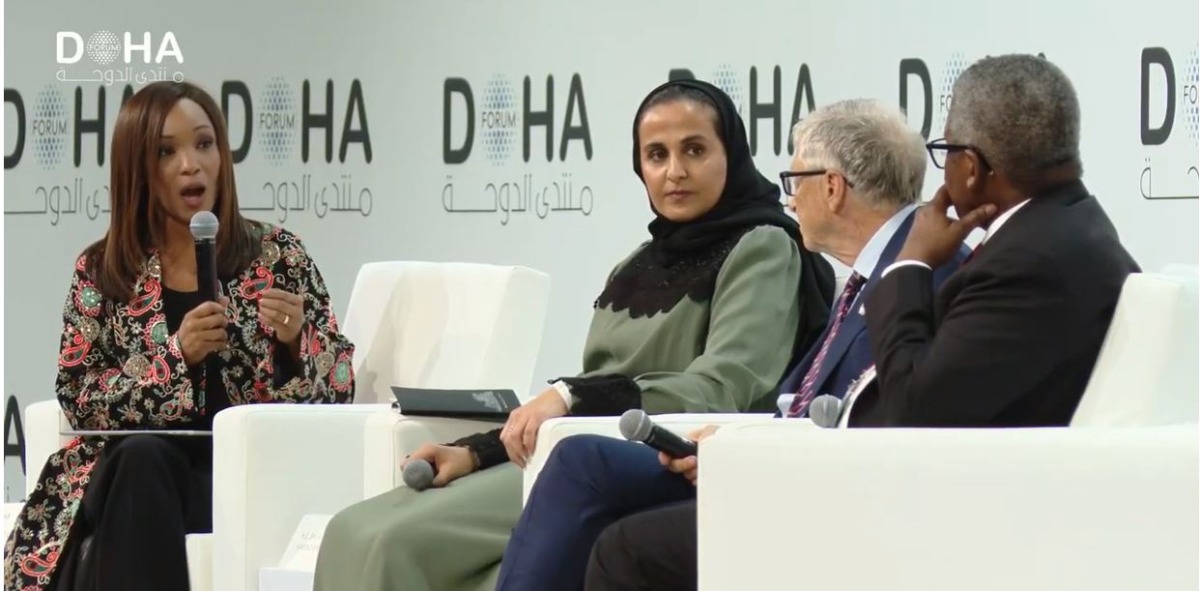
The conversation at the Doha Forum this year marked a decisive turning point. Instead of centering on aid, dependency, or deficits, the panel on “Humanity’s Next Chapter: Innovation and Impact from the Global South” revealed something far more transformative: emerging regions are no longer asking how to catch up. They are defining the future. In a rare and powerful convergence, the Chairperson of Qatar Museums, Sheikha Al Mayassa bint Hamad bin Khalifa Al Thani; Co-Chair of the Bill and Melinda Gates Foundation, Bill Gates; and President and Chief Executive of the Dangote Group, Aliko Dangote offered a unified vision of how culture, health, and industry are reshaping global progress.
Their discussion wove together three distinct but complementary forms of innovation: the cultural imagination shaping identity, the human development systems enabling potential, and the industrial muscle powering economic transformation. What emerged was a portrait of the Global South not as a region awaiting solutions, but as a rising force redefining the global center of gravity.
YOU CAN ALSO READ: Nigeria’s December Boom Signals New Era for the Nation’s Hospitality Industry
Sheikha Al Mayassa set the tone by emphasizing that the future of any society is rooted in the stories it tells and the spaces it creates for talent. Her vision of cultural investment went far beyond museums or exhibitions. She described Qatar’s deliberate effort to build creative ecosystems that nurture designers, filmmakers, and storytellers, including the Doha Film Institute, M7, and Lewan, each crafted to incubate original voices. Her collaboration with African creatives, including Lagos Fashion Week founder Omoyemi Akerele, reflects an emerging cultural axis linking Arabia, Africa, and Southeast Asia. In her view, this creative economy is not ornamental; it is infrastructure. It is how nations reclaim identity, build confidence, and enter global conversations on their own terms.
Bill Gates entered the dialogue from a different angle, yet his message naturally intersected with hers. While Sheikha Al Mayassa focused on narrative power, Gates shifted attention to human capacity. Drawing from decades of work across the African continent, he explained that the foundation of progress is the health and education of children. Without these basics, no amount of innovation, creativity, or industrial expansion can thrive.
Gates highlighted the partnership between his foundation and Aliko Dangote, particularly their work with Nigerian state governors to strengthen primary healthcare systems. He underscored that most of the world’s population growth this century will happen in Africa, making the continent not just a regional priority but a global determinant of prosperity. Healthy children, he argued, are the starting point for every other form of advancement from creativity to entrepreneurship to industrial development.
This intertwined naturally with Aliko Dangote’s perspective. As he spoke, the conversation expanded from human capacity to structural transformation. Dangote described an Africa whose growth depends on bold investments in industry, agriculture, and skills. His new seven hundred million dollar education initiative, supporting more than one hundred and fifty thousand young people, connects directly to Gates’s call for human development.
His agricultural programs, which link farmers to processing plants and clean energy systems, reflect the same ethos Sheikha Al Mayassa expressed about building ecosystems, not isolated interventions. And when he spoke about Nigeria’s potential to lead the global fashion industry within the next decade, he was echoing the creative wave that Sheikha Al Mayassa highlighted and reinforcing Gates’s belief in Africa’s demographic strength.
YOU CAN ALSO READ: House of Lords Hosts AYT Foods in Prestigious SmallBiz100 Celebration
Across all three perspectives ran a shared thread: the Global South is rising by investing in people, identity, and opportunity, not by replicating old models but by creating new ones. Their insights blended into a single narrative in which culture fuels confidence, health enables potential, and industry drives prosperity.
What emerged from the Doha Forum was unmistakable. The Global South is no longer positioned as a passive recipient of global solutions. It is a dynamic center of imagination, capability, and leadership. Its thinkers, builders, and innovators are charting humanity’s next chapter and in doing so, they are reshaping the world’s understanding of where the future is truly being built.