So anybody who has read the synopsis of this panel knows it is actually quite broad, but that is the idea when we look at Africa, a continent with many different countries and different economies. For the last two decades or so, there has been a recurring theme that Africa stands at a pivotal moment: a young population, extensive natural resources, and growing economies. But on aggregate, there are still some very stubborn challenges including youth unemployment, poverty, and limited access to finance.
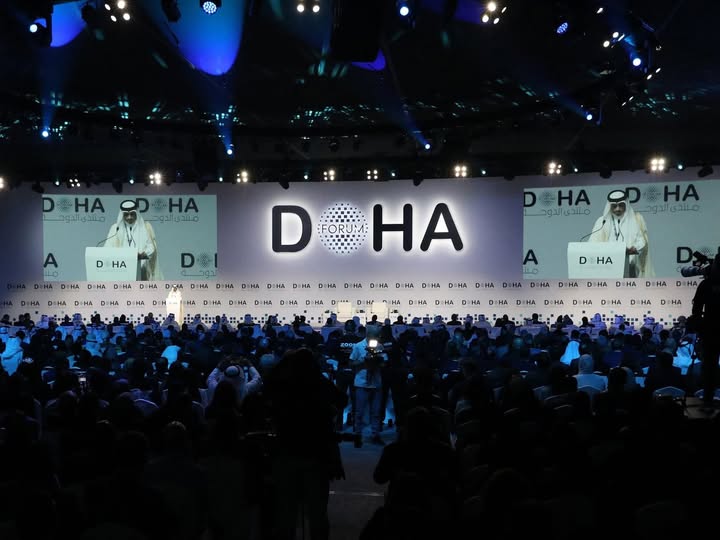
We want to frame this conversation within the broader Doha Forum aim for this year, going beyond promises to progress. I want to focus with all of you here today on the challenges, and we truly have the perfect panel of experts, leaders who have been integral in driving economic transformation across many countries for decades.
YOU CAN ALSO READ: Doha Forum Marks Global Shift as Sheikha Al Mayassa, Bill Gates, Aliko Dangote Chart Humanity’s Next Phase
President Mahama, I want to start with you. You have been a champion of farming for a long time, using technology to increase yields and productivity. Is this one of the main opportunities you see in strengthening the economy? And what other sectors are you looking at? Because you need to increase the tax base and really address your debt and fiscal situation.
Thank you very much, Jakaya. I am not just a champion of agriculture; I am a farmer myself, and so I empathize with my country’s farmers. For many years, Africa has relied on smallholder peasant agriculture at the expense of medium to large scale agriculture. Peasant farmers grow enough to feed their families for the year, and only if there is excess do they sell at the market.
The time has come to see agriculture as a business. Unfortunately, the Green Revolution bypassed Africa, even though the continent still has some of the most extensive arable land. Climate change has made things harder. Two years ago on my 400 hectare farm, rains stopped for 10 weeks at a critical moment, and the crops wilted. We must adapt to this new reality, which means expanding irrigation.
Poor farmers cannot afford irrigation; government must support them. My government is introducing affordable, appropriate irrigation solutions. Large pumps linked to the national grid are too expensive for farmers. Solar water pumps, improved seeds, quality extension services, and the development of agribusiness are essential. Farmers must have assured offtake; otherwise, they harvest with no buyers.
Recently, Ghana had a maize glut. Prices fell below production cost. Government had to intervene with a minimum guaranteed price. Subsidies on fertilizers and improved seeds are necessary investments. One farmer used the same seed for 20 years and barely harvested one bag per acre; with improved seeds, he can harvest 20. Because seeds are costly, government must subsidize them.
Thank you. To connect this to what President Mahama said: a large part of agriculture in Africa is subsistence, which is essentially structured poverty. It is hard work, low productivity, and informal.
To boost productivity, farmers need mechanization and fertilizer, which requires capital. The capital exists globally; the problem is perception of risk. Many investors think Africa is riskier than it is.
This is where UNDP plays a major role: supporting investment in mini grids, rural electrification, and helping governments build strong legal frameworks. We also co invest and emphasize local ownership, which is crucial.
We support governments during negotiations with institutions like the World Bank. Today, technology has made decentralized, low cost energy solutions easier. Africa’s fundamentals, young population, growing needs, rapid adoption of technology, are strong. With enabling conditions, the continent’s potential can be unlocked.
Thank you. Building on the earlier points: the challenge is creating new jobs. Economic empowerment in Africa demands new approaches. Opportunities exist, but governments cannot keep borrowing. The private sector must take the lead.
We aim to shift from traditional aid to private sector investment. Agriculture has massive demand. Mining is another big opportunity, but it requires skills and capacity building. The President of Ghana has asked us to support personalized learning and skills development because this is the foundation of the future.
Qatar went through a similar transition: capacity building, long term planning, and empowering the private sector. Africa can follow the same path.
I have been involved in education through the Global Partnership for Education, created by the G7 and hosted by the World Bank. Its mission is to support low and lower middle income countries in transforming their education systems and ensuring every child receives quality education.
YOU CAN ALSO READ: Nigeria’s December Boom Signals New Era for the Nation’s Hospitality Industry
Funding comes mainly from G7 donors in five year cycles. The last replenishment in 2021 was co hosted by Boris Johnson and President Uhuru Kenyatta; before that, President Macron and President Macky Sall. Next year, Italy’s Prime Minister Meloni and Nigeria’s President Tinubu will co host.
We do not dictate solutions. Countries define their priorities. So far, GPE has helped 372 million children attend school, trained 4.7 million teachers, and provided 200 million textbooks.
Skills development and foundational learning are key. Children need digital skills, AI competencies, and strong technological foundations. Domestic financing of education is essential. President Kenyatta championed allocating at least 20 percent of national budgets to education. Ghana already exceeds this threshold.
We hope President Tinubu will champion this agenda because these are our children, the future of the continent.