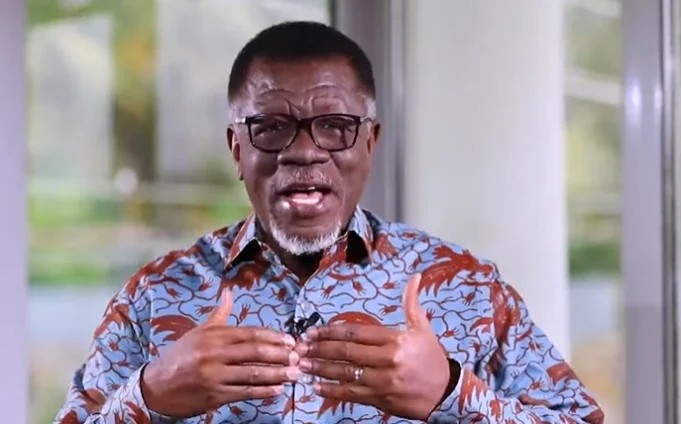
Renowned theologian, scholar, and public intellectual, Dr. Mensa Otabil, has called for a deep rethinking of Africa’s approach to development, insisting that decades of political change have failed to deliver meaningful improvements in the lives of ordinary citizens because the continent has often been answering the wrong questions.
Speaking at the Institutional Lecture of Central University, Dr. Otabil framed his address titled ‘How to Bring About Change in Africa’ not as a conventional academic lecture but as a reflective conversation on Africa’s long standing struggle with transformation.
“Although this event is described as a lecture, I decided it should not be a lecture in the strict sense. I would rather it be a conversation,” he said, explaining that his aim was not eloquence but clarity. “I do not want this to be one of those speeches where people say afterwards, ‘He spoke good English,’ without truly understanding the message.”
YOU CAN ALSO READ: Cosmas Maduka Opens Up on Hardships, Discipline, Road to Business Success
Drawing from his personal experience of Ghana’s political evolution, Dr. Otabil noted that he had lived through every major era from the time of Kwame Nkrumah through military rule, democratic transitions, and the Fourth Republic, yet the lived reality of many citizens had remained largely unchanged.
“One is forced to ask,” he said, “why has so much changed politically, yet so little has changed qualitatively in the lives of the people?”
According to him, this question has shaped more than four decades of his engagement with African transformation, spanning ideas of African renaissance, Black emancipation, and the pursuit of the African dream. However, he admitted that this long journey led him to a sobering realisation.
“After decades of effort, I had to pause and ask myself a humbling question. Are we even asking the right question?”
To illustrate Africa’s dilemma, Dr. Otabil referenced a popular Mr Bean episode in which the character expends great effort in an exam only to discover he had been answering the wrong question. “You can put in enormous effort and still fail if you are solving the wrong problem,” he remarked, likening the scene to Africa’s development experience.
He traced Africa’s historical focus to the era of decolonisation when liberation struggles in countries such as Mozambique, Angola, Zimbabwe, Namibia, and South Africa dominated continental consciousness. The prevailing belief, he noted, was that political freedom would automatically translate into prosperity.
“Kwame Nkrumah captured this belief when he said, ‘Seek first the political kingdom, and everything else shall be added,’” Dr. Otabil recalled. “For decades, this idea shaped African thought.”
However, events in post apartheid South Africa forced him to reassess that assumption. Recounting his early visits to the country after the end of apartheid, he said he was disturbed by rising xenophobia and Africans turning against fellow Africans.
“That was when I realised something was wrong. The solution was not unfolding as expected,” he said, adding that South Africa’s subsequent political and social challenges further reinforced the conclusion that Africa had been tackling symptoms rather than root causes.
Dr. Otabil argued that Africa’s challenges operate on three distinct levels, with the most fundamental being what he described as the African cultural condition.
“This is not about food or clothing,” he explained. “It is about worldview, how we think, how we interpret reality, how we organise life, and how we relate to our environment.”
He maintained that without this internal weakness, colonial domination would not have been possible. “In Ghana, fewer than 400 British public servants ruled the entire country. In Nigeria, about 500 governed a vast and complex society. This was flimsy power that succeeded because of internal weaknesses,” he said.
The second layer, he noted, was colonialism itself, which initially began as trade before evolving into political domination. While acknowledging the profound damage caused by colonial rule, he argued that it also unintentionally produced structures such as modern nation states, infrastructure, and formal education.
The third layer, according to Dr. Otabil, is contemporary politics, leaders and political parties, which many young Africans focus on exclusively. “Addressing only this layer is like repainting a cracked wall without fixing the foundation,” he warned.
He criticised the romanticisation of precolonial Africa, arguing that the continent had avoided confronting difficult historical questions. “We avoided uncomfortable questions,” he said. “Why were we colonised so easily? Why did we sell fellow Africans into slavery? Why did our systems fail to evolve?”
Dr. Otabil attributed many of Africa’s challenges to centuries of isolation from the main currents of global civilisation. While ideas in science, governance, and philosophy circulated across Asia, Europe, and North Africa, he said sub Saharan Africa remained largely cut off due to geography and limited interaction.
“Colonialism did not create Africa’s weakness. It exploited it,” he stated.
Rather than offering quick fixes, Dr. Otabil proposed three key considerations for genuine transformation. First, he called for a culture of accuracy and precision, stressing that no civilisation develops without order, discipline, and respect for systems.
YOU CAN ALSO READ: Cosmas Maduka Opens Up on Hardships, Discipline, Road to Business Success
Second, he urged Africans to cultivate a future minded culture, warning that societies that consume everything today without regard for tomorrow inevitably undermine themselves. He cited environmental degradation and reckless governance as symptoms of this failure.
Third, he emphasised the need for a culture of cause and effect, lamenting what he described as a magical worldview in which outcomes are disconnected from actions. “We pray instead of planning. We explain failure through superstition instead of analysis,” he said.
He concluded by challenging Central University to model these values and serve as a microcosm of a transformed Africa. “If we fix the machine, the products, our leaders, will improve,” Dr. Otabil said. “Leaders emerge from society. They do not fall from the sky. When society changes, leadership quality follows.”