Bayo Adeoshun
Nigeria’s agricultural and food systems sector in 2025 was shaped by a mix of positive gains and structural challenges. The year recorded increased yields in key staple crops: yam, maize, rice, and cassava, driven by improved farming practices, favourable rainfall, expanding technology adoption, and government-led interventions such as dry-season farming. These gains contributed to a nationwide decline in food prices, offering relief to consumers.
However, these benefits were partially offset by rising production costs, including fertilizers, fuel, herbicides, and machinery, which significantly squeezed farmers’ margins. Climate-related shocks and persistent security challenges further complicated the operating environment. As a result, 2025 emerged as a year of paradox: greater food availability alongside heightened financial stress for producers. Nevertheless, technology adoption and value-chain-focused investments continued to emerge as critical pathways for resilience.
High Input Costs
One of the most significant challenges in 2025 was the continued rise in agricultural input costs. Despite a drop in food prices celebrated nationwide following the federal government’s temporary exemption of selected staples from import duties, farmers struggled with soaring costs of fertilizers, herbicides, and machinery.
YOU CAN ALSO READ: Inside Lagos’ Bold ₦500bn Agriculture Plan: How Origin Tech Group Is Powering Systems for Greater Efficiency
The decline in market prices for staples reduced farmers’ selling prices, effectively eroding potential gains. In response, many farmers scaled back production or abandoned the cultivation of crops such as maize and rice. This contraction in planting decisions is expected to have repercussions in 2026, as reduced acreage may result in supply shortages and renewed price pressures.
Improved Crop Output and Lower Prices
Steady growth in the production of staples such as yam, rice, maize, and cassava contributed to a nationwide decline in food prices, improving household food access and consumer welfare.
The Agric-Import Window and Market Effects
Following the federal government’s emergency declaration exempting selected food staples from import duties, prices of essential commodities dropped sharply. According to insights from Sensale Research, a sub-national f Origin Tech Group Nigeria Limited, the average price of locally produced rice declined to about ₦65,000 from a peak of ₦90,000, while foreign parboiled rice fell to an average of ₦62,000 from ₦92,000. Prices of maize, beans, and Garri also recorded significant declines.
These price movements contrast with data from the National Bureau of Statistics (NBS), which revealed that Nigeria spent ₦3.32 trillion on food imports between January and September 2025, underscoring the urgency of strengthening domestic production.
Empowerment and Employment Effects
A major positive outcome of the exemption policy was the increase in household purchasing power. The lower cost of staples encouraged a resurgence in food trading activities, with many Nigerians re-entering the foodstuffs trade, attracted by improved affordability and strong market potential.
Government Interventions and Mechanisation Drive
Government-led initiatives played a notable role in boosting production. Programmes such as the 500,000-hectare Dry Season Farming Scheme and efforts to modernise rural infrastructure contributed to output gains.
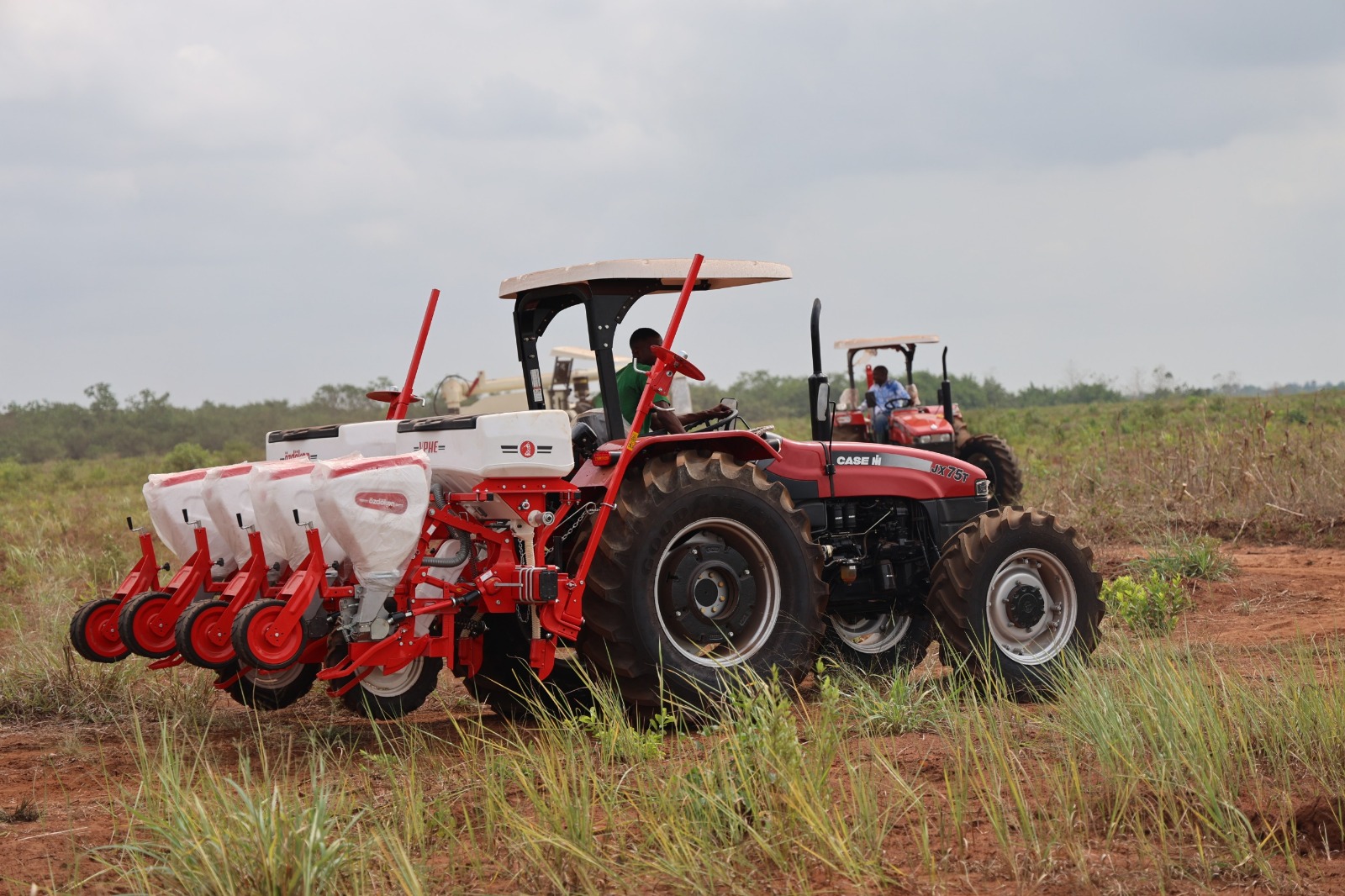
In a major push for agricultural renaissance, President Bola Ahmed Tinubu (GCFR) launched the Renewed Hope Agricultural Mechanisation Programme (GHAPP) on June 23, 2025, at the National Agricultural Seeds Council, Sheda, along the Abuja–Lokoja Expressway. The programme involves the deployment of 2,000 tractors and over 9,000 specialised implements, including bulldozers, disc ploughs, harrows, trailers, and 12 mobile workshops.
The initiative aims to modernise farming, boost food security reduces reliance on manual labour, and increase yields, particularly for smallholder farmers. It is supported by the National Agricultural Development Fund (NADF), with ₦100 billion approved, and includes partnerships with international and local technical partners such as Belarus and Origin Tech Group Nigeria. Farmers may access equipment through leasing arrangements, with repayment options linked to produce, while the programme also targets youth participation in mechanisation services.
Technology Adoption and Extension Services
Increased use of precision agriculture tools: drones, mobile applications, and data analytics, helped optimise farm management in 2025. Although uneven, improvements in mechanisation and extension services also supported productivity gains across several regions.
Insecurity and Climate Change
Security challenges continued to disrupt farming activities. While early 2025 recorded some improvements, renewed attacks by herdsmen beginning in North-Central farming communities such as Benue State and later spreading to parts of the North-West, South-West, and Middle Belt, led to farmer displacement and severe disruptions to food supply chains.
Climate change presented a dual impact. On one hand, sustained rainfall supported higher yields; on the other, excessive rainfall caused devastating floods. In May 2025, flooding in Mokwa, Niger State, a major rice and grain-producing area destroyed over 25,000 acres of farmland and washed away critical infrastructure, including the Mokwa Bridge, a key transport link for food distribution. The incident significantly disrupted regional food supply chains.
2026 Outlook: Defining Issues and Emerging Trends
Nigeria enters 2026 at a critical juncture. After decades of underinvestment and policy inconsistency, the agricultural sector can no longer afford stagnation. As a pre-election year, 2026 will also be pivotal for political and economic direction.
Experts argue that a viable alternative to large-scale food imports lies in substantial subsidies for farm inputs, particularly fertilizers and Agro-mechanisation equipment. In this context, the Renewed Hope Agricultural Mechanisation Programme is expected to play a crucial role in advancing productivity, rural development, and national food security.
Private sector participation will also shape the outlook. Origin Automobile Works (OAW), a subsidiary of Origin Tech Group, is expected to play a pivotal role through equipment financing and locally assembled tractors. With over 25 years of experience, the company plans to support large-scale farming by rolling out financing initiatives targeting farms of at least 1,000 hectares, with a long-term goal of enabling 1,000 such farms nationwide. Achieving scale remains essential for mechanisation, competitiveness, and productivity.
Technology will be another defining driver in 2026. Origin Tech Group plans to introduce an AI-powered agricultural platform built on over a century of accumulated data, delivering Nigeria-specific insights for farmers, investors, and policymakers. The deployment of drones for farm imaging and precision agriculture will further enhance efficiency and decision-making.
Food Systems Infrastructure and Market Reorganisation
The year 2026 is expected to witness the commissioning of major food systems infrastructure, including Phase 1 of the Lagos Central Food Systems and Logistics Park in Ereyun-Ketu, Epe; several mid-level markets; and the Igbodu Cattle Feedlot, projected to be the largest in Nigeriaand possibly Africa. In addition, the Bulk Food Company is expected to commence full operations.
These developments are poised to redefine Nigeria’s food systems by improving aggregation, storage, logistics, and market efficiency, both nationally and across the continent.
YOU CAN ALSO READ: Origin Tech Chairman Commends Nigerian Workers’ Grit, Grace
Conclusion
In 2026, Nigeria’s agricultural and food systems sector stands at a threshold—rich with promise but dependent on discipline, policy consistency, and stakeholder commitment to best practices. The challenge ahead is not merely growth, but balanced growth that aligns commercial sustainability with affordability, service quality, and inclusion.
If government, operators, and citizens can address long-standing constraints including fragmentation, weak continuity, and lack of scale, Nigeria could begin its transition toward global benchmarks, like countries like the United States and the Netherlands, which generate over $100 billion annually from agricultural exports while employing less than four per cent of their workforce in agriculture.