There are leaders who manage institutions, and then there are those who redefine what those institutions stand for. For Dr. Akinwumi Adesina, former President of the African Development Bank (AfDB), leadership was never a title. It was a mission anchored in urgency, dignity, and an unshakeable belief in Africa’s latent power.
Speaking with the conviction of an economist and the passion of a reformer, Adesina has consistently challenged one of the most enduring myths about the continent, that Africa’s prosperity lies beneath its soil rather than in its systems. Oil and gas may dominate headlines, he argues, but food sustains humanity. “Who drinks oil? Who smokes gas?” he often asks. “But everybody eats food.”
By 2030, Africa’s food and agriculture market is projected to exceed one trillion dollars. Yet for decades, the continent has remained trapped at the bottom of global value chains, exporting raw materials while importing finished products at premium prices. Nowhere is this paradox clearer than in cocoa. Africa produces about 75 percent of the world’s cocoa beans, yet accounts for barely 2 percent of the 120 billion dollar global chocolate market.
YOU CAN ALSO READ: Making Big Shifts: Why Africa’s Boldest Leaders Are Heading to Lagos
For Adesina, this imbalance is not accidental. It is structural, and structure, he insists, can be changed.
Central to his philosophy is a radical reframing of agriculture, not as subsistence or charity, but as serious business. Agriculture, he maintains, is not a way of life. It is an industry. Wealth is created through value addition, not raw exports. Coffee beans may collapse in price, but a cup of brewed coffee at Starbucks never does. Cocoa prices fluctuate, but chocolate remains profitable. Nations that export raw materials remain poor, while those that industrialize grow wealthy.
This conviction shaped the African Development Bank’s investment strategy under his leadership. In Ghana, the Bank supported a 600 million dollar financing package, alongside international partners, to industrialize the cocoa sector. When Ghana’s president later presented locally produced chocolate at a global forum, Adesina’s pride was unmistakable. “There is no brain surgery in making chocolate,” he remarked. “What is required is the mindset, and the financing, to do it.”
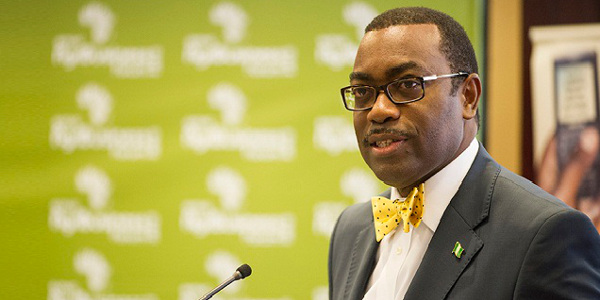
Changing mindsets, particularly among young people, has always been central to Adesina’s approach. As Nigeria’s Minister of Agriculture, he deliberately defied stereotypes, famously wearing bow ties to meetings to challenge perceptions of farming as backward or unappealing. Agriculture, he insisted, could be modern, aspirational, and profitable.
He often drew parallels with other professions. Engineers wear overalls, architects work on dusty construction sites, yet no one questions their status. Farming, he argued, deserved the same respect. His approach yielded results. One of his proudest moments came when Africa’s richest man, Aliko Dangote, shifted from being the continent’s largest rice importer to becoming a major producer. What began as a 300 million dollar commitment soon grew to one billion dollars and eventually expanded into nearly eight billion dollars in agricultural investments.
Dangote later told Adesina that if he were to start again, he would choose agriculture over cement. For Adesina, that moment defined success, when the largest importer becomes the largest producer.
When Adesina assumed office as President of the African Development Bank, he was unequivocal. The role was not a job. It was a mission. To be entrusted by one’s own people, he said, with the responsibility of changing their destiny is the highest calling.
That sense of mission shaped the Bank’s development framework, articulated through five strategic priorities. Universal access to electricity. Food security. Industrialization. Regional integration. Improved quality of life. The results were tangible. Eighteen million people gained access to electricity. One hundred and forty million benefited from improved agricultural technologies and food security. Thirteen million gained access to finance. Improved transport infrastructure served 101 million people, while 60 million gained better access to water and sanitation.
In just over four years, the Bank’s interventions touched the lives of more than 730 million people.
For Adesina, development is not theory. It must translate into real improvements in people’s lives. Numbers matter, but only insofar as they reflect human impact.
He has also been a persistent voice against exaggerated perceptions of African risk. Long term data, including reports from Moody’s, show that Africa has one of the lowest loan default rates globally, second only to the Middle East. Yet capital often flows elsewhere, driven more by bias than by evidence.
To counter this, the African Development Bank helped establish the Africa Investment Forum, a deal focused platform designed to move capital efficiently into bankable projects. In its first year, the Forum mobilized 38.7 billion dollars in investment interest within 72 hours. The following year, it surpassed 40 billion dollars. For Adesina, the lesson was clear. Africa does not need aid. It needs disciplined, intelligent investment.
Few issues resonate with him as deeply as women’s economic empowerment. A formative experience watching West African market women dominate regional trade while navigating systemic barriers left a lasting impression. Under his leadership, the Bank launched Affirmative Finance Action for Women in Africa, aiming to mobilize three billion dollars for women owned businesses.
Risk sharing mechanisms were introduced to encourage banks to lend, countering entrenched biases that ignored the data. Women, Adesina emphasized, consistently demonstrate some of the highest loan repayment rates on the continent. The problem was never bankability. It was perception.
In 2019, Africans voted Adesina African of the Year in a continent wide poll. He received the recognition with humility, describing awards not as ornaments but as obligations. For him, an award represents an agreement to do more, and to do so selflessly.
YOU CAN ALSO READ: IFC Partners TerraKulture to Strengthen Nigeria’s Creative Economy
Raised in poverty as the son and grandson of farm laborers, Adesina often attributes his journey to grace and responsibility. Life, he believes, is only meaningful to the extent that it improves the lives of others.
That belief has defined a career marked not by rhetoric but by results. And as Africa continues to reposition itself in a rapidly changing global order, the legacy of Akinwumi Adesina stands as a testament to what is possible when optimism is matched with discipline, vision, and unwavering commitment to people.