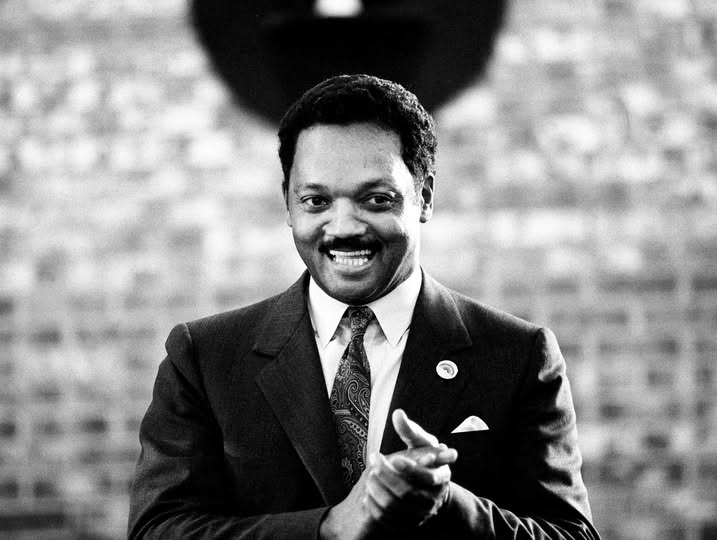
The announcement came not merely as news, but as the closing of a towering chapter in American public life. In a solemn message shared by his family, the passing of Rev. Jesse Louis Jackson Sr. was confirmed, an elder statesman of the civil rights movement whose voice had for decades echoed across pulpits, protest lines, convention halls, and presidential campaigns. He departed peacefully on Tuesday morning, surrounded by those closest to him.
To his family, he was first a father and husband. To history, he was an architect of moral agitation, an unrelenting advocate who refused to allow injustice the comfort of silence. They described him as a servant leader whose conviction in justice, equality, and love did not waver with age or opposition. His life, they suggested, should not be memorialized in sentiment alone, but in continued action.
He leaves behind his wife, Jacqueline, six children, Santita, Jesse Jr., Jonathan, Yusef, Jacqueline, and Ashley, and grandchildren who carry forward both his name and his imprint.
YOU CAN ALSO READ: Elliott Hill Signals Nike’s Comeback With Innovation, Sport and Bold Brand Reset
Across the political landscape, tributes reflected the breadth of his influence. Leaders from different ideologies acknowledged his force of presence. New York City Mayor Zohran Mamdani emphasized his fearless activism. Senator Raphael Warnock spoke of the nation losing one of its defining moral voices. Former Vice President Kamala Harris honored him as a mentor whose presidential ambitions once inspired her as a young law student.
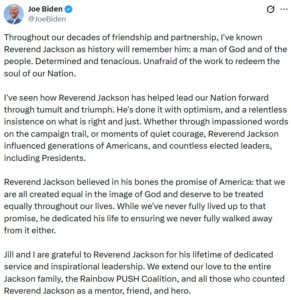
Former Presidents also weighed in. Joe Biden remembered him as a man grounded in faith and public service. Bill Clinton reflected on his relentless pursuit of a fairer America. Donald Trump recalled an earlier era of cordial relations between them, particularly during the 1990s when Jackson publicly engaged Trump on minority business issues and even operated from space in his Wall Street building. That relationship later fractured amid sharp disagreements over racial rhetoric and national policy. Still, Trump characterized Jackson as charismatic and formidable.

Perhaps most symbolically, reflections from Barack Obama underscored Jackson’s structural impact on American politics. Obama described him as a giant whose presidential bids in 1984 and 1988 expanded the imagination of what was politically possible. Before Obama’s historic victory in 2008, Jackson’s campaigns were the most electorally successful efforts by an African American candidate seeking the presidency.
His runs mobilized millions, broadened coalitions, and challenged the Democratic Party to confront issues of race, poverty, and representation more directly.
Their relationship was not without complexity. During the 2008 campaign, Jackson was caught in a moment of frustration over remarks he perceived as dismissive toward Black communities. He later apologized and reaffirmed his support. After Obama’s election, Jackson celebrated the victory as a watershed moment, one he had in many ways helped make conceivable.
YOU CAN ALSO READ: Lead the Shift. Own the Future.
Rev. Al Sharpton offered perhaps the most intimate reflection, describing Jackson as the figure who first summoned him into purpose at the age of twelve. He called him not just a leader, but a movement embodied in one man.

Historically, Jackson’s political achievements remain singular. In 1984, he became only the second Black candidate to compete seriously for a major party’s presidential nomination, following Shirley Chisholm. He secured over three million votes.
By 1988, he had won 13 states and nearly 30 percent of the Democratic primary vote, coming second only to Michael Dukakis. Those campaigns were not symbolic gestures. They were structural shifts that recalibrated the Democratic electorate and expanded the political imagination of a generation.
Rev. Jesse Jackson Sr. was more than an orator or organizer. He was a bridge between eras, linking the movement generation and the modern political class, street protest and institutional power, moral urgency and electoral ambition. His passing marks the quieting of a distinctive voice, but the reverberations of that voice remain embedded in the architecture of contemporary American politics.