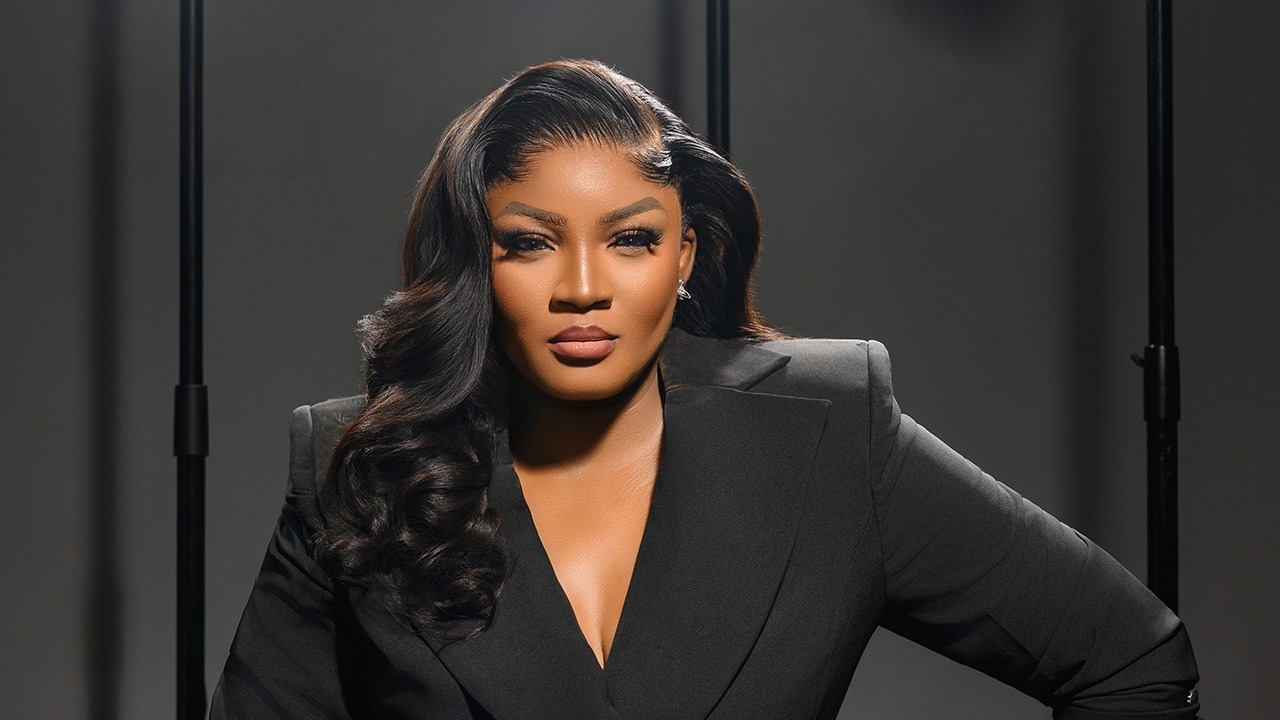
The Lagos that shaped Omotola Jalade-Ekeinde was loud, relentless and alive with ambition. It was a city where opportunity often hid behind chaos and where survival could be as much an art as success. For Jalade-Ekeinde, one of Nollywood’s most enduring icons, that environment produced a career that stretched across three decades, more than 300 films and a reputation that reached far beyond Nigeria’s borders.
She arrived in the industry in 1995 as a teenager. Today she is an international figure, a former honoree on the TIME 100 list and a voting member of the Academy of Motion Picture Arts and Sciences. Yet when she spoke about Nollywood’s rise, the story she told was far less glamorous than many imagined.
“We have all the money to do everything we’re supposed to do, and we didn’t do it well,” she said, before correcting the assumption embedded in the statement. “The truth is, we don’t.”
YOU CAN ALSO READ: How Omotola Jalade-Ekeinde Turned Stardom into a Powerful Brand
Nollywood, she explained, was never built on the kind of institutional financing that sustained Hollywood. It grew instead from improvisation, risk and sheer stubbornness. “Most filmmakers are using their own money, or money from family and friends,” she said. “There’s no real structure for funding. There’s no system where if your last project succeeds, you can easily get funding for the next one. Everyone is basically winging it.”
The result was an industry powered less by capital than by endurance. People pushed forward while exhausted, anxious and uncertain about whether the next project would survive long enough to pay its bills. Jalade-Ekeinde had watched colleagues mortgage their futures to keep their films alive. Some sold cars. Others sold property. A few sacrificed nearly everything they owned just to finish a production.
“And when you ask them why they’re still doing this,” she said softly, “the answer is always the same. Passion.”
That word appeared often when she talked about Nollywood, and not as a cliché. It was the engine that kept the industry alive in its earliest years and the force that still drove it forward. Jalade-Ekeinde herself could have slowed down long ago. After thirty years of acting, international recognition and a life that included four children and a marriage that had lasted just as long as her career, she could easily have chosen comfort over ambition. Instead she talked about legacy.
“I’ve always wanted to do something that hasn’t been done before,” she said. “I’ve always had a global vision for Nollywood. And I still feel like we’re not there yet.”
That sense of unfinished work was what kept her moving. Sometimes she withdrew from the spotlight to recharge. She disappeared for a while, reset, found new creative energy and returned with fresh projects. Each pause, she said, was simply preparation for the next push.
Her understanding of struggle had not begun with filmmaking. Long before fame arrived, life forced her to grow up faster than most children. She was twelve when her father died, a loss that shattered the stability of her family and quietly rearranged her role within it. She had been close to him, an only child for many years before younger siblings arrived. Suddenly she found herself expected to be strong in ways she did not yet understand.
“Everyone kept saying, ‘Be strong for your mom,’” she recalled. “But I didn’t even know what that meant. I was just a child.”
Grief never came in the way she expected. Instead of crying openly or collapsing under the weight of loss, she learned to move forward. Her younger siblings were toddlers at the time, barely old enough to understand what had happened. Responsibility arrived early. By the time she was fifteen she was already working, helping to support the household and stepping into a protective role that felt closer to parenthood than adolescence.
Looking back, she suspected that experience shaped the way she handled emotion even years later.
“Sometimes people think I’m cold,” she said. “But I just learned very early to keep going.”
There were moments during those years when survival felt uncertain. She remembered sitting outside a man’s house with her mother late into the night, waiting for him to return so they could ask for money to buy food. The memory remained vivid, a quiet reminder of how fragile life once felt.
Another time she borrowed money from men she later realized were dangerous, hoping to pay her brother’s school fees. When the family could not repay the loan, the men came to their house and threatened them. They left carrying the only valuables the family owned, including a television and a DVD player.
At the time it felt like humiliation layered on fear. Later she saw something different in those experiences.
“They forged me,” she said.
They also changed her relationship with wealth. Money, she explained, never became the center of her ambitions because she had already seen how quickly it could disappear.
“That’s why money doesn’t control me now,” she said. “I care more about legacy and impact.”
Faith also became an anchor. She gave her life to Christ at fifteen, an experience she described as the foundation of her life.
“It gave me confidence that God would always make a way,” she said. “There were times I could have compromised my values and become extremely wealthy. No one would have known. But I walked away every time. And every time I walked away, somehow God still made a way.”
When she first entered Nollywood in the mid-1990s, the industry itself was still improvising its identity. The VHS era was raw and unstructured. Productions were fast, chaotic and often held together by enthusiasm rather than infrastructure. There were no trailers for actors, no strict work schedules and rarely any formal rest periods. Scenes were sometimes filmed in private homes, and performers rested wherever they could find space between takes.
“The first time I ever had a trailer was when I worked on a Hollywood production in Ghana,” she said.
Yet the lack of polish also created a kind of authenticity that audiences responded to. Without social media or massive marketing campaigns, actors became popular through word of mouth. If audiences loved a performance, the news spread city by city across Nigeria before it eventually reached the entire country.
“That was real training,” she said.
As Nollywood grew, so did the need for better standards. At one point Jalade-Ekeinde and several other actors began pushing publicly for improvements in working conditions. The people who controlled film distribution at the time—the marketers—did not welcome the pressure.
Eventually several actors were banned from the industry.
“They invited everyone back after one year for reconciliation,” she said. “But I refused. My ban lasted two years.”
It was a risky decision. For an actor at the height of her popularity, disappearing from screens could have damaged a career permanently. Yet she believed the sacrifice mattered.
“We were essentially risking our careers to push the industry forward.”
While her professional life was unfolding at extraordinary speed, her personal life was also taking shape in ways that surprised many observers. She married at eighteen, a decision that might have seemed reckless from the outside but felt entirely natural to her.
“The right person,” she said when asked why she was so certain.
Her husband, a pilot, spent much of his time traveling across continents. Each time he returned home she bombarded him with questions about the countries he had visited, the cultures he had seen and the world beyond Nigeria’s borders.
“Our relationship was built on learning and respect,” she said. “And respect is everything to me.”
More than three decades later, the marriage remained one of the anchors of her life. Home, she said, was still the place where she felt most restored. After years of public appearances and film sets, her idea of self-care was disarmingly simple.
“Staying at home with my family,” she said with a smile. “And spa days. I never miss those.”
As Nollywood continued expanding onto the global stage, Jalade-Ekeinde spent increasing time working abroad, particularly in California. The contrast between industries was striking. Hollywood productions operated under rigid union rules that governed work hours, safety and compensation.
“At first we were shocked by how many breaks there were,” she said with a laugh. “Smoke breaks, coffee breaks… you start wondering if you’ll ever finish the film.”
Yet those rules also protected workers in ways Nollywood was still learning to implement. In Nigeria’s film industry, efficiency and improvisation remained powerful survival tools. When something went wrong on set, everyone jumped in to fix the problem regardless of whose responsibility it technically was.
“That’s something Nollywood does well,” she said. “We find solutions.”
But that flexibility could also blur boundaries and sometimes prevented proper systems from developing. She believed the next stage of Nollywood’s evolution would depend on building stronger financial and organizational structures, from better pre-production planning to transparent funding processes.
“You often hear about projects receiving funding,” she said, “and before the project even starts, the money has already been spent on other things. Why is it so hard for us to put funds in escrow?”
The absence of such systems, she argued, created temptations that could damage both trust and reputation. International partners, including Netflix and Amazon, had already tested the Nigerian market with varying degrees of success. Subscriber numbers, local habits like account sharing and broader structural issues had all influenced those outcomes.
Still, Jalade-Ekeinde remained convinced that the potential audience was enormous. With stronger discipline and better industry education, she believed Nollywood could become one of the most influential film industries in the world.
Relocating part-time to California also changed her perspective in quieter ways. Life in Los Angeles offered a level of anonymity she rarely experienced in Lagos.
“In Lagos there’s always pressure,” she said. “You’re going to an event, so you book a makeup artist, you book a stylist, you take photos before you leave and post them before photographers post pictures you don’t like.”
In California the expectations were far lighter. She could attend events dressed simply and walk through the city without constant recognition.
YOU CAN ALSO READ: The Power of Starting Late: Temilola Adepetun’s Path to Building SKLD
“Here, I can breathe,” she said.
After spending most of her life in the spotlight, that freedom felt like a gift.
When asked to name the achievement she was proudest of, she paused. The list was long: three decades in film, a marriage that had lasted just as long, four children, global recognition and the survival of a recent medical emergency that required urgent surgery.
“I can’t pick just one,” she finally said.
The journey from a grieving twelve-year-old girl to a globally recognized actress felt too vast to reduce to a single moment.
“From the girl who once thought about begging at an embassy for a visa,” she said quietly, “to someone who now lives internationally with her family… it’s impossible to choose.”
She smiled, reflecting on the improbable arc of her life and career.
“God has been too good to me.”
Disclaimer:
This article was adapted from an interview featuring Omotola Jalade-Ekeinde on the Afropolitan – YouTube. The content was culled and edited for clarity and length from that conversation. All credit for the original interview belongs to the Afropolitan – YouTube. This article was published by EnterpriseCEO for editorial and informational purposes and should not be interpreted as an original interview conducted by Enterprise CEO.