Nigeria’s economic leadership has entered a new phase with the formal assumption of office by the new Minister of Finance and Coordinating Minister of the Economy, marking a transition that signals both continuity and recalibration in the country’s fiscal direction.
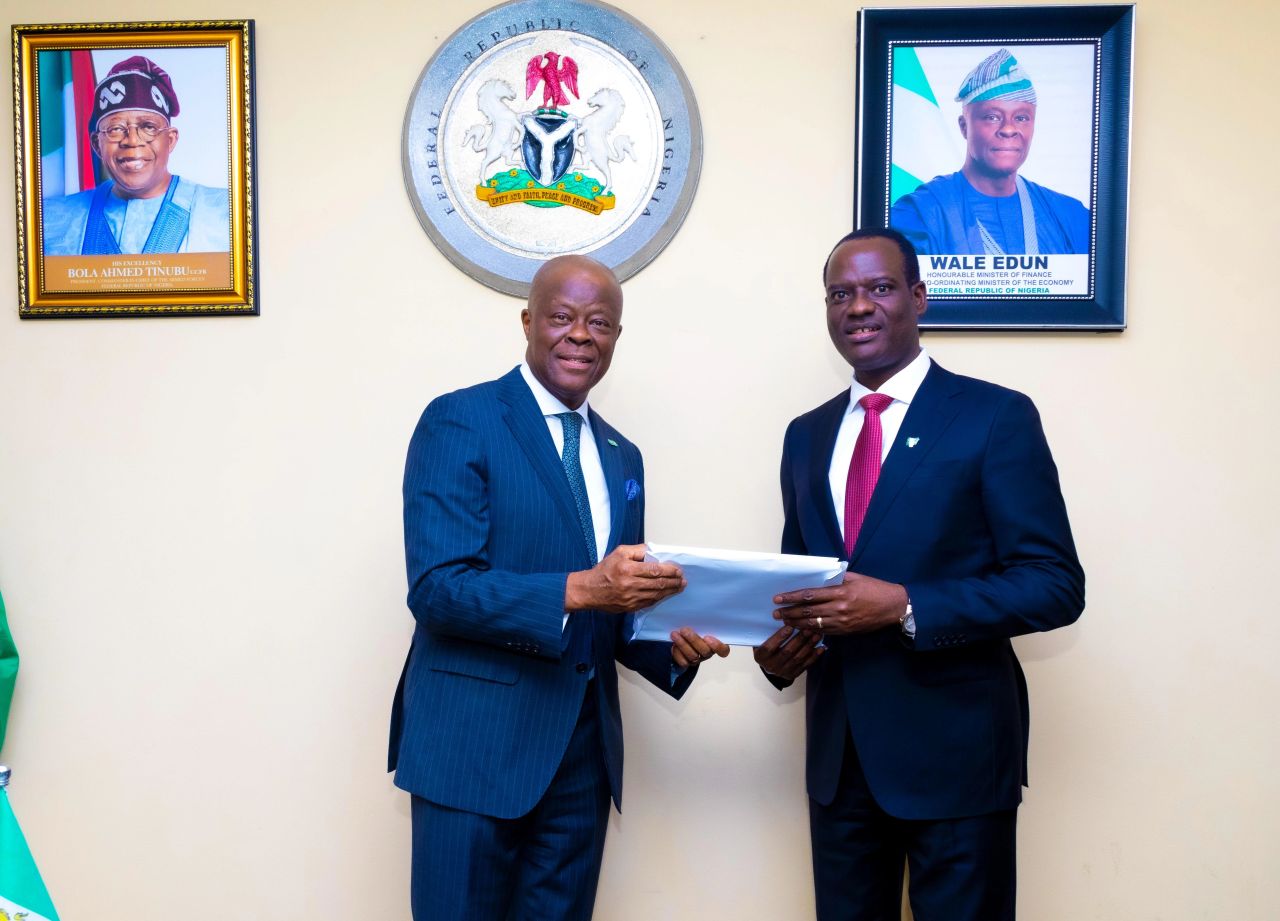
The handover, received from outgoing minister Mr. Wale Edun, was more than ceremonial. It represented a moment of reflection on ongoing reforms and a forward-looking commitment to deepen policy implementation in a nation still navigating complex economic headwinds.
In his first official address, the minister paid tribute to his predecessor, acknowledging the groundwork laid in recent years to stabilize key macroeconomic indicators. Yet, he was clear that stabilization is only the beginning. The real test, he noted, lies in transforming macroeconomic gains into visible improvements in livelihoods, productivity, and national welfare.
At the core of his economic vision is a renewed focus on productivity and growth, anchored on predictability, policy coherence, and investor confidence. In a global economy where capital flows toward certainty, he stressed that Nigeria must position itself as a credible and consistent destination for investment, innovation, and enterprise expansion.
Equally central to his agenda is fiscal discipline and sustainability, a theme that reflects longstanding concerns over public spending efficiency and revenue leakages. The minister emphasized the need for transparent and prudent management of public resources, underscoring that fiscal responsibility is not merely an accounting exercise but a governance imperative with direct consequences for national stability.
On the sensitive issue of taxation and revenue generation, he outlined a reform direction centered on fairness and efficiency. Revenue optimization, he said, must go hand in hand with equitable taxation that broadens the base without overburdening vulnerable populations. The goal, according to him, is a tax system that supports growth rather than constrains it, while ensuring that government can sustainably fund critical infrastructure and social services.
Recognizing the complexity of Nigeria’s governance structure, he also placed strong emphasis on intergovernmental coordination. Effective economic management, he argued, requires alignment across federal, state, and institutional actors to ensure that policies do not exist in isolation but work in harmony toward shared national objectives.
Perhaps most notably, the minister highlighted the importance of deepening public–private partnerships as a central engine of reform execution. In his view, government alone cannot drive the scale of transformation required. Collaboration with the private sector, development partners, and technical stakeholders will be essential in designing data-driven policies, implementing reforms, and refining outcomes through continuous feedback.
Yet, beneath the policy architecture lies a recurring theme: execution. The minister was unequivocal that good policy design, while necessary, is insufficient on its own. The true measure of success, he stressed, will be disciplined implementation, institutional accountability, and measurable economic results.
His remarks reflect a broader recognition within Nigeria’s economic governance space that reforms have often been well-articulated but unevenly implemented. Bridging that gap between intention and impact now stands as the defining challenge of the new fiscal leadership.
As Nigeria contends with inflationary pressures, fiscal constraints, and external vulnerabilities, the new administration is positioning itself around a simple but demanding proposition: that sustainable economic recovery will depend not only on bold reforms, but on the consistent discipline to see them through.
For now, the message from the nation’s fiscal helm is clear. The era of reform continues, but the emphasis is shifting decisively from policy design to delivery, from ambition to execution, and from promises to measurable national outcomes.