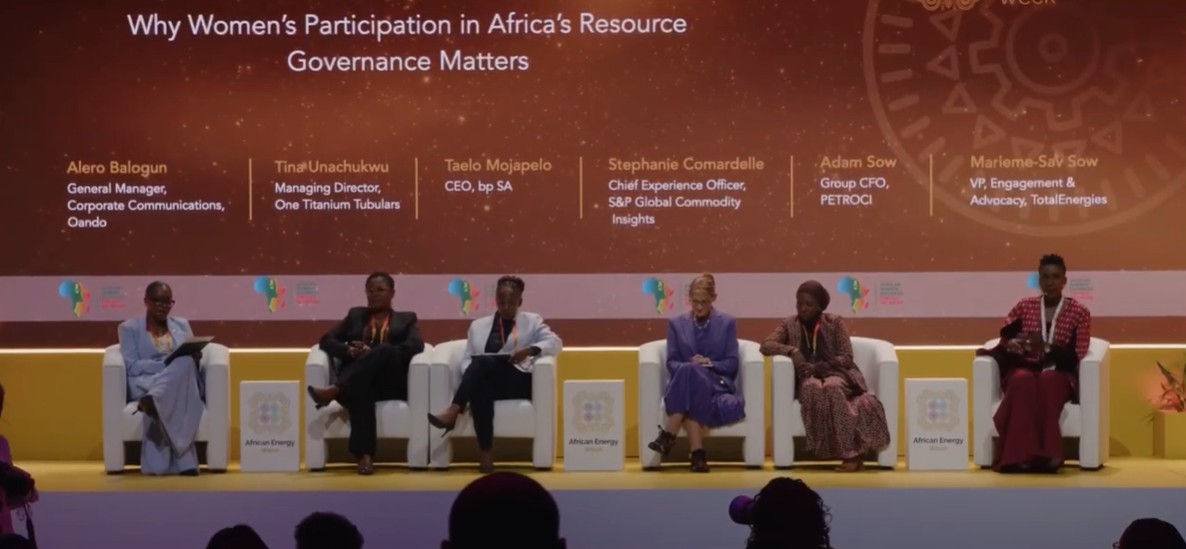
The future of Africa’s energy security will depend not only on resources beneath the ground but also on the leadership shaping how those resources are governed. At a pivotal industry gathering that brought together senior leaders across the energy ecosystem, a powerful panel discussion examined how inclusive leadership, gender-responsive governance and strategic policy alignment can strengthen the continent’s energy systems while accelerating economic growth.
Moderated by the General Manager, Corporate Communications at Oando PLC, Alero Balogun, the panel brought together Managing Director, One Titanium Tubulus, Tina Unachukwu; Chief Executive Officer, BP Southern Africa, Taelo Mojapelo; Chief Experience Officer, S&P Global Commodity Insights, Stephanie Comardelle; Group Chief Financial Officer of Petroci, Adam Sow; and Vice President of Engagement and Advocacy at TotalEnergies, Mariam Sarr.
Together, the panellists examined how Africa can build resilient energy systems capable of supporting long-term economic growth, highlighting the importance of resource development, infrastructure expansion, investment mobilization and policy alignment. At the centre of the conversation was a critical question: how can the continent design energy governance systems that truly serve the people most affected by energy poverty?
YOU CAN ALSO READ: From Legal Career to Culinary Influence: The Inspiring Story of Chef Ify
Balogun opened the conversation by grounding the discussion in the stark realities facing the continent. Nearly 600 million Africans still lack access to electricity, while close to 900 million people do not have access to clean cooking fuels. The consequences of this energy deficit are not evenly distributed. Women bear a disproportionate burden, often spending up to 1,500 hours every year gathering firewood or cooking with unsafe fuels. The health impacts of these practices are devastating, contributing to more deaths among women and children than malaria and HIV combined.
For Balogun, energy security must therefore be understood as far more than keeping the lights on. It is about unlocking Africa’s industrial potential while ensuring that those most affected by energy challenges, particularly women, are actively involved in shaping solutions. If women are overwhelmingly impacted by energy poverty, she argued, then their voices must be present in the governance frameworks that determine how energy systems are developed and managed.
Group Chief Financial Officer of Petroci, Adam Sow explained that the foundation of energy security in Africa rests on four pillars: accessibility, affordability, reliability and sustainability. However, developing the continent’s vast energy resources requires enormous capital investment, and access to affordable capital remains one of the biggest barriers to progress.
Regulatory uncertainty and country risk, she noted, often make projects difficult to finance, which in turn slows down the development of infrastructure and limits the continent’s ability to fully utilize its resources. For Africa to build stronger energy systems, governments must create policies and regulatory frameworks that enable investment while ensuring projects remain economically viable. These policies, Petrusi added, have profound implications for women and communities because when energy systems fail, the effects ripple across households and local economies.
Vice President of Engagement and Advocacy at TotalEnergies, Mariam Sarr emphasized that effective governance must begin with communities themselves. Drawing on her operational experience across African markets, she argued that companies too often approach projects with predetermined ideas about what communities need rather than engaging directly with those who will live with the outcomes.
True energy governance, she said, requires listening. Women and youth frequently experience the effects of energy poverty most directly, and their voices must shape how projects are designed. Transparency is equally critical. Sarr referenced major infrastructure developments such as the East African crude pipeline linking Uganda and Tanzania, where sustained engagement and clear reporting of project progress helped build trust with communities that initially viewed the project with skepticism.
Beyond engagement and transparency, Sarr highlighted a deeper insight about women’s leadership. Across Africa, women have long demonstrated extraordinary skill in managing limited resources within households and communities. That ability to stretch scarce resources while balancing competing needs is a strategic capability that could significantly strengthen energy governance if more women were involved in shaping decisions at the highest levels.
Managing Director, One Titanium Tubulus, Tina Unachukwu reinforced the importance of representation, arguing that women must not simply be invited into conversations but must hold meaningful decision-making power. Women represent about half of Africa’s population and play a central role in shaping families and communities. Excluding them from resource governance inevitably produces policies that fail to reflect the realities of everyday life.
Unachukwu noted that leadership diversity often brings broader perspectives and more holistic decision-making. In her own career, she deliberately increased female representation in leadership positions within her organization and saw firsthand how diverse viewpoints improved strategic outcomes. She also recalled advocating for a simple yet transformative policy change during her time at Baker Hughes, when offshore safety gear designed primarily for men made it uncomfortable for women to work in certain environments. Adjusting the design of the gear enabled more women, including Muslim professionals, to participate in offshore operations with confidence.
Chief Executive Officer of BP Southern Africa, Taelo Mojapelo offered a broader perspective on leadership and diversity. While discussions about women in leadership often focus on differences between men and women, Mojapelo suggested that the real advantage lies in diversity itself. Different backgrounds and perspectives strengthen organizations and improve decision-making.
She also stressed the importance of building inclusive ecosystems across the energy value chain. Energy companies operate within networks that include suppliers, entrepreneurs and service providers. Ensuring that women participate meaningfully within these ecosystems helps expand economic opportunity while strengthening the resilience of the sector.
Within BP’s operations, Mojapelo highlighted initiatives that have expanded opportunities for women entrepreneurs, including significant growth in female ownership across the company’s retail network. She also underscored the importance of visible role models. When young professionals see leaders who look like them occupying senior positions, it becomes easier to imagine themselves pursuing similar paths.
Chief Experience Officer at S&P Global Commodity Insights, Stephanie Comardelle approached the conversation from a research and analytics perspective, emphasizing the importance of partnerships and education in expanding women’s participation in the energy sector. Collaborations between private companies, governments, universities and non-governmental organizations can create stronger pipelines for women entering technical fields.
Providing access to scholarships, training programs and professional development opportunities is essential if the industry hopes to close gender gaps in leadership. Kodal also emphasized resilience as a defining leadership quality. The energy industry is evolving rapidly, and leaders who can adapt, innovate and persevere through change are vital to its future.
As the discussion returned to the role of government, Petrusi highlighted the importance of gender-responsive budgeting, a policy approach that ensures national spending decisions consider their impact on women and girls. Without data and measurable indicators, policies designed to promote inclusion often fail to deliver real results. Supporting STEM education, expanding capacity-building programs and ensuring women have access to information about opportunities within the sector are all crucial steps toward building a stronger pipeline of female leaders.
Sarr further argued that representation must extend to the highest levels of governance. Women should not only participate in discussions but also hold leadership roles where they can influence strategy and investment decisions. Representation in boardrooms, she said, remains essential for driving meaningful change.
YOU CAN ALSO READ: Oando CEO Signals Strong Momentum for Nigeria’s Oil and Gas Sector at Davos
Unachukwu also pointed to the role of the private sector in accelerating progress. Companies have the resources and operational flexibility to implement diversity initiatives, support STEM education and create supplier diversity programs that open opportunities for women across the value chain. In many cases, corporate leadership in these areas can help shape broader industry standards and eventually influence public policy.
As the session drew to a close, moderator Alero Balogun reflected on the broader lessons emerging from the conversation. Africa’s energy ambitions, she said, cannot be guided solely by profitability. The continent’s ultimate objective must be to uplift its people. Achieving that vision will require bold thinking, collaborative leadership and a commitment to inclusive governance.
Women have long served as resource managers within households and communities across Africa. Extending that leadership into the energy sector may be one of the continent’s most powerful strategies for building resilient, sustainable energy systems capable of powering Africa’s next era of growth.