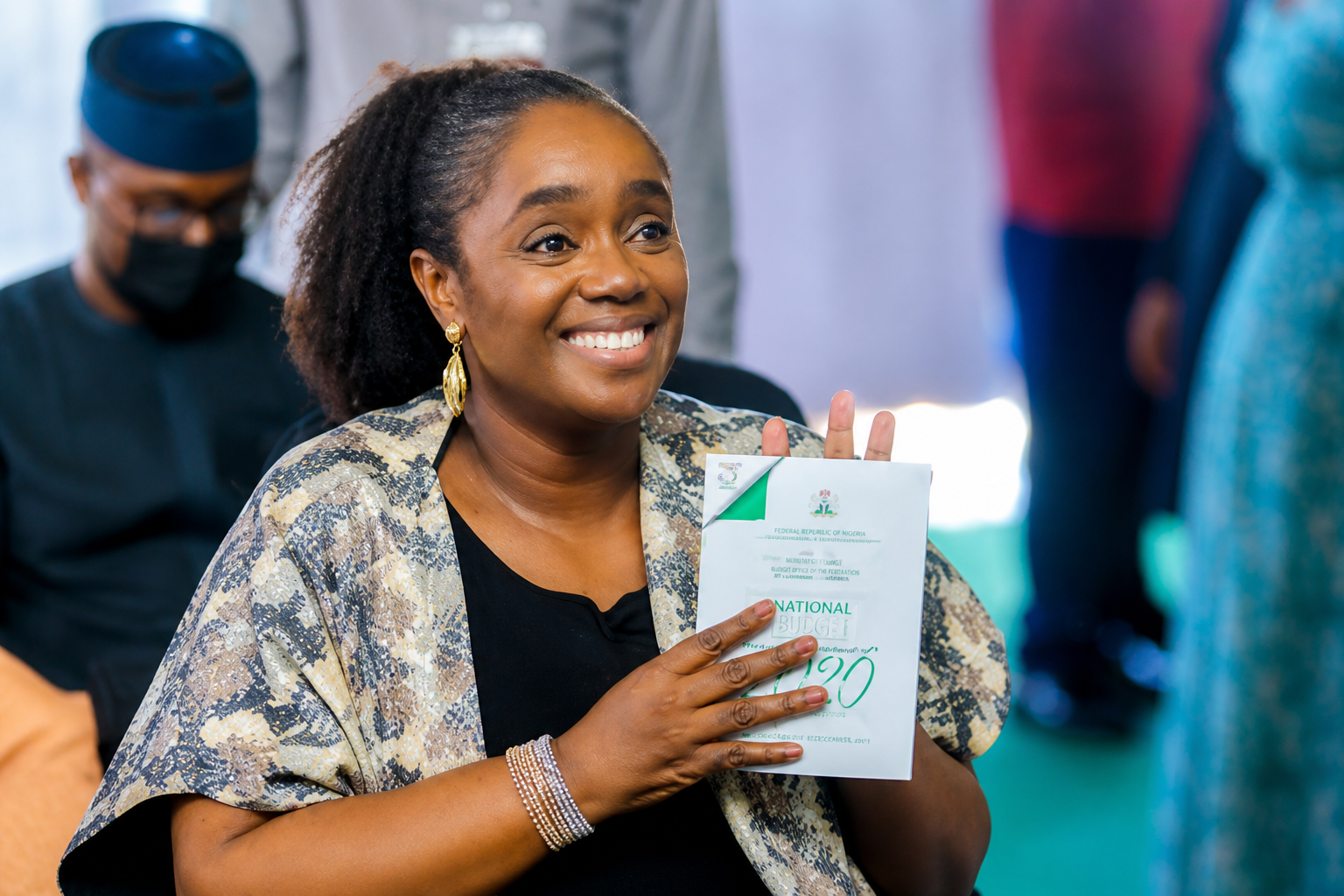
In the measured cadence of her speech, there was both conviction and candor, an unusual pairing in a landscape often defined by certainty. Kemi Adeosun did not speak like someone trying to impress; she spoke like someone trying to correct.
At the 2026 edition of The Platform Nigeria, held to mark Workers’ Day, the atmosphere leaned less towards ceremony and more towards urgency. Convened by Poju Oyemade, the gathering brought together a cross-section of thinkers, builders, and operators to confront a defining question: what will power Nigeria’s next phase of growth?
Among the most anticipated voices was Adeosun, former Minister of Finance and former chairman of the Board of the African Export–Import Bank, who delivered a characteristically direct and reflective address on the realities of entrepreneurship in Nigeria.
YOU CAN ALSO READ: From Finance to Philanthropy: Dashmi Foundation Makes Every Gift Count
She took the stage not as a policymaker revisiting past reforms, but as a practitioner interrogating the future. Her remarks marked a clear evolution in her public voice, shifting from macroeconomic policy to the granular realities of building businesses in a challenging environment. Her central argument was unambiguous: Nigeria’s long-promised economic transformation will not be delivered by projections or policy declarations alone. It will depend on whether small and medium-sized enterprises, already responsible for the majority of employment, can survive, grow, and scale.
Drawing on both data and personal experience, she painted a sobering picture of the entrepreneurial landscape. Nigeria may rank among the most entrepreneurial countries in the world, but the majority of its startups do not survive beyond five years. For Adeosun, this is not simply a statistic; it is evidence of a deeper structural problem rooted in a lack of preparation, discipline, and understanding of fundamental business principles.
She dismantled several assumptions that continue to shape entrepreneurial thinking in the country. Chief among them was the belief that inspiration, or even conviction grounded in faith, can substitute for structure. Reflecting on her own journey, she openly shared that she had started nine businesses, six of which failed, while two broke even and one continues to struggle. The point, she explained, was not failure itself, but what it reveals. Entrepreneurship, in her view, is not a guarantee of success but a disciplined process that demands rigor.
Her framework for understanding that process rested on four core elements: market, numbers, timing, and team. On the market, she emphasized the need for founders to move beyond intuition and engage deeply with demand, pricing, and competition. Every business, no matter how inspired, operates within an ecosystem that must be understood and respected. On numbers, she was unequivocal in her insistence that entrepreneurs must know their financials, revenue, profit margins, cash flow, and break-even points, arguing that many businesses fail not from lack of effort, but from a lack of financial clarity.
Timing, she suggested, is often underestimated. Many ventures collapse not because the idea is fundamentally flawed, but because it is executed too early or without adequate preparation. Her own experience, she admitted, was marked by impatience, launching businesses before fully understanding the terrain. Team, the fourth element, broadened her argument into a national conversation. Nigeria, she noted, faces a paradox of high unemployment alongside a shortage of skilled talent, a gap that continues to constrain business growth.
One of the more striking aspects of her address was her critique of what she described as “entrepreneurs of necessity,” individuals pushed into business by the absence of formal employment rather than by deliberate choice. In a country where entrepreneurship is often presented as the default solution, Adeosun offered a more nuanced perspective. Not everyone, she argued, is meant to build a business, and forcing that path can lead to avoidable failure. What Nigeria needs, she suggested, is not just more startups, but stronger ones, businesses capable of growing large enough to absorb talent across multiple functions.
YOU CAN ALSO READ: NGX Eyes Continental Influence as Popoola Pushes Strategic Reforms
Her appearance at the event also reflected a broader shift in her post-government work. Through her initiative, Nidacity, she is working to address many of the gaps she identified, focusing on mentorship, data, and practical business education. The platform aims to document real entrepreneurial journeys within Nigeria, offering insight not just into success, but into the failures and adjustments that shape it.
Throughout her remarks, Adeosun maintained a tone of realism that distinguished her contribution. She rejected the widely held belief that lack of capital is the primary barrier to starting a business, pointing instead to clarity of idea, understanding of market dynamics, and disciplined execution as the more decisive factors. In doing so, she reframed entrepreneurship from an aspirational concept into a structured, learnable process.
By the time she concluded, the conversation had shifted noticeably. What began as a discussion about opportunity had become a deeper reflection on responsibility, on what it truly takes to build something that lasts. In a country accustomed to projecting future greatness, Adeosun’s intervention was a reminder that economic transformation is not declared; it is constructed.
Her message at The Platform was not one of easy optimism, but of grounded possibility, an insistence that Nigeria’s future will depend less on what it hopes to become, and more on what it is willing to build.