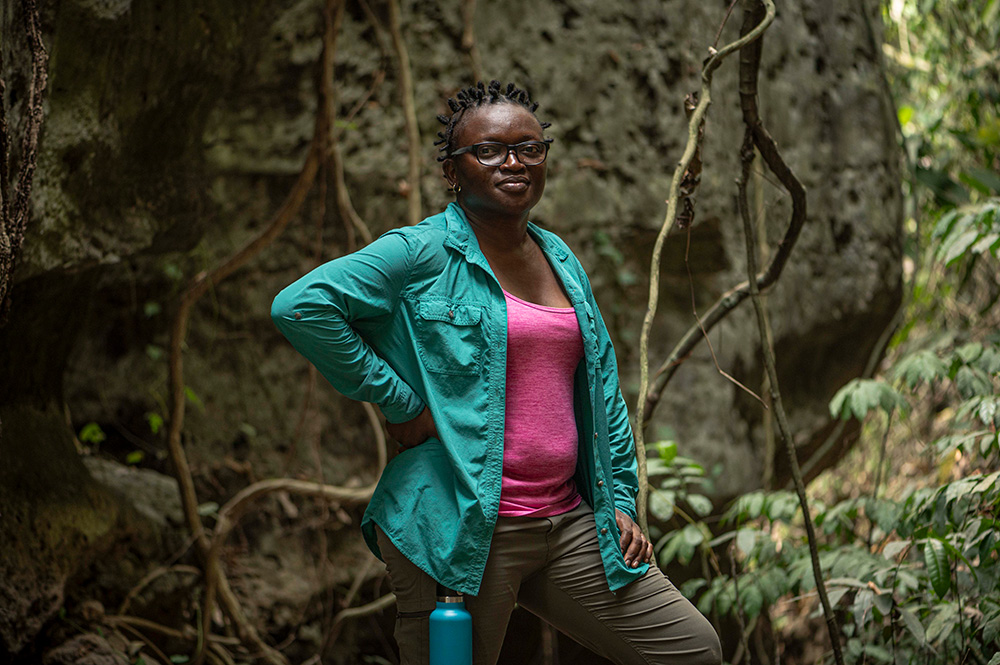
In the dense, emerald folds of southeastern Nigeria’s Cross River rainforests where mist settles like breath between ancient trunks and caves open into darkness older than memory, one scientist is reshaping how an entire region understands the night.
Her name is Iroro Tanshi and at 41 she stands at the meeting point of ecology, culture and survival, working in a landscape where endangered species, rural livelihoods and climate disruption are tightly interwoven rather than separate problems.
She was raised in Warri, an oil producing industrial town where the rhythm of life was shaped more by pipelines and refineries than forests or rivers. Nature, for her, existed at a distance. It arrived through television documentaries, through images of ecosystems untouched by the pressures she saw around her. Those early encounters did not feel like entertainment. They felt like a quiet invitation into another way of understanding the world.
That contrast became defining. In university, where she studied environmental science, Tanshi began to connect what she had seen growing up with what she was learning in theory. She started to recognize that environmental degradation was not abstract. It was visible in land use change, in declining biodiversity, in the gradual reshaping of communities that depended directly on natural systems.
What emerged from that realization was not only academic interest but a long term commitment to field based conservation, especially in places where ecological importance and public misunderstanding collide most sharply.
Few creatures illustrate that collision more than bats.

In many parts of Nigeria, bats are not seen as wildlife in the conventional sense. They are often associated with fear, superstition or nuisance. In some communities they are killed on sight, in others avoided entirely, and in many cultural narratives they are tied to spiritual interpretations that reinforce distance rather than curiosity. This makes them one of the most ecologically important yet socially misunderstood groups of animals in the region.
Tanshi’s work does not begin with myth. It begins with biology, behavior and ecological function.
Bats, she explains in her field research and outreach, are among the most efficient natural systems of balance in tropical ecosystems. They regulate insect populations at scale, including species that affect agriculture and public health. They pollinate night blooming plants that would otherwise fail to reproduce. They disperse seeds across fragmented landscapes, effectively stitching together forest regeneration pathways that would otherwise collapse.
In practical terms, this means they are embedded in food systems, agriculture and ecosystem resilience in ways most people never see directly.
One example often cited in her work is dawadawa, a plant with a narrow and highly specialized pollination window. It flowers at night and relies heavily on bats for reproduction. Without them, entire local food chains linked to that plant would be disrupted.
Another is shea, a tree that supports both ecological stability and rural economies through shea butter production. Its regeneration depends in part on seed dispersal networks that include bats as key agents.
In other words, bats are not peripheral. They are structural.
Tanshi’s conservation work is grounded in the Afi Mountain Wildlife Sanctuary, a 24,700 acre protected area in Cross River State, supported by the adjacent Afi River Forest Reserve. Together, these landscapes represent some of Nigeria’s most intact rainforest systems, increasingly rare in a country where deforestation, agricultural expansion and infrastructure development continue to fragment natural habitats.
Within these forests lives a remarkable concentration of biodiversity including Cross River gorillas, chimpanzees, drill monkeys and numerous bird species found nowhere else. But it is the bat populations that reveal the most fragile story.
In 2016, the rediscovery of the short tailed roundleaf bat in the sanctuary marked a significant scientific moment. The species had been thought locally extinct. Instead, it persisted in small, isolated colonies of just a handful of individuals, surviving in cave systems that function as both refuge and vulnerability.
With global populations estimated at fewer than 1,500, every disturbance matters. A shift in temperature, a change in airflow, a fire event or repeated human intrusion can alter colony stability permanently.
This fragility becomes even more pronounced when viewed alongside the human geography of the region.
Around the sanctuary are approximately 16 rural communities with a combined population of about 27,000 people. These communities rely heavily on subsistence agriculture, cultivating crops such as cassava, plantain and cacao. For generations, controlled burning has been used as a land management tool to prepare fields and improve yields.
But climate change has altered the conditions under which those practices take place. Dry seasons are longer and hotter. Vegetation is more combustible. Forest edges are closer to human activity than before. As a result, controlled burns frequently escalate into wildfires that move beyond fields into forest ecosystems.
Between January and April, the dry season intensifies both ecological stress and fire risk. These wildfires now represent one of the most significant threats to bat habitats in the region. Even when fires do not directly reach cave systems, smoke alone can disrupt bat colonies. Sensitive species may abandon roosts entirely, a response that can fragment populations beyond recovery.
In regions with limited firefighting infrastructure, these fires often continue until natural rainfall intervenes, leaving behind damaged forests, reduced biodiversity and disrupted livelihoods.
For Tanshi, this is where conservation becomes most complex. It is not a matter of protecting nature from people, but of designing systems where both can persist under changing conditions.
This perspective is central to her work through the Small Mammal Conservation Organization, SMACON, which she co founded in 2016. The organization operates on the principle that conservation must be embedded within local realities rather than imposed from outside them.
Instead of treating bat hunting or forest use as isolated problems, SMACON examines the economic and social conditions that drive those behaviors. In many cases, reliance on wildlife is linked to income insecurity or lack of accessible alternatives.
One of the organization’s responses has been to support alternative livelihood systems that reduce dependence on bushmeat while strengthening food security. These interventions are not framed as restrictions but as substitutions that maintain survival options while reducing ecological pressure.
Tanshi often emphasizes that conservation framed as opposition to human need is unlikely to succeed. Instead, she positions biodiversity as part of the infrastructure of survival itself.
Forests provide fuel, food resources, medicinal plants and non timber products that communities rely on daily. When bat populations decline or forest systems fragment, those services weaken in ways that eventually affect human stability as well.
Her work also extends into practical policy engagement.
In Benin City, for example, bat colonies roosting in trees at King’s Square became a source of conflict due to droppings and public concern. The initial response from authorities was removal. Tanshi’s team proposed an alternative that preserved the trees while addressing human concerns through structural solutions such as covered parking. The intervention succeeded in maintaining both urban functionality and ecological presence.
This approach reflects a broader philosophy. Conservation is not only about biological protection. It is about designing coexistence in ways that are functional in real environments.
Her engagement with cultural beliefs is similarly nuanced. Rather than attempting to dismantle spiritual interpretations of bats, she focuses on expanding knowledge of their biology and behavior. In some communities bats are feared as symbols of darkness or witchcraft. In others they are seen as omens or messengers. These narratives vary widely, but Tanshi observes that most are rooted in limited direct interaction.
Because bats are nocturnal and rarely observed closely, misunderstanding fills the gap left by absence. Field education, she has found, often changes perception more effectively than debate.
When people encounter bats in controlled educational contexts, reactions frequently shift from fear to curiosity.
Over time, Tanshi’s work has gained significant international recognition, including the Future for Nature Award in 2020, the Whitley Award in 2021, the Pritzker Emerging Environmental Genius Award in 2023 and the Henry Arnhold Fellowship in 2025. These awards reflect growing global attention to conservation efforts that integrate science with community engagement in regions under environmental pressure.
Yet she consistently returns to local impact as the most meaningful measure. Farmers reporting reduced fire damage, communities experiencing improved agricultural stability and growing participation in conservation programs represent outcomes that cannot be captured by awards alone.
Despite her global profile, she maintains a direct and grounded relationship with fieldwork. She does not keep bats, nor does she encourage it. Instead, she emphasizes professional handling and habitat protection. Her role is not custodial in a domestic sense but ecological in a systems sense.
She has also encountered social stigma, often being labeled unusual for dedicating her work to animals many people avoid or fear. Rather than resisting that perception, she uses it as a teaching moment, turning curiosity into dialogue and dialogue into understanding.
At the core of her work is a consistent idea that misunderstanding is not an endpoint but an entry point.
In a country facing accelerating pressures from climate change, deforestation, urban expansion and resource competition, Tanshi’s research and advocacy sit within a broader question of how human societies adapt to ecological limits without undermining the systems that sustain them.
Her ambition is not simply to protect a species but to strengthen the conditions that allow ecosystems and communities to remain viable together.
In the forests of Cross River, where bats emerge each night into air thick with humidity and sound, that work continues quietly, one roost, one conversation and one reimagined belief at a time.