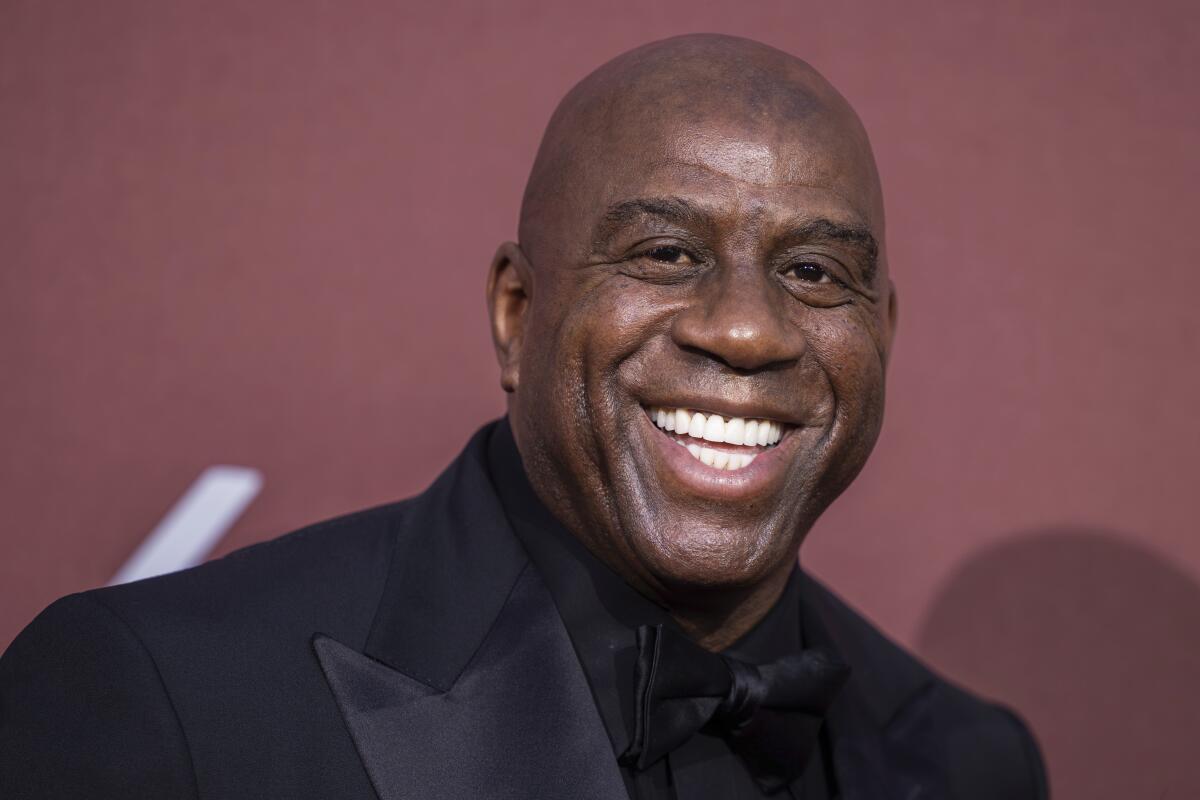
Magic Johnson stands as one of the most compelling figures in modern sports and business history, a man whose life has unfolded in bold chapters of brilliance, courage, reinvention, and extraordinary influence. From the electric arenas of professional basketball to boardrooms and ownership suites across major American sports, Johnson’s journey reflects a rare fusion of athletic genius and entrepreneurial vision.
When he entered the NBA in 1979 as the first overall draft pick of the Los Angeles Lakers, the league was searching for renewed energy and cultural momentum. Johnson arrived not simply as a player but as a phenomenon. At 6-foot-9, he defied conventional definitions of a point guard. His size gave him dominance, but it was his imagination on the court that set him apart. His no-look passes became iconic, threading through defenses with a theatrical flair that made basketball feel like performance art. Crowds did not just watch Magic Johnson play; they experienced him.
His rivalry with Larry Bird of the Boston Celtics helped transform the NBA into a must-watch spectacle throughout the 1980s. Their battles were intense, symbolic, and deeply personal, yet grounded in mutual respect. Together, they elevated professional basketball to global prominence. Johnson led the Lakers to five NBA championships during that decade, collecting three league MVP awards and three Finals MVP honors.
YOU CAN ALSO READ: Policy, Capital, Infrastructure Key to Africa’s Shared Prosperity, BUA’s CEO Insists
The Lakers’ fast-paced style, famously known as Showtime, was built around his vision and leadership. Every fast break seemed choreographed, every assist a statement of creativity. Teammates thrived in his presence because he made everyone better. That capacity to amplify others would later define his business career as well.
In 1991, at the height of his powers, Johnson altered the narrative of his life and the perception of an entire disease. His public announcement that he had tested positive for HIV stunned the world. At that time, fear and misinformation dominated public understanding. Rather than withdraw, Johnson stepped forward with remarkable composure and determination. His decision to speak openly helped dismantle stigma and ignited broader conversations about prevention, education, and compassion. When he returned to the NBA All-Star Game in 1992 and earned MVP honors, it was more than a sporting achievement. It was a powerful cultural moment that signaled resilience, hope, and a refusal to be defined by diagnosis.
Yet the most transformative phase of his career was still ahead. Many athletes struggle to replicate their competitive drive outside the arena, but Johnson redirected his ambition into enterprise. Through Magic Johnson Enterprises, he built a diversified investment portfolio focused on underserved urban communities. His strategy was deliberate and forward-thinking. He recognized that minority communities possessed enormous spending power yet were often overlooked by major corporations. By partnering with established brands and placing them strategically in urban markets, he demonstrated that inclusive capitalism was not merely socially responsible but economically sound.
Over time, Johnson expanded into real estate development, healthcare initiatives, media ventures, and food services. His approach combined data-driven analysis with lived experience, allowing him to identify gaps in the marketplace and transform them into profitable ventures. He proved that athletes could move beyond endorsement deals and become architects of economic ecosystems. His investments were not symbolic gestures; they were structural interventions designed to create employment, stimulate growth, and foster dignity within communities long excluded from mainstream capital flows.
Johnson’s ascent into sports ownership further solidified his influence. He became part of ownership groups that include Major League Baseball’s Los Angeles Dodgers, the WNBA’s Los Angeles Sparks, and Major League Soccer’s LAFC. Each role signified more than financial participation; it represented access to the highest levels of sports governance and decision-making. In an industry historically limited in minority ownership representation, Johnson’s presence helped shift the landscape. He moved from being the face of a franchise to shaping its long-term strategy and community engagement.
What distinguishes Magic Johnson is not simply success across multiple domains but the consistency of his philosophy. Whether on the hardwood or in corporate negotiations, he operates with optimism, discipline, and a belief in shared success. Teammates once relied on his court vision to find open lanes; business partners now rely on his strategic clarity to identify sustainable opportunities. His life demonstrates that adversity can become an inflection point rather than an endpoint. It also illustrates that celebrity, when combined with preparation and purpose, can evolve into institutional power.
YOU CAN ALSO READ: Obasanjo, Sanwo-Olu Celebrate Flutterwave’s 10 Years of Transforming African Enterprise
Today, Johnson’s influence stretches far beyond championship banners and highlight reels. He is frequently cited as a model for athlete entrepreneurship and civic leadership. His advocacy work continues to promote health awareness and philanthropy, while his business ventures reinforce the idea that capital can be both profitable and transformative. The narrative of Magic Johnson is not confined to sports history; it is woven into discussions about leadership, resilience, equity, and generational wealth creation.
In every phase of his life, he has embodied expansion. He expanded the definition of a point guard. He expanded public understanding of HIV. He expanded opportunities for minority business ownership. He expanded the blueprint for what life after professional sports can become. Magic Johnson’s story is one of sustained reinvention, a testament to the power of vision paired with execution. He remains not only a Hall of Fame athlete but a global symbol of possibility, proof that greatness evolves when courage meets opportunity.