With $46 billion in planned investments, a refinery positioned to transform Africa’s energy landscape and ambitions to list outside the continent, Aliko Dangote is laying out a new chapter for the Dangote Group, one defined by scale, global competitiveness and broad-based ownership.
For Aliko Dangote, the question is no longer whether the Dangote Group has enough capital to execute its ambitious expansion plans. In his assessment, the group has already raised more than it needs to pursue its current pipeline of investments and remain on course toward its 2030 vision.
“We have actually raised more than what we need as a group to execute all our projects,” Dangote said, outlining the scale of the group’s expansion ambitions. According to him, approximately $46 billion is currently in the pipeline for investment and expansion across the group’s businesses, with the objective of positioning the conglomerate for its 2030 targets.
The figure is significant not simply because of its size, but because of what it represents: a deliberate attempt to build industrial capacity at a scale capable of competing beyond Nigeria and Africa.
YOU CAN ALSO READ: Jumia Targets 3x Growth as CEO Bets on Nigeria’s Underserved Markets
Dangote says the group remains on track and intends to continue measuring its progress closely to ensure that the 2030 vision remains within reach.
At the heart of the strategy is the Dangote Refinery, the flagship industrial project that has already altered the conversation around Nigeria’s refining capacity and Africa’s energy independence. But for Dangote, the refinery is increasingly becoming more than an industrial asset. It is emerging as a platform for a much larger global business.
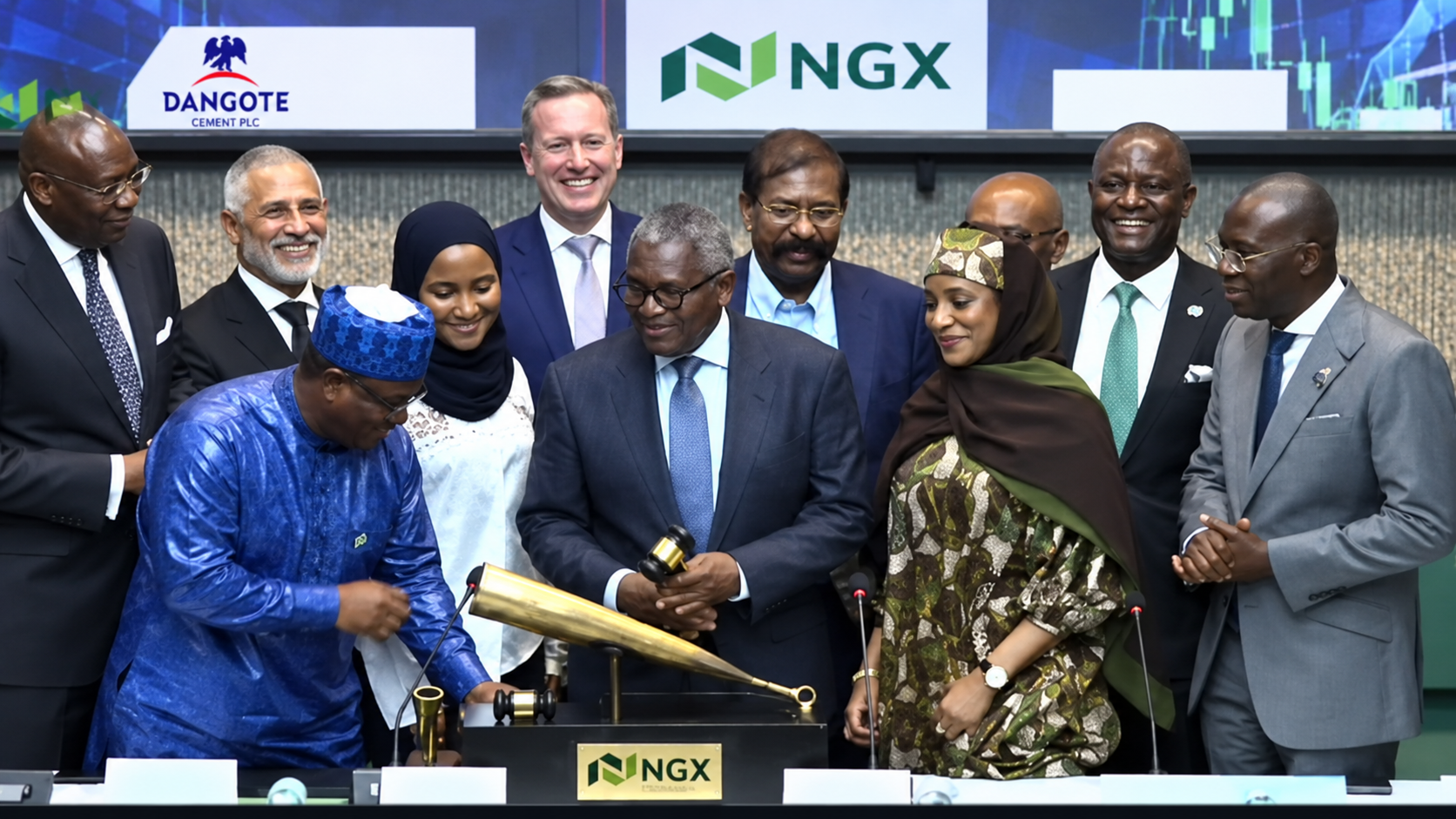
The group’s recent capital-raising exercise offers an insight into how Dangote intends to take that business forward. The company initially sought to raise $2.5 billion through a combination of a $1.5 billion initial public offering and a $1 billion private placement. The response, according to Dangote, exceeded expectations.
Demand was so strong that the company ultimately had to rethink how applications would be allocated. Dangote recalled discussions among the team about how to accommodate investors after receiving applications that significantly exceeded the amount the company intended to raise.
Rather than simply exclude investors, the company sought to accommodate as many as possible. Even then, a substantial amount had to be returned to applicants. The successful private placement, Dangote explained, effectively met the group’s immediate funding requirement. The subsequent public offering therefore has a different purpose.
It is about opening ownership of the refinery to a much wider audience. For Dangote, that distinction is critical. He believes an asset of the refinery’s magnitude should not create wealth for only a small circle of investors. Instead, he wants the opportunity to extend to millions of people, both within Nigeria and across the world.
“This is something that you have to really understand,” he said, arguing that investors are not simply buying into a narrative about what the refinery might become. They are buying into an industrial enterprise that is moving increasingly from ambition to reality.
Dangote is particularly bullish about the refinery’s future.
He projects that, by the end of the year, the company could become the largest company in Africa, based not only on revenue but also on profitability. The scale of its operations, he argues, could place it ahead of several major sovereign-backed companies.
For potential investors, his message is unmistakable: the opportunity is already moving. “Don’t let the train leave you at the station,” he said.
Yet the most compelling aspect of Dangote’s argument is not simply the anticipated size of the company. It is the potential impact of its ownership structure. He envisions an investment opportunity that can appeal to teachers, civil servants, families with children studying abroad and investors around the world. The proposition, as he presents it, is that ownership of a dollar-linked industrial business could provide investors with a measure of protection against currency depreciation.
The underlying business, he argues, generates revenues in a dollarised environment. Investors who receive dividends in dollars could therefore preserve part of the value of their investment even in the face of local currency devaluation.
That broad-based ownership ambition represents a significant evolution in Dangote’s approach to industrial development. For decades, the Dangote story has largely been associated with the rise of one of Africa’s most prominent entrepreneurs and the creation of one of the continent’s largest business groups. The next phase could increasingly be about turning that industrial success into a widely owned African corporate institution.
And Dangote is already thinking beyond Africa.
Within the next three to four years, he says, the Dangote Refinery could seek a listing outside the African continent, with the United States emerging as the most likely destination.
The ambition reflects the extraordinary scale the business expects to achieve.
Dangote points to a refinery capacity of 1.4 million barrels per day, alongside plans that could position the company to account for a significant share of America’s refining capacity. Beyond refining, the industrial complex is being developed around a broad portfolio of petrochemical products, including an anticipated 2.5 million tonnes of polypropylene capacity.
The company is also entering markets where Africa remains heavily dependent on imports.
One example is linear alkylbenzene, a critical raw material used in detergent production. Dangote notes that Africa currently has limited production capacity in the area, with facilities in Egypt and Algeria, while Nigeria is set to host a major new facility with a planned capacity of 400,000 metric tonnes.
The significance of these investments extends beyond Dangote’s balance sheet. They speak to a larger question about Africa’s place in global value chains.
For Dangote, the continent’s challenge is not simply a lack of resources. It is the failure to capture enough value from those resources before they leave African shores.
He describes Africa’s natural resources as an opportunity that remains largely underdeveloped, arguing that the continent must move beyond exporting raw materials and instead build the industrial systems required to process them, manufacture products and capture greater value locally. This, in many ways, is the philosophy underpinning the Dangote Group’s expansion.
The objective is not merely to become bigger. It is to build businesses large enough to compete for global capital, serve large markets and create industrial ecosystems around Africa’s resources.
That ambition also explains Dangote’s emphasis on opening the company to international investors.
Global investors, he observes, are often reluctant to deploy significant capital into very small businesses. They are searching for large-scale opportunities capable of absorbing substantial investment and generating meaningful returns.
The Dangote Group wants to create those opportunities from Africa. But behind the numbers and industrial megaprojects, Dangote also points to another transformation taking place within the group itself: the emergence of a new generation of leaders.
The billionaire businessman acknowledged that while his face remains one of the most recognisable symbols of the group, a significant amount of the organisation’s work is now being driven by younger executives and professionals.
He describes the organisation as increasingly being powered by a new generation of leaders, many of whom operate away from the public spotlight. The message is important. Dangote’s vision for the future is not designed around a single individual. It is increasingly about institutionalising the group, developing leadership capacity and creating an organisation capable of sustaining its growth over generations.
The refinery itself provides perhaps the clearest example. Dangote noted that the executive running the refinery is significantly younger than him, highlighting the depth of talent being developed within the organisation.
YOU CAN ALSO READ: How Donovan Chimhandamba Is Building South Africa’s Next Industrial Champion
This succession of leadership, combined with massive capital deployment, technological investment and an increasingly global outlook, could become one of the defining features of the Dangote Group’s next chapter.
The bigger picture is therefore larger than an IPO. It is about transforming a privately controlled African conglomerate into a globally recognised industrial institution with a broad shareholder base, international capital access and a portfolio of businesses capable of competing at the highest level.
Dangote’s proposition is ultimately straightforward: Africa possesses the resources, markets and entrepreneurial talent required to build globally significant companies. What is needed is the scale, capital, infrastructure and strategic execution to unlock that potential. The Dangote Group intends to be one of the companies leading that transformation.
With $46 billion in expansion plans, a refinery moving toward unprecedented scale, ambitions for an international listing and a strategy to bring millions of investors into its ownership story, Aliko Dangote is no longer talking only about building Africa’s biggest business. He is describing an industrial institution designed to compete with the world. And, in his telling, the journey has already moved beyond the dream. It is becoming reality.