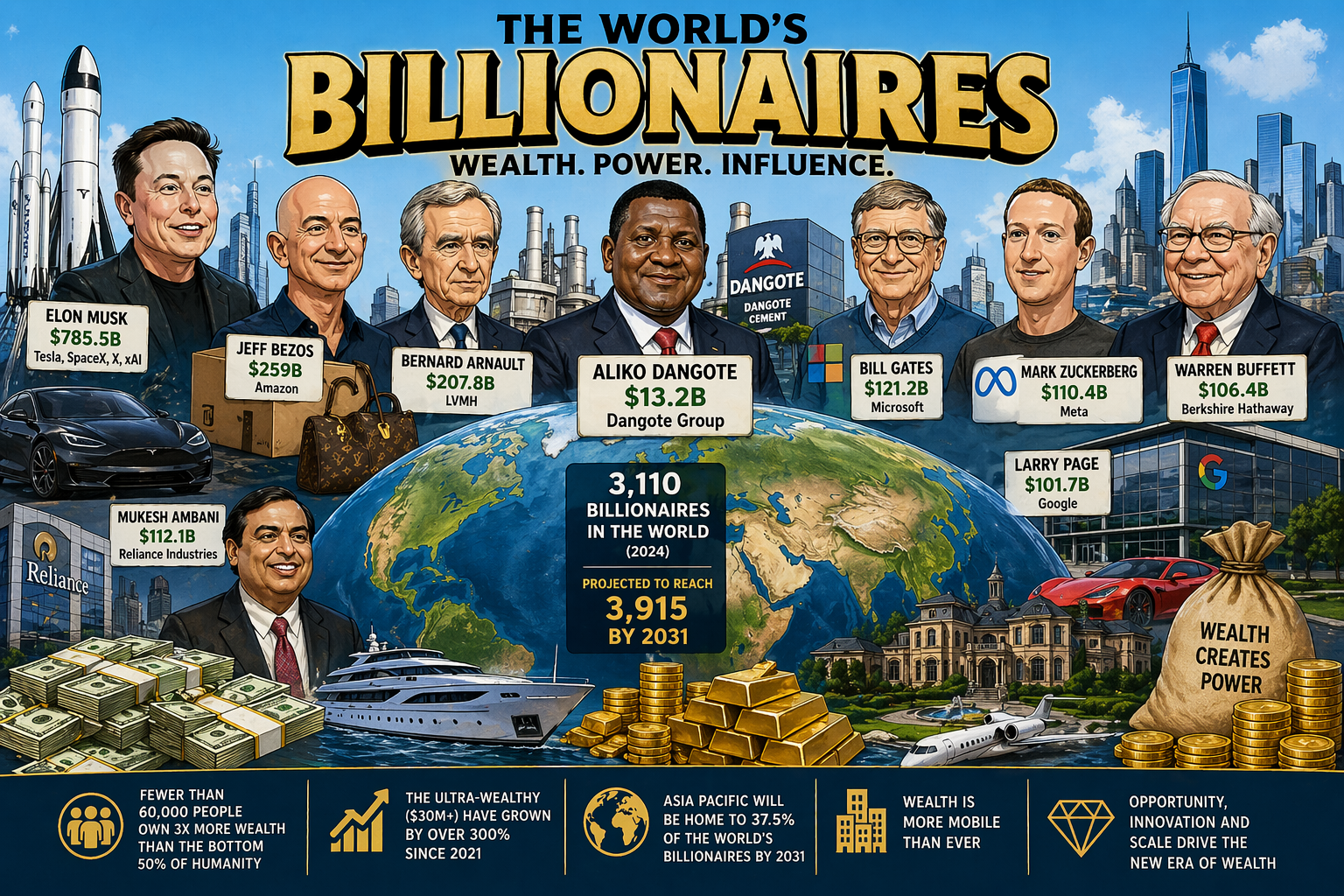
A new era of wealth is unfolding, faster, broader, and more concentrated than at any other point in modern economic history. By 2031, the world is expected to host nearly 4,000 billionaires, a striking milestone that signals not just growth in wealth, but a transformation in how fortunes are created, scaled, and sustained.
According to projections from Knight Frank, the global billionaire population has already reached 3,110 and is on course to rise by 25% within the next five years, bringing the total to approximately 3,915. Beneath these numbers lies a deeper narrative driven by speed, technology, and an increasingly complex global economy.
At the heart of this surge is a structural shift in wealth creation. Traditional pathways of industry and inheritance are being overtaken by the exponential power of technology. From artificial intelligence to digital platforms, the capacity to scale a business has reached unprecedented levels. As Liam Bailey, Head of Research at Knight Frank, observes, fortunes are now being built at a pace once unimaginable, propelled by innovation and amplified by global connectivity.
This acceleration is not limited to billionaires alone. The ranks of the ultra-wealthy, individuals worth at least 30 million dollars, have expanded dramatically. In just a few years, their numbers have grown from 162,191 in 2021 to over 713,000 today, marking an increase of more than 300 percent. Wealth is no longer just accumulating, it is multiplying.
Geography is also reshaping the map of affluence. Oil rich economies are emerging as powerful engines of billionaire growth, with Saudi Arabia expected to more than double its billionaire count from 23 to 65 by 2031. In Europe, countries like Poland and Sweden are witnessing similar upward trajectories, reflecting a broader redistribution of wealth creation beyond traditional strongholds.
Yet, as wealth expands, so too does inequality. The findings of the World Inequality Report paint a stark picture. Fewer than 60,000 individuals, just 0.001 percent of the global population, control three times as much wealth as the bottom half of humanity combined. It is a disparity that continues to fuel global debate, particularly around taxation, fairness, and the growing influence of wealth in political systems.
Advocacy groups such as Oxfam have intensified calls for reform, noting that billionaire wealth has surged to a collective 18.3 trillion dollars. The organisation highlights not just the scale of wealth, but its concentration, as record numbers of billionaires continue to emerge year after year.
At the pinnacle of this wealth hierarchy sits Elon Musk, whose fortune, estimated at 785.5 billion dollars, places him far ahead of his peers. He is followed by Larry Page, co founder of Google, and Jeff Bezos, founder of Amazon, each representing the immense financial power generated by the digital economy.
Across the Atlantic, wealth narratives are shifting. The Sunday Times Rich List identifies the Hinduja family as the wealthiest in the United Kingdom, even as the country records a decline in its billionaire population from 165 to 156 in a single year, the sharpest drop in decades. This contraction reflects a growing trend, the migration of wealth.
Policy changes, including the United Kingdom’s removal of the non domiciled tax regime, have prompted many high net worth individuals to reconsider their base. Increasingly, the global elite are gravitating toward cities and regions that offer not just opportunity, but stability and predictability. As Rory Penn of Knight Frank notes, while wealth is becoming more mobile, the number of destinations deemed safe for investment and residence is narrowing.
Meanwhile, the global balance of wealth is shifting eastward. Although North America currently hosts nearly a third of the world’s billionaires, it is expected to be overtaken by the Asia Pacific region by 2031. By then, Asia Pacific is projected to account for 37.5 percent of the global billionaire population, compared to North America’s 27.8 percent, marking a decisive realignment of economic influence.
What emerges from these trends is a world where wealth is no longer bound by geography, but by access to technology, capital, and systems that enable rapid scale. The billionaire boom is not simply a story of riches, it is a reflection of a changing global order, where innovation drives accumulation and mobility defines power.
In this new age, the question is no longer whether wealth will grow, it is how, where, and for whom.