In just five years, Anthropic has transformed from an ambitious startup founded by former OpenAI researchers into one of the world’s most influential artificial intelligence companies. Today, its Claude family of AI models powers businesses across industries, its valuation rivals the biggest names in technology, and its products have become indispensable to software developers, enterprises and knowledge workers.
Yet despite the company’s meteoric rise, President and Co-Founder of Anthropic, Daniela Amodei insists that success has changed very little about how the company measures itself.
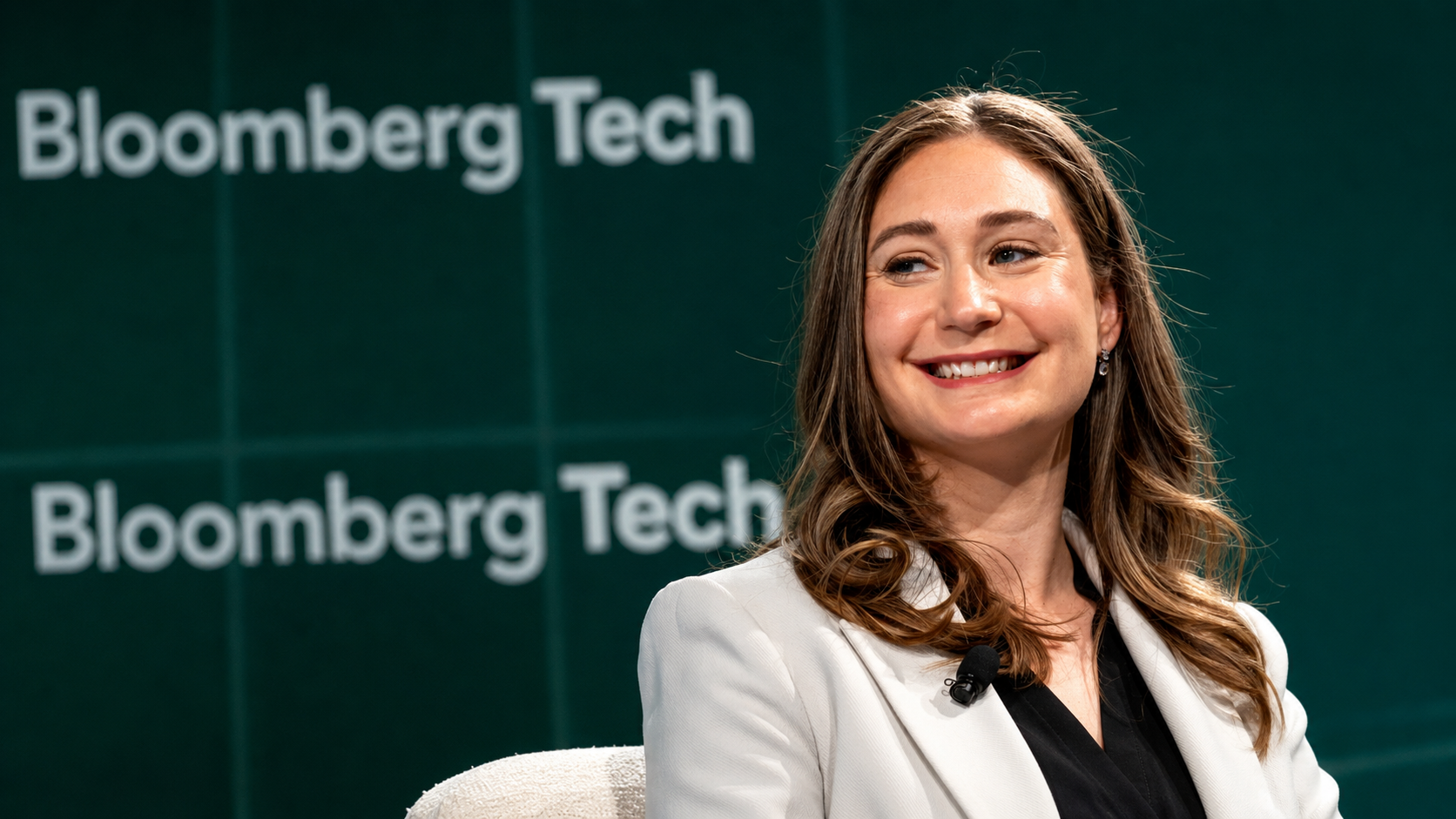
Speaking with Bloomberg’s Shirin Ghaffary at Bloomberg Tech 2026 in San Francisco, Amodei offered a rare look inside the company behind Claude, discussing everything from leadership and commercialization to AI safety, government partnerships, enterprise adoption and the future of work.
Throughout the conversation, one theme remained remarkably consistent. Anthropic is determined to build artificial intelligence that prioritizes responsibility over hype, long-term value over short-term victories, and trust over technological spectacle.
For Amodei, the company’s leadership structure is central to that philosophy.
YOU CAN ALSO READ: The Entrepreneur Who Built a Billion Dollar Brand by Putting People First
While her brother and Anthropic CEO, Dario Amodei, drives the company’s long-term scientific vision, Daniela oversees the operational engine that keeps the rapidly expanding organisation moving. She manages the executive team, customer strategy, product development and day-to-day business decisions, describing the partnership as a balance between visionary research and disciplined execution.
Rather than competing for authority, the siblings embrace disagreement as part of better decision-making. Years of growing up together, she joked, have taught them how to challenge each other respectfully, often discovering solutions that neither would have reached independently.
That collaborative approach has become increasingly important as Anthropic enters a new phase of growth.
Only two years ago, the company was widely viewed as the challenger in an AI race dominated by OpenAI. Today, Claude has emerged as one of the industry’s most trusted enterprise AI platforms, particularly among software developers, while Anthropic’s revenue and valuation have surged dramatically.
Yet Amodei rejected the notion that the company now considers itself the industry’s front-runner.
Leadership, she argued, should never become distracted by rankings, valuations or headlines. Instead, the organisation remains focused on serving customers while pursuing its founding mission of developing AI that is ethical, reliable and beneficial to society.
That customer-first philosophy has also shaped Anthropic’s commercialization strategy.
Unlike many consumer-focused AI companies, Anthropic has deliberately concentrated on enterprise customers, believing businesses place greater value on trust, transparency and reliability. Claude has become deeply integrated into corporate workflows, helping organisations write software, analyse financial data, streamline operations and improve productivity across departments.
Inside Anthropic itself, employees rely heavily on Claude. Beyond engineering and research teams, finance, human resources and operations all use internally developed AI tools that were first created to solve the company’s own challenges before being released to customers.
One example is an AI-assisted performance review system that helps employees organise achievements, generate thoughtful assessments and improve feedback conversations. According to Amodei, these internal deployments serve as practical laboratories for future enterprise products.
Despite the enthusiasm surrounding enterprise AI, she acknowledged that businesses are still experimenting with how best to use these technologies.
Some organisations, she noted, have become obsessed with measuring AI usage through internal leaderboards or token consumption rather than actual business outcomes. Anthropic deliberately avoids that approach.
Instead of encouraging employees to maximise AI usage for its own sake, the company focuses on identifying meaningful applications that genuinely improve productivity and decision-making.
Amodei believes the current wave of experimentation is only the beginning. As models become more capable over the next several years, AI will become a natural part of everyday work rather than a novelty measured by usage statistics.
Behind those increasingly powerful models lies another challenge that few outside the industry fully appreciate. Training frontier AI systems requires extraordinary amounts of computational infrastructure and billions of dollars in capital investment.
Anthropic recently confidentially filed paperwork that could eventually lead to an initial public offering, although Amodei declined to discuss specific IPO plans.
She did, however, explain why public markets are becoming increasingly attractive for frontier AI companies.
Developing advanced AI models requires enormous upfront investment in computing resources long before revenue is realised. Access to public capital markets, she suggested, may become essential for companies seeking to remain at the cutting edge of AI research.
Even so, Anthropic has deliberately avoided aggressively overcommitting to infrastructure.
Rather than purchasing vast quantities of computing capacity years in advance, the company has taken what Amodei describes as a fiscally disciplined approach, preferring to occasionally face supply constraints rather than risk investing in infrastructure that could later prove unnecessary.
That measured philosophy also extends to product releases.
Anthropic’s most advanced cybersecurity model, Mythos, has not been released broadly despite intense demand.
Instead, the company first granted access to cybersecurity organisations, governments and critical infrastructure providers, allowing them to identify and patch vulnerabilities before expanding availability to additional customers.
The gradual rollout reflects Anthropic’s belief that responsible deployment sometimes requires slowing down rather than racing competitors to market.
For Amodei, safety cannot simply be discussed after products launch. It must shape how products are introduced from the beginning.
The same philosophy guides Anthropic’s relationship with governments.
While debates over AI regulation continue globally, the company has actively engaged with policymakers, national security agencies and government institutions.
Amodei described artificial intelligence as fundamentally a geopolitical technology whose responsible development requires close cooperation between private companies and democratic governments.
She expressed optimism about Anthropic’s ability to work constructively with the U.S. administration while maintaining the company’s own principles and ethical standards.
Perhaps the most thought-provoking part of the discussion focused not on technology itself but on society’s readiness for it.
As AI capabilities continue advancing, concerns about labour displacement have become increasingly prominent.
Although Anthropic’s own research currently shows very limited evidence of widespread job replacement, Amodei acknowledged that future disruption remains possible.
Rather than making definitive predictions, she argued that companies should openly study AI’s societal impacts and prepare for multiple outcomes.
She also challenged businesses and policymakers to think beyond traditional employment models.
If artificial intelligence ultimately performs many tasks currently handled by humans, society must reconsider how people earn livelihoods, find purpose and contribute meaningfully.
YOU CAN ALSO READ: Shan Sinha Helped Create Google Drive. See What He’s Building Next.
Rather than viewing AI solely as a threat to employment, Amodei believes it could create an opportunity to redesign work around uniquely human strengths such as creativity, empathy, collaboration and interpersonal relationships.
The challenge, she suggested, is ensuring economic systems evolve alongside technological progress.
Underlying every topic discussed, from commercialization and infrastructure to public policy and the future of work, was Anthropic’s insistence that artificial intelligence should ultimately serve people rather than simply outperform competitors.
In an industry often driven by speed, valuation and increasingly powerful models, Daniela Amodei presented a noticeably different vision of leadership.
For her, success is not measured by who builds the largest model or commands the highest valuation. It is measured by whether AI earns society’s trust, creates lasting value for businesses and individuals, and advances technology without losing sight of the human beings it is meant to serve.
As Anthropic enters what may become its defining chapter, with an IPO on the horizon, growing enterprise adoption and intensifying global competition, that philosophy could prove to be one of its most valuable competitive advantages.