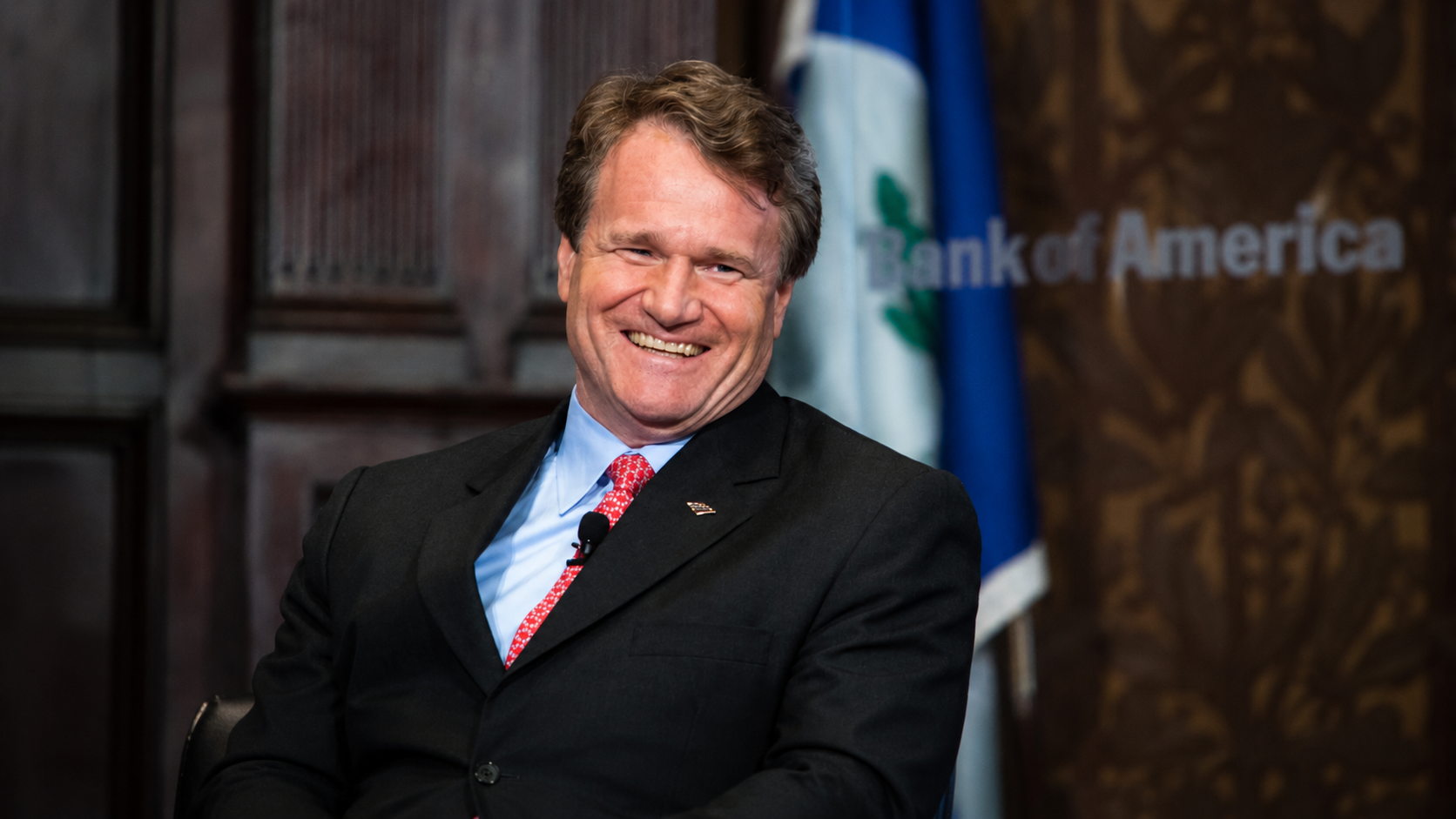
In an era when the average chief executive’s tenure continues to shrink, few corporate leaders have demonstrated the staying power, consistency and adaptability of Brian Moynihan, Chairman and CEO of Bank of America. Having led one of the world’s largest financial institutions for more than 16 years, Moynihan has navigated the aftermath of the global financial crisis, economic recessions, geopolitical shocks, a global pandemic, banking sector turbulence and the accelerating rise of artificial intelligence.
Speaking from the top floor of Bank of America Tower in New York City as part of The CEO Moment, a new executive interview series, Moynihan offered a rare window into the state of the American economy, the future of leadership and the principles that have guided one of the longest-serving CEOs in modern banking.
From his vantage point overseeing a financial institution that serves millions of consumers and businesses, Moynihan sees an economy that remains remarkably resilient despite ongoing uncertainty.
YOU CAN ALSO READ: The Entrepreneur Who Built a Billion Dollar Brand by Putting People First
According to the veteran banking executive, the U.S. economy continues to show stronger fundamentals than many observers appreciate. While geopolitical tensions, particularly conflicts in the Middle East, have disrupted growth forecasts and injected volatility into global markets, he believes the underlying momentum remains positive.
“The economy has been strengthening,” Moynihan said. “Businesses are strong, consumers are strong, and if uncertainty doesn’t get worse, we should see a pretty good year in the United States and a decent year around the world.”
That optimism is rooted in what Bank of America sees every day through its vast network of consumer and business transactions. Despite persistent concerns about inflation and affordability, Americans continue to spend.
“People are concerned about prices and affordability,” he acknowledged. “But what they’re doing is different from what they’re saying. Consumers are spending about five percent more than they spent last year.”
The contradiction highlights a defining characteristic of today’s economy: households remain frustrated by higher prices, yet strong employment levels and rising wages continue to support spending. Moynihan noted that while inflation has eased from its pandemic-era peaks, consumers still remember how much less everyday essentials once cost, creating a lingering sense of financial pressure.
Housing remains one of the economy’s most stubborn challenges. For Moynihan, the issue is less about interest rates and more about supply. Millions of homeowners remain locked into low-rate mortgages secured years ago, making them reluctant to move into a market where borrowing costs are significantly higher.
“The biggest problem with housing is simple,” he said. “They’ve got to build more units. Period. End of story.”
He argued that cities across America must accelerate housing development if they hope to improve affordability, pointing to markets where increased construction has successfully moderated prices.
Beyond consumers, Moynihan also sees resilience among America’s small businesses. While entrepreneurs remain cautious about trade policies, tariffs and energy prices, most continue to hire, borrow and grow.
“Credit quality is good. They’re borrowing, they’re growing, they’re employing more people and paying their employees more,” he said. “In the aggregate, they’re in pretty good shape.”
His broader outlook reflects a belief that economic growth ultimately comes from private-sector activity rather than government intervention.
“I’m a believer that America is not a central-bank-led economy,” Moynihan said. “The underlying private sector drives this economy. Period. End of story.”
That conviction extends to his views on artificial intelligence, a technology rapidly reshaping industries worldwide. While fears about job losses and automation dominate public debate, Moynihan sees AI primarily as a productivity tool rather than a replacement for human talent.
Bank of America has been experimenting with AI for years through its virtual assistant Erica, which now serves millions of customers. Yet he remains adamant that technology should enhance people’s work rather than eliminate it.
“Our job is to invest for growth and use these tools to make our teammates more effective,” he explained. “It’s a tool, like spreadsheets were. It’s a tool, like email was.”
Even in areas such as lending, where algorithms increasingly influence decision-making, Moynihan insists accountability must remain human.
“The answer can’t be, ‘The model made me do it,’” he said. “We’re responsible for every decision we make.”
His philosophy reflects a broader leadership approach grounded in accountability, preparation and discipline—principles forged during one of the most turbulent periods in modern financial history.
When Moynihan became CEO in the aftermath of the global financial crisis, he inherited an institution facing enormous challenges. The experience reinforced a lesson he believes every leader must embrace: organisations should never become dependent on regulators, market sentiment or favourable conditions.
“We have to be able to run our company no matter what,” he said. “Capital, liquidity, discipline and a strong team—that’s what matters.”
The same mindset guides his approach to crises. Asked how he behaves when confronted with uncertainty, Moynihan offered a simple but memorable analogy.
“You’ve got to be like a duck on a pond,” he said. “You’re moving along smoothly on the surface. You may be swimming like heck underneath, but it doesn’t do any good to sit there and lament the situation. You’ve got to figure out how to fix it.”
That calm-under-pressure mentality has helped him steer the bank through multiple disruptions, from COVID-19 to regional banking failures and global economic shocks.
Yet some of the most enduring leadership lessons did not come from boardrooms or financial markets. They came much earlier—during a summer job working in a municipal water and sewer department.
Moynihan recalls spending long days replacing water lines, repairing sewer systems and learning practical lessons that few future CEOs ever encounter.
“It teaches you a lot,” he reflected. “When you’re drilling a hole through a 15-inch water main six feet below the surface, you learn quickly how things work.”
The experience shaped his appreciation for hard work, technical knowledge and the people who keep essential systems running behind the scenes.
That same curiosity remains central to his leadership philosophy today. Whether evaluating future executives or developing talent within the bank, he looks for individuals willing to go deep, ask questions and continually learn.
“If you aren’t curious about leadership, if you aren’t curious about how things work, that’s a problem,” he said. “I’m always looking for people who have gone deep into something and can explain it. That tells you they’ll keep digging and learning.”
Perhaps the most surprising story Moynihan shared was how he once effectively fired himself.
In 2008, during a corporate restructuring, he designed an organisational plan that eliminated his own position. As the changes were being prepared for announcement, circumstances shifted dramatically and he was instead offered a different role—one that eventually led to the chief executive’s office.
YOU CAN ALSO READ: How Leo Ku Turned Creativity, Resilience and Purpose into a Lasting Legacy
“I eliminated my own job,” he recalled with a smile. “Then they came back and asked if I wanted to do another one.” The anecdote underscores a recurring theme throughout his career: leadership is not about protecting positions but creating value wherever it is needed.
As he reflects on more than a decade and a half at the helm of Bank of America, Moynihan remains focused on succession, talent development and ensuring the institution is prepared for the future.
“If you don’t thrill to this job every day, if you stop being curious, if you start blocking people instead of helping them grow, then it’s time to go,” he said.
For a leader who has weathered crises, transformed one of the world’s largest banks and maintained relevance through rapidly changing times, the message is clear. Great leadership is not defined by longevity alone. It is defined by resilience, curiosity, adaptability and the willingness to keep learning long after reaching the top.