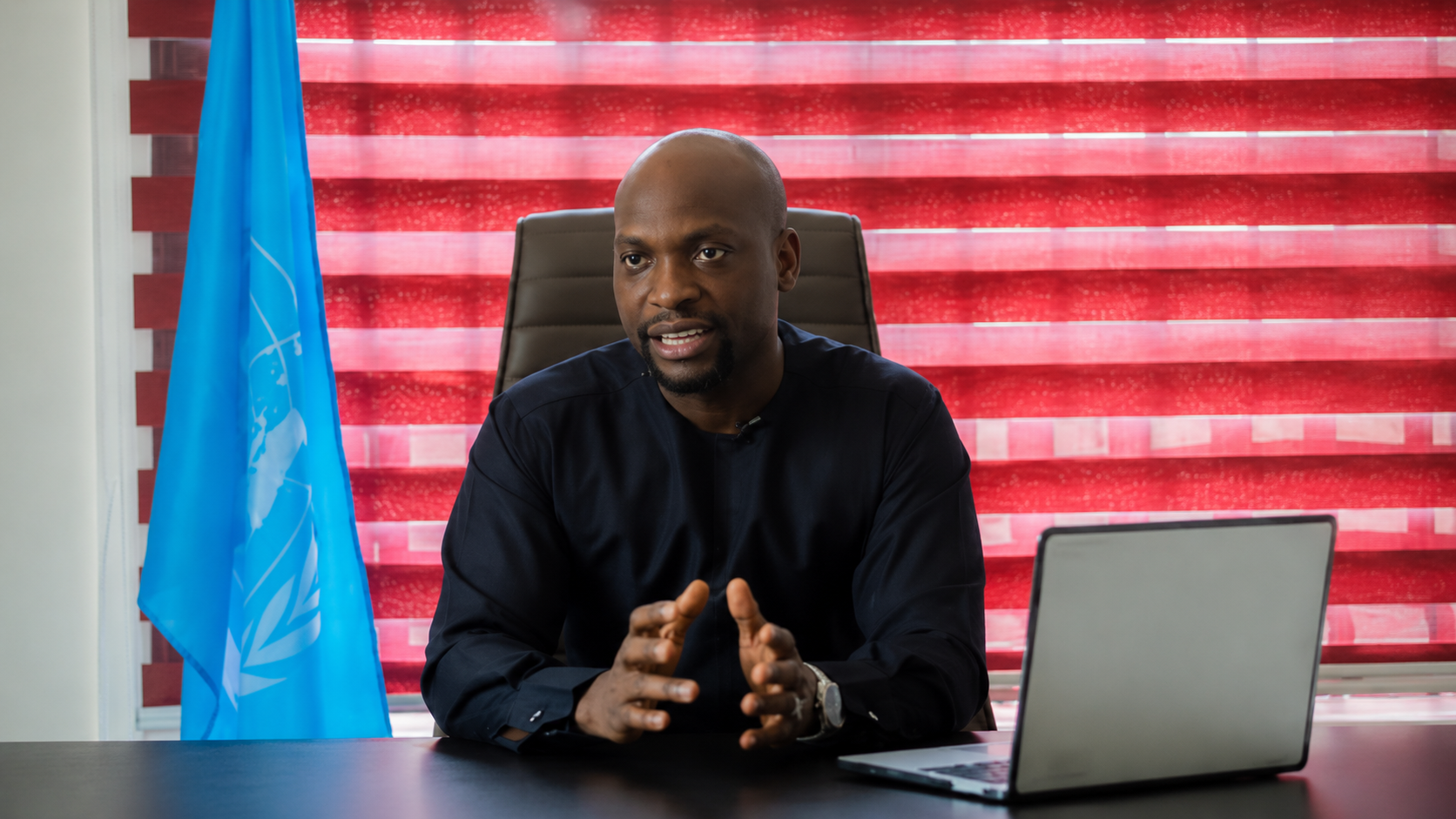
For more than a decade, Sanmi Lajuwomi lived the kind of professional life many Nigerians dream of. Based in the United Kingdom, he built a successful career as a business analyst and project manager, working on major technology projects for organisations including Discovery Channel, Sky and Daily Mail Group. As a contractor, he earned as much as £500 a day and was rarely without a contract. Then, he walked away from it.
Lajuwomi gave up his UK residence permit, left behind a comfortable career and returned to Nigeria to join a business that was paying him just ₦120,000 a month. It was a decision that appeared irrational to many around him, but for Lajuwomi, it was not a career move. It was a calling. Today, he is the founder of Winock Group, a growing business group with interests spanning solar energy, microfinance and agricultural commodity trading.
Born and raised on Lagos Mainland, Lajuwomi grew up seeing two very different sides of society. His father, through hard work, had risen into a prominent position, but continued to maintain relationships with people living in poverty. That exposure to both opportunity and deprivation planted an early sense of responsibility in him.
Like many Nigerian parents, his father sent him to the UK, where he attended university and began building his career. He quickly established himself as a highly sought-after business analyst, working across business analysis, project management and technology projects involving billions of pounds.
YOU CAN ALSO READ: Nigeria’s Reforms Prevented States’ Fiscal Crisis, Improved Reserves — Oyedele
But professional success did not completely settle the question of purpose. One experience in particular stayed with him. During a business meeting in the UK, someone introduced him as Sanmi, a Nigerian. The response was a question about whether he was a “419 person.” For Lajuwomi, the comment was more than an insult. It forced him to confront how Nigeria and Nigerians were perceived internationally.
By 2012, he had begun seriously contemplating what contribution he could make to Nigeria. His thinking was also shaped by books on leadership, philosophy and social change, including the works and biographies of Martin Luther King Jr., Malcolm X and Nelson Mandela, as well as Marcus Aurelius’ Meditations and Plato’s Republic. He eventually found a framework that explained what he was experiencing: Joseph Campbell’s concept of the “Call to Adventure” in the Hero’s Journey.
“I could either be living safe in the UK, earning money, or I could go back to my country to contribute to it economically,” he reflected.
The decision was not made in isolation. His wife supported the move, even giving up her own British life and returning to Nigeria with their son. For Lajuwomi, the decision was also influenced by what he witnessed in China. Having arrived in the UK when China was still widely viewed as a developing economy, he watched the country transform within a relatively short period. He began asking himself why Africa could not do the same.
“I thought, look, we are going to have another slavery if we Africans don’t go back to Africa to grow Africa,” he recalled.
His return was therefore not simply about coming home. It was about finding an opportunity to participate in the economic transformation of the country he believed could become far more productive.
His first major entrepreneurial interest was oil and gas. He immersed himself in the sector, attending industry events in London, reading books, watching videos and networking with players across the value chain. He began exploring opportunities to acquire an oil block and came close to several major transactions, including discussions around a potential $40 million gas-to-power deal. He also ventured into gold mining, sourcing gold from Niger State and taking it to London.
Yet, just as the oil and gas opportunity appeared to be gaining momentum, Lajuwomi began looking beyond the obvious opportunity. At the time, he noticed growing investment in renewable energy and off-grid solar. He had learned an important lesson from a former colleague: entrepreneurs must always watch for the next train.
“You must always be on the lookout for that train, for the next train,” he explained. “If you hop on that train, you will go to the next destination very quickly. But if you miss it, you’ll be stuck.”
He believed the oil and gas train had already been moving for years. Solar, he concluded, was the next major opportunity.
That decision eventually gave birth to Winock Solar. In 2016, Lajuwomi began researching how to become a “solarreneur” in Nigeria. He discovered the potential of pay-as-you-go solar and explored a solar manufacturing concession with NASENI. But an unexpected conversation changed his direction. Rather than pursuing manufacturing, he was advised to consider providing solar systems to micro-businesses on credit. That became the foundation of Winock Solar.
His first significant external investment came from an unlikely connection. While participating in the Nigeria-UK Golf Association, he met a Nigerian-born dentist in the UK. Lajuwomi eventually became the dentist’s patient and paid £2,000 for dental treatment. Three months later, the dentist invested $80,000 in his business.
For Lajuwomi, the story reinforced one of his strongest beliefs: opportunities often emerge from showing up, building relationships and being willing to engage with people without knowing what the eventual outcome will be.
With the funding, he sourced solar products from China, built a team and began serving customers. What started with one customer eventually grew into tens of thousands.
But the business, like Nigeria itself, would face a changing economic environment. Winock Solar has since evolved from focusing primarily on micro-businesses to a broader direct-to-consumer model targeting low- and middle-income households. Lajuwomi says the business has also shifted from a lease-to-own approach as commercial banks increasingly enter the consumer solar financing market.
He now sees bank-financed solar distribution as one of the sector’s most compelling opportunities. For entrepreneurs entering the market, his advice is straightforward: master the customer-facing distribution value chain, build a strong reputation and partner with financial institutions that can provide consumer financing and carry the credit risk.
For Lajuwomi, solar is not simply another business opportunity. It is a response to one of Nigeria’s most persistent infrastructure challenges. He believes distributed energy, captive power and independent power providers will play a critical role in expanding electricity access, particularly because building traditional grid infrastructure at the scale Nigeria needs requires enormous capital and time.
He sees an opportunity for solar farms and independent power providers to supply communities and businesses directly, reducing dependence on the national transmission infrastructure. But he argues that this will require policy stability, regulatory certainty and stronger incentives for private investment.
“Policy assurance” is, in his view, critical to unlocking the capital required to transform Nigeria’s energy landscape.
But energy is only one part of Lajuwomi’s broader ambition. Winock Group now operates across three strategic areas: energy through Winock Solar, finance through Winock Lending and agriculture through Winock Agro. The businesses are tied together by a simple philosophy: provide access to energy, food and finance.
Winock Lending was established to address what Lajuwomi sees as a significant credit gap among Nigerian micro, small and medium-sized enterprises. He believes affordable formal credit remains inaccessible to a large proportion of businesses, forcing many entrepreneurs to depend on expensive informal lending. His ambition is to build a top-five credit-led microfinance institution in Africa.
His experience in lending has also challenged some assumptions about Nigerian borrowers. According to Lajuwomi, customers do pay when lending businesses are properly managed. He argues that poor corporate governance, weak internal controls and mismanagement are often bigger causes of failure in the microfinance sector than the supposed unwillingness of customers to repay.
His approach to lending is built around three critical questions: Who exactly is the borrower? Can the borrower repay? And where can the borrower be found if things go wrong? Technology can help verify identity and financial capacity, while offline methods remain important for address verification.
The third leg of the group, Winock Agro, reflects another opportunity Lajuwomi believes is hiding in plain sight: Nigeria’s enormous agricultural trading economy. Rather than beginning with exports, he started small. He visited markets in Abuja, including Mararaba and Masaka, studied how the informal trading system worked and travelled to Zaria to develop supplier relationships.
He began trading agricultural commodities through agents and says the experience has given him an entirely new perspective on the Nigerian economy. He discovered an agricultural economy that operates largely outside the formal structures of government and financial markets.
Tomatoes, yam and other commodities move through complex informal networks involving traders, agents, market associations and labourers. The margins can be significant, but so are the risks, particularly for perishables. For Lajuwomi, successful commodity trading is therefore less about luck and more about understanding market cycles.
The objective is to identify when prices are rising, enter at the right point, sell before the market becomes oversupplied and wait for the next cycle. He sees the same opportunity extending into cold-chain logistics, where businesses can transport perishable agricultural products from production areas to urban consumers and institutional off-takers.
This belief sits at the centre of Lajuwomi’s broader philosophy about entrepreneurship in Nigeria. He does not see the country simply as a difficult place to do business. He sees it as a market filled with inefficiencies waiting to be solved. “There is real business to do in Nigeria,” he said.
But building businesses in Nigeria has also exposed him to some of the country’s harshest economic realities. One of the most difficult periods came during the currency and foreign exchange crisis that followed the COVID-19 pandemic. Lajuwomi had raised foreign currency capital and was operating in a market where the naira was rapidly losing value. The mismatch between dollar liabilities and naira revenues became increasingly painful.
At one point, he recalled sitting in his office after speaking with a creditor about repayment, only for his head of human resources to walk in and tell him that employees were demanding salary increases because transportation costs had risen. For an entrepreneur, he said, that is the weight of wearing the crown.
The experience fundamentally changed how he viewed risk, finance and resilience. “Losses lead to lessons,” became one of the principles he took from the experience. Rather than seeing difficult periods simply as failures, he came to see them as an unavoidable part of the entrepreneurial journey.
His experience also shaped his approach to foreign investment. Lajuwomi has raised significant institutional funding, including equity and debt from impact-focused investors such as Acumen and other institutions. He attributes much of that success not to privilege or extraordinary intelligence, but to clarity, intentionality, relationships and credibility.
His advice to founders seeking capital is to first understand exactly what the money is required for. A founder must know how much capital is needed, whether it should come as equity or debt, what the money will fund and how each financing decision affects the company’s balance sheet.
Just as importantly, founders must understand their businesses deeply. A CEO seeking institutional capital, he argues, cannot only understand marketing or product development. They need to understand finance, accounting, human resources, operations and strategy well enough to speak credibly with investors and their own teams.
The investment environment has also changed. Lajuwomi believes impact investors are now scrutinising businesses more closely than they did in the early days of social impact investing. It is no longer enough to demonstrate social impact. Businesses must increasingly prove that their models can generate sustainable financial returns.
For Lajuwomi, however, the ultimate goal is bigger than raising capital or building profitable companies. It is what he calls patriotic entrepreneurship.
He defines patriotic entrepreneurship as the understanding that business is not only a mechanism for personal wealth creation but also a form of service to society. The entrepreneur, in his view, takes resources from places where they generate little value and moves them into areas where they can create greater economic and social value.
That mindset explains why he is so passionate about building in Nigeria despite the country’s challenges. He argues that Africa needs more large businesses, more institutions and more entrepreneurs willing to build at scale.
“When you think of America, you think of Microsoft. You think of China, you think of Jack Ma,” he said. “When you think of Nigeria, you think of Dangote and others.”
For him, Nigeria needs many more businesses capable of reaching that scale. His argument is not simply about jobs. It is about global relevance. He believes the economic strength of nations is closely tied to the strength of their businesses and entrepreneurs.
This conviction also informs his criticism of Nigeria’s growing obsession with migration. Lajuwomi is not opposed to people leaving the country in search of opportunities. But he believes Nigerians must also develop a culture that celebrates building at home.
He questions a society where foreign-made products are often automatically perceived as superior to locally manufactured alternatives and where migration can sometimes be celebrated as the ultimate measure of success. His generation, he argues, should be a generation of builders.
Previous generations fought for independence and democracy. The responsibility of today’s generation, in his view, is to build institutions, companies and systems capable of creating prosperity.
That philosophy has also influenced how he thinks about leadership. Lajuwomi says one of the biggest transitions he has made recently is moving from being a founder to becoming a CEO. The distinction, he believes, is critical.
A founder is often deeply involved in everything. A CEO, however, must create systems, establish governance, define strategy, empower leaders and allow the organisation to operate without constant intervention from the founder.
He admits that he initially became a bottleneck in his own organisation because of his tendency to make decisions personally and change directions quickly. The transition required him to step back, establish clearer decision-making structures and trust his management team.
His philosophy is simple: a company should become an institution, not remain an extension of its founder’s personality. That, for him, is what “building to last” means.
It also explains his emphasis on corporate governance, succession planning and performance-based incentives. In a continent where many businesses struggle to survive beyond their founders, Lajuwomi believes the next generation of African entrepreneurs must build organisations that can continue long after they are gone.
His own journey has not been without pain. But he does not describe pain as something to avoid. Instead, he sees it as part of the Hero’s Journey that first inspired his return to Nigeria.
Pain, he believes, develops resilience. Challenges expose weaknesses. Losses create lessons. And fear often proves less powerful once the feared event actually happens.
For Lajuwomi, failure itself does not truly exist if the entrepreneur learns from it. “If you lose and you learn, you haven’t lost,” he argues. “That lesson will take you to a greater height.”
YOU CAN ALSO READ: Exclusive Shelters, Urban Shelters Ignite Abuja’s Next Commercial Investment Boom
His reading has played a major role in shaping this philosophy. Beyond business books, he draws inspiration from philosophy, history and biographies. He recommends The Alchemist, Shoe Dog, Marcus Aurelius’ Meditations and Execution, alongside biographies and historical accounts of Nigerian leaders.
Shoe Dog, in particular, remains a favourite because of its unfiltered portrayal of entrepreneurship. It is a fitting choice for a man whose own story has little to do with the polished mythology of overnight success.
Lajuwomi’s story is instead about leaving certainty for uncertainty, repeatedly changing direction when the market changes, surviving currency crises, raising institutional capital, building teams and continually searching for the next opportunity.
At the centre of it all is a belief that entrepreneurship should mean more than personal wealth. He describes what he does simply as “adding value to people and making lives better for people in my country and my continent through business.”
That may be the clearest summary of his journey. From earning £500 a day in the UK to building businesses in Nigeria, from chasing oil blocks to catching the solar opportunity, and from navigating foreign exchange shocks to entering agriculture and microfinance, Sanmi Lajuwomi has built his career around one enduring idea: the next train is always coming, and builders must be willing to recognise it, board it and create value when they arrive.
For him, the ultimate destination is not comfort. It is contribution. And the ambition is not merely to build companies. It is to build institutions that last.