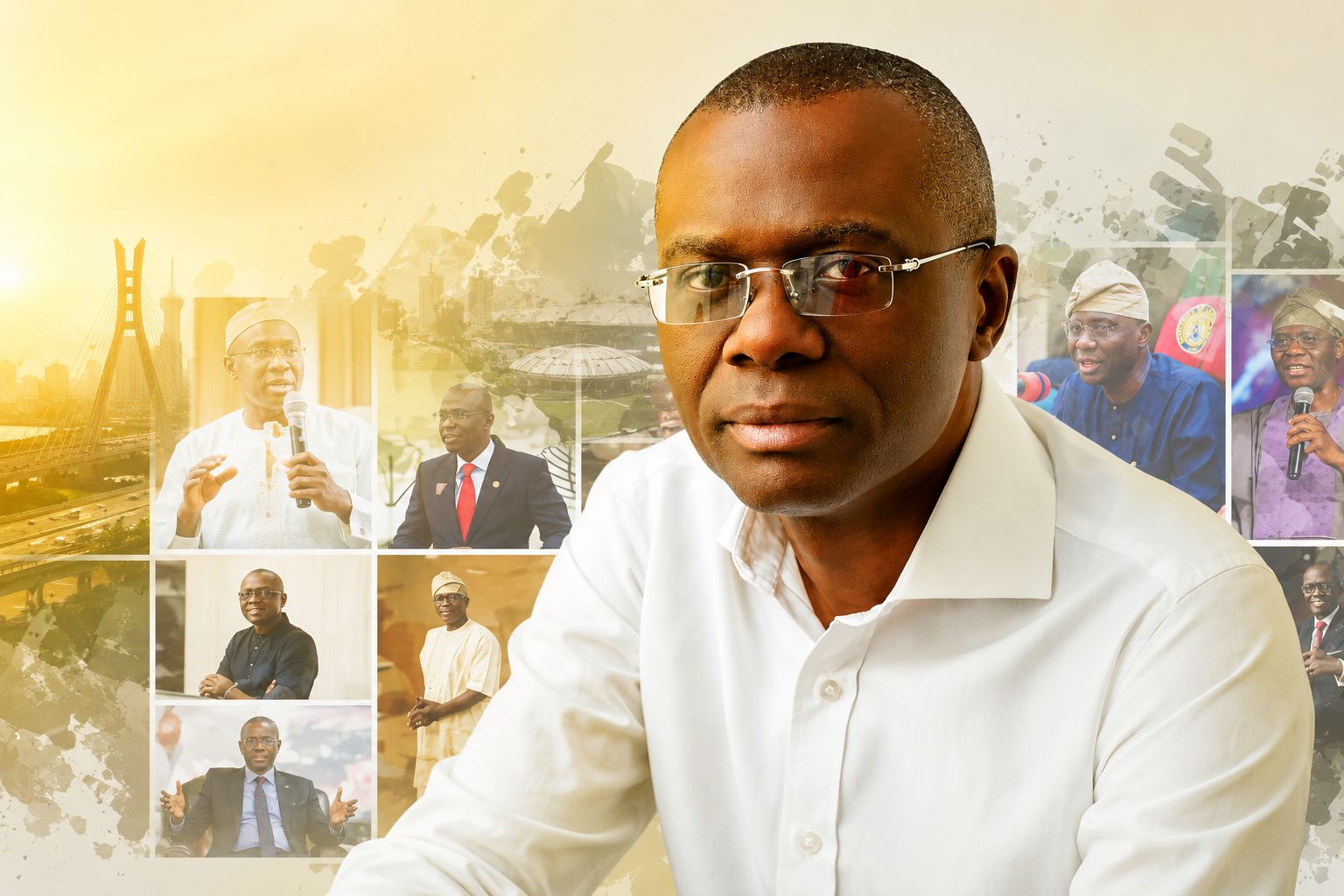
There are few cities in the world that arrive before you even set foot in them. Mention Lagos in London, Atlanta or Johannesburg and the reaction is almost immediate. People speak of endless traffic, noise and disorder. Yet in the same breath, they talk about creativity, ambition and opportunity. Lagos has always lived within that contradiction.
For the Governor of Lagos State, Babajide Sanwo-Olu, that contradiction is not a weakness. It is Lagos’ identity. Speaking during a reflective conversation on Afropolitan’s podcast stage, he described Lagos as a city of seeming confusion that somehow produces extraordinary possibility.
According to him, people everywhere ask the same question: What is Lagos really like? The answer, he suggested, often begins with two competing images. On one side is congestion and chaos. On the other is movement, creativity and energy. “You see people running and you wonder what is chasing them,” he said.
YOU CAN ALSO READ: Africa’s Future Depends on Ownership, Not Extraction, Says BUA Chairman
Yet beneath that movement lies something more difficult to explain. People may not immediately see where Lagos’ wealth comes from, but they can feel it. It exists in marketplaces, cafés, universities and among ordinary people pursuing extraordinary dreams. That energy, Sanwo-Olu argued, is what makes Lagos different.
Only Lagos, he suggested, can make someone wake up and discover a film production taking place on their street or unknowingly work beside the next global music star. The city thrives on unpredictability and possibility.
The governor pointed to Lagos’ expanding influence in entertainment, fashion and major cultural experiences as evidence of that identity becoming impossible to ignore. Under his administration, Lagos has hosted record-breaking concerts, global sporting events and cultural showcases attracting worldwide attention.
He recalled the E1 electric boat racing series, which many initially doubted Lagos could successfully host. Months before the event, skeptics questioned whether the city could deliver at international standards. Eventually, Lagos exceeded expectations and delivered one of the strongest editions of the event.
For Sanwo-Olu, moments like that represent the spirit of Lagos. It is a city constantly attempting what others consider unrealistic. Whether through entertainment, entrepreneurship or innovation, Lagos has developed a culture of stretching beyond perceived limits.
He believes that same spirit exists in its people. For every globally recognised star like Burna Boy, Wizkid or Davido, he said there are thousands of equally talented individuals waiting for visibility and opportunity. Their stories have simply not been written yet.
But creativity alone, he argued, is not enough. While culture and storytelling may attract global attention, infrastructure ultimately closes the deal. Investors may arrive because of the city’s energy, but they stay because of practical realities—transport systems, event spaces, security and institutional support.
Creativity opens the conversation, he explained. Infrastructure completes it. Government therefore has a responsibility to provide the systems that allow ambition to scale.
Perhaps the most revealing moment came when discussion turned toward a long-standing tension between creatives and government. Many creators see government as an obstacle rather than a partner. Sanwo-Olu acknowledged that criticism directly.
Trust, he argued, cannot be demanded; it must be earned through consistency. Governments are often among the least trusted institutions, meaning policies and engagement must repeatedly prove sincerity over time.
Still, he insisted creators also have responsibilities. Government alone does not possess all the answers. Its role is to create space, while innovators and creatives continue pushing ideas forward. “We’re two sides of the same coin,” he said.
The governor also offered a rare glimpse into the pressure of governing a city of more than twenty million people. Emergency calls, crises and constant decision-making remain part of daily life. In Lagos, a ringing phone can instantly signal trouble.
YOU CAN ALSO READ: Talent Deficit Threatening Africa’s Economic Prosperity – And Its Way Forward
Yet beyond emergencies, he said one issue concerns him even more: complacency. If there is anything capable of slowing Lagos’ momentum, it is becoming comfortable with small successes.
Creatives cannot stop innovating. Government cannot stop improving. And Lagos itself cannot stop evolving.
Ten years from now, Sanwo-Olu hopes Lagos will become more than Nigeria’s commercial capital. He wants it to become a global benchmark-a city people immediately associate with opportunity and growth.
“If you can do it well in Lagos,” he said, “then you can do it well anywhere.”
That aspiration may sound ambitious. But ambition, perhaps more than anything else, has always been Lagos’ native language.