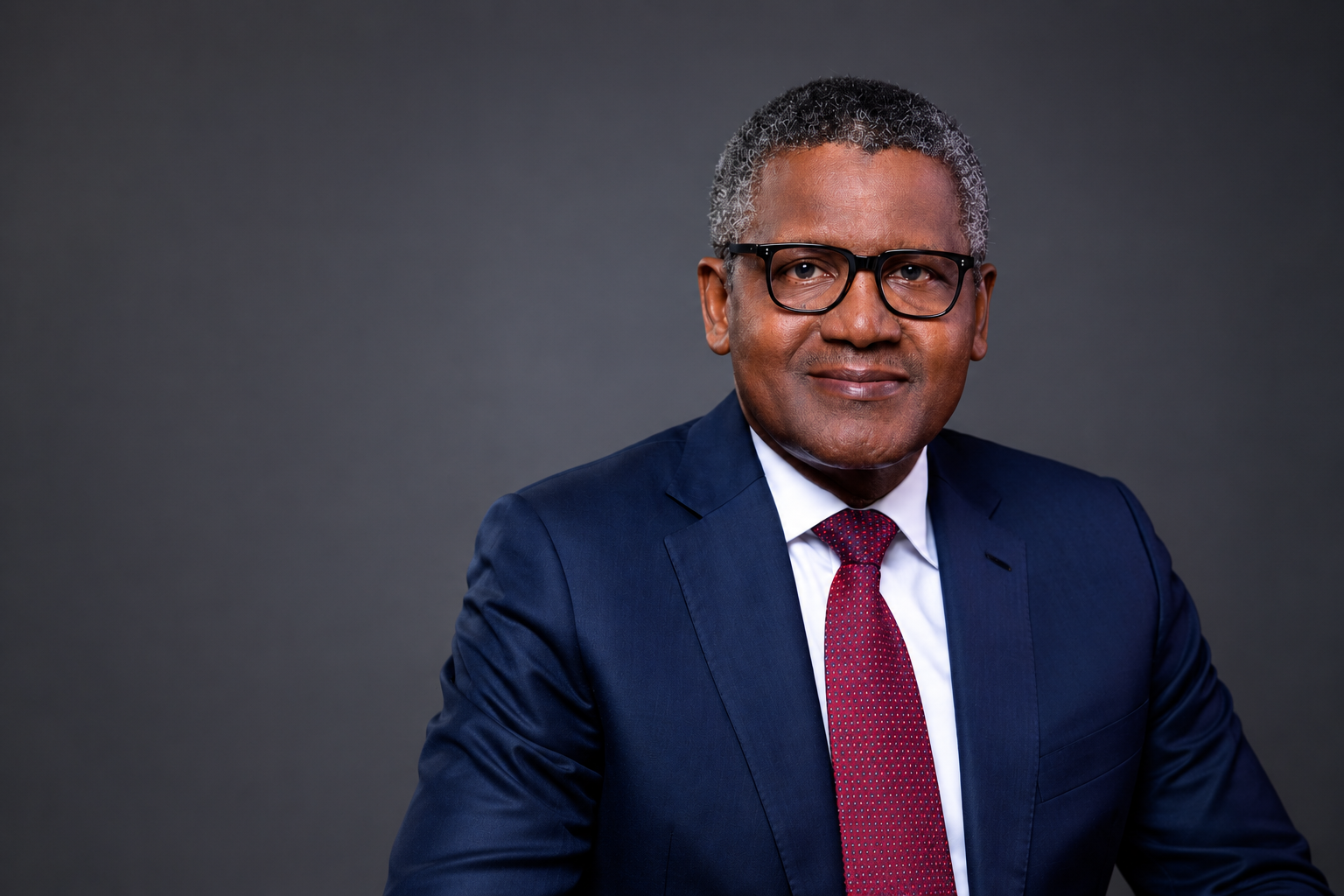
In a wide-ranging and deeply revealing conversation on In Good Company, hosted by Nicolai Tangen, Chief Executive Officer of Norges Bank Investment Management, Africa’s most influential industrialist, Aliko Dangote, reflects on a journey that has reshaped the industrial imagination of an entire continent.
What begins as a modest trading story in Lagos evolves into a sweeping account of industrial ambition at continental scale.
Dangote recalls his earliest steps in business, moving cement in small quantities across Lagos before expanding into sugar, rice, and other essential commodities. What stands out is not just diversification, but discipline. He attributes much of his grounding to a family legacy of trade stretching back generations, where business was not flamboyant but methodical, structured, and deeply principled.
That foundation, he explains, became the backbone of a philosophy that now governs one of Africa’s largest conglomerates, spanning cement, fertiliser, petrochemicals, logistics, and energy infrastructure across multiple countries. At the heart of the conversation is a simple but powerful idea: scale is not accidental, it is designed.
YOU CAN ALSO READ: Jensen Huang Tells Graduates to “Run, Don’t Walk” Into the AI Revolution
Dangote speaks candidly about the realities of building in Africa, where ambition often collides with structural friction. He references regulatory resistance, entrenched interests, and what he describes as deeply embedded “systems of control” that often slow transformative projects. Yet his tone is not frustration but persistence.
The most defining illustration of this mindset is the $20 billion refinery project in Nigeria, a facility designed to be the largest single-train refinery in the world. The project demanded not only capital but the creation of entirely new infrastructure ecosystems, including ports capable of handling 3,000-ton equipment, extensive road networks, and massive water treatment systems.
At its peak, the project involved more than 67,000 workers. It became less a construction site and more a temporary industrial city.
Dangote admits that had he fully understood the scale and complexity from the outset, hesitation might have set in. Instead, progress unfolded step by step, driven by necessity, problem-solving, and a refusal to retreat.
The refinery, now operational and expanding, represents more than engineering success. It represents a structural shift in Africa’s role in global energy markets, moving from exporter of crude to producer of refined value.
A central pillar of Dangote’s strategy is backward integration, the principle of producing locally what is currently imported. This philosophy underpins operations in cement, sugar, fertiliser, and now energy products. It is not just a business model but an economic argument for self-reliance and resilience.
Across 14 African countries, the group’s cement operations alone have reshaped supply chains, stabilised pricing in some markets, and expanded industrial access in regions previously dependent on imports.
In fertiliser and petrochemicals, demand has surged beyond initial projections, positioning the group as a key supplier in global markets, particularly as geopolitical tensions reshape energy and agricultural supply chains.
Dangote also reveals a strategic shift in financial structure, increasingly positioning parts of the business for export-linked revenue streams. With up to 80 percent of revenue in foreign currency in certain segments, the group is actively reducing exposure to domestic currency volatility and improving investor confidence.
Beyond expansion, however, lies deliberate simplification. Dangote describes the decision to sell overseas properties and centralise focus in Africa as a conscious effort to eliminate distractions and reinforce long-term execution.
His routine reflects this philosophy. He rises at 5 a.m., works through structured schedules, and maintains an intense operational involvement that blurs the line between leadership and execution. He describes his work not as obligation but as personal engagement, stating that business itself functions as his primary interest.
The broader macroeconomic vision discussed in the interview is equally ambitious. Dangote argues that Africa stands at the centre of the next global growth cycle, driven by three primary forces: a young and rapidly expanding population, vast untapped natural resources, and a significant infrastructure deficit that now represents opportunity rather than limitation.
He highlights countries such as Nigeria, Ethiopia, Kenya, Tanzania, Rwanda, Egypt, Ghana, and others as emerging industrial anchors, each at different stages of transformation but moving toward greater industrial capacity.
A key theme in the discussion is the shifting global investment landscape. China’s dominant role in African infrastructure is acknowledged, particularly its ability to deploy capital through long-term credit frameworks tied to equipment and construction. However, Dangote also notes a gradual re-engagement by Western and Asian capital providers, including increasing interest from United States development finance institutions and Japanese stakeholders.
This evolving dynamic, he suggests, is turning Africa into a competitive investment frontier where governments and corporations must now actively negotiate for capital rather than passively receive it.
Despite this optimism, Dangote does not ignore structural challenges. Infrastructure gaps remain significant. Policy consistency varies across markets. Inequality persists as a critical issue requiring coordinated public and private intervention.
Yet his conclusion is rooted in responsibility rather than constraint.
YOU CAN ALSO READ: Inside Lagos’ Game of Money 3.0: A New Blueprint for Salary Earners
The transformation of Africa, he argues, will not be delivered externally. It must be built internally through coordinated action between governments, entrepreneurs, and long-term institutional capital.
Through the Dangote Group and his foundation’s philanthropic initiatives, including health, education, and disease eradication programs, Dangote positions business not only as an engine of profit but as a structural instrument of development.
For Tangen, whose institution, Norges Bank Investment Management, invests across global markets including emerging economies, the conversation offers a rare window into how industrial ambition and global capital intersect at scale.
Ultimately, the interview returns to a singular idea that frames the entire dialogue: Africa is not short of potential, it is in transition toward execution.
Dangote’s ambition is not simply to build companies, but to help build a continent capable of producing what it consumes, financing what it builds, and sustaining its own industrial future.