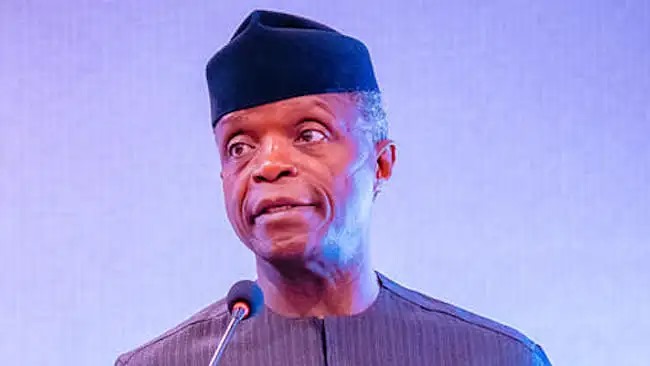
At a major Christian leadership gathering, former Vice President of Nigeria, Prof. Yemi Osinbajo, delivered a sweeping and deeply reflective address on Christian leadership, capacity building, and the transformative power of the gospel, arguing that the effectiveness of believers in leadership roles depends not merely on presence in positions of influence, but on spiritual depth, doctrinal clarity, and practical alignment with the teachings of Jesus Christ.
He opened by expressing appreciation to the host pastor, Pastor Charles Osazuwa of the Rock of Ages Christian Assembly, commending both the early invitation and the organisational discipline behind the event. From there, he transitioned into what became a wide-ranging theological and socio-economic discourse on leadership formation within the Christian faith.
Osinbajo defined capacity building for Christian leaders as the intentional equipping of believers with the tools, knowledge, and spiritual maturity required to succeed in their assignments, stressing that the ultimate purpose is transformation. In his framing, leadership development is not an end in itself, but a process that produces individuals who can, in turn, transform others.
He anchored his message in scripture, citing the example of Peter and John in Acts, noting that their boldness despite limited formal education demonstrated the power of divine formation over human credentials. According to him, true capacity building produces leaders so impacted by Christ that their lives become evidence of spiritual transformation.
The former Vice President argued that Christian leadership carries a universal mandate across all sectors, including politics, business, education, and public service. He stressed that every believer, regardless of profession, is called to influence society through the principles of the gospel. Even roles often considered minor, he said, hold spiritual significance because they contribute to how the gospel is reflected in everyday life.
He further grounded his argument in the Great Commission, stating that the command to disciple nations is not symbolic but practical and far reaching. For him, the Christian mission extends beyond personal salvation into societal transformation, requiring active engagement in systems and institutions.
A significant portion of his address focused on the historical influence of Christianity on Western civilisation. He argued that principles such as hard work, integrity, education, justice, and care for the vulnerable, largely propagated by early Christian movements like the Puritans, played a decisive role in shaping modern Europe and America. These values, he said, moved from pulpits into public life and became the foundation for institutional development.
He referenced historical accounts, including Japanese observations during the Meiji era, to illustrate how external societies recognised Christianity as a foundational pillar of Western progress. In his view, this historical evidence underscores the capacity of the gospel, when properly understood and practiced, to transform entire nations.
However, Osinbajo cautioned that this transformative power is dependent on the integrity of the message being preached. He warned against what he described as distortions of the gospel, particularly teachings that overemphasise material wealth and bypass the central demands of sacrifice, service, and righteousness.
He argued that when leaders operate with a diluted understanding of Christianity, especially one centred on material gain, they lose the ability to influence society meaningfully. According to him, genuine Christian leadership requires embracing a gospel that prioritises service, humility, and moral responsibility over personal enrichment.
Turning to the teachings of Jesus, Osinbajo highlighted what he described as the counter cultural nature of the gospel. He referenced biblical injunctions on loving enemies, rejecting revenge, and prioritising the Kingdom of God over material possessions, noting that these principles often contradict natural human instincts and modern success ideologies.
He warned that contemporary emphasis on wealth accumulation risks overshadowing the core message of the gospel. In his words, wealth is not condemned in itself, but becomes dangerous when it competes with devotion to God.
The address also examined the biblical foundations of work, integrity, and economic productivity. Osinbajo emphasised that work is a divine principle rooted in creation, and that human beings, made in the image of God, are designed for creativity, productivity, and value creation. He cited scripture to reinforce the idea that diligence and consistent labour are central to prosperity.
He contrasted this with what he described as a growing trend of messages that promote miraculous wealth without corresponding emphasis on work and discipline. Such teachings, he argued, undermine economic development and distort biblical principles of prosperity.
Integrity, he noted, is equally essential. Drawing from biblical teachings on honesty, repayment of debt, and fair dealing, he explained that trust forms the foundation of all functioning economies. Without integrity, he warned, systems of credit, commerce, and governance collapse.
Osinbajo also highlighted historical Christian contributions to social welfare systems, pointing to early church practices of caring for widows, orphans, the poor, and the sick. He noted that these practices laid the groundwork for modern welfare structures in Europe and America, including hospitals, shelters, and public assistance systems.
He referenced early Christian responses to plagues and societal crises, where believers often remained behind to care for the sick at great personal risk. According to him, these actions demonstrated that Christian leadership is rooted in sacrifice rather than privilege.
A key theme in his address was the call for active participation in society. Drawing from personal experience as a public servant, he illustrated how engagement within systems is necessary for meaningful influence. He recounted an early experience as Attorney General of Lagos State, where he realised that transformation requires presence, not distance.
He concluded that Christian leaders cannot influence systems they refuse to enter. For him, leadership is not theoretical but practical, requiring believers to be present in governance, business, and public life to serve as agents of change.
Osinbajo ended with a reaffirmation of the Christian leader’s responsibility to embody truth, justice, and service, insisting that the credibility of the gospel in society depends on the character and engagement of those who represent it.