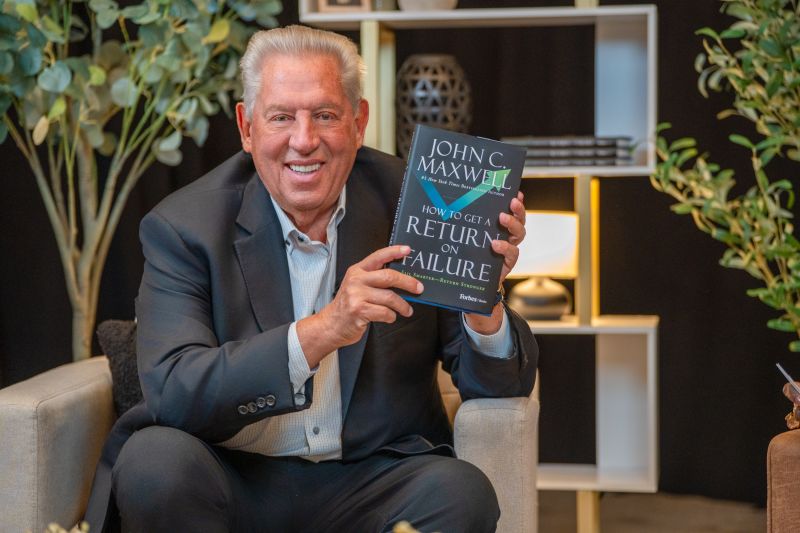
In a wide-ranging and deeply reflective conversation, leadership expert John Maxwell reframed one of the most universal human experiences, failure, not as an endpoint or identity marker, but as a powerful catalyst for growth, resilience, and transformation. Speaking during a special dialogue marking the launch of his latest book How to Get a Return on Failure, Maxwell challenged long-held assumptions about mistakes and setbacks, urging individuals, leaders, and parents to rethink how they interpreted and responded to failure in every sphere of life.
The conversation, moderated by Valerie Burton, unfolded through audience questions that touched leadership, parenting, confidence, emotional resilience, and personal growth. Across each exchange, Maxwell returned to a central conviction that shaped his philosophy, perspective determined outcome. For him, failure was never the defining moment, but the interpretation of that moment was.
At the core of his message was a distinction he returned to repeatedly. Failure, he argued, was an event, not an identity. This separation, he suggested, was essential for people who struggled with shame, fear of judgment, or hesitation after setbacks. When individuals confused failure with who they were, they stopped taking risks. When they saw it as an experience instead, they began to learn, adapt, and grow.
Maxwell explained that early in his journey, he often rushed to escape failure because of embarrassment. He would withdraw quickly, avoid scrutiny, and move on without fully understanding what went wrong. Over time, however, he discovered a counterintuitive truth. Leaving failure too early prevented learning, while staying with it long enough transformed it into insight.
He emphasized that failure only became valuable when it was engaged rather than avoided. If individuals left failure early, they did not learn. If they stayed, they improved. This shift, he noted, was what turned repeated mistakes into meaningful progress.
The conversation took a personal turn when parenting was introduced. Maxwell openly reflected on his early tendency to shield his children from failure, an instinct rooted in protection but ultimately limiting in impact. He acknowledged that while the intention was love, the outcome sometimes reduced opportunities for growth. Over time, he changed his approach, allowing his children to experience setbacks, take responsibility, and learn through consequence.
With his grandchildren, he described a more intentional philosophy, one that embraced failure as part of development rather than something to be avoided. In his view, resilience was not inherited, it was developed through experience.
Leadership emerged as another major theme. Maxwell challenged the idea that effective leaders must always be confident or certain. Instead, he described leadership as a journey often taken without complete clarity. Leaders, he argued, were frequently responsible for guiding people into situations they themselves were still figuring out.
This, he said, was why authenticity mattered more than perfection. Leaders earned trust not by appearing flawless, but by being honest, adaptable, and willing to adjust direction when necessary. He even described what he called a “U-turn leadership” mindset, the willingness to admit mistakes, correct course, and move forward transparently rather than pretending certainty.
A key transformation he highlighted was the shift from the question “Can I?” to “How can I?” According to Maxwell, “Can I?” was rooted in doubt and hesitation, while “How can I?” signaled commitment and action. The shift was subtle but powerful, moving individuals from uncertainty into problem-solving and momentum.
Throughout the discussion, Maxwell emphasized that action was the bridge between failure and learning. Without action, failure became stagnation. With reflection and movement, it became growth. He argued that people often underestimated the importance of simply starting, even imperfectly, as the first step toward improvement.
Another recurring theme was humility. Maxwell repeatedly described himself not as an expert standing above others, but as a fellow traveler still learning from experience, conversation, and observation. Even at 79, he insisted his learning process was ongoing. Every person, he said, carried something valuable to teach.
He also challenged the modern tendency to over-focus on perfection and curated success, particularly in public discourse. In his view, this created unrealistic expectations and isolated people in their struggles. Authentic stories of failure, he suggested, were what truly connected people, because they revealed shared humanity rather than distance.
As the conversation drew to a close, Maxwell reflected on aging, legacy, and purpose with a sense of continued momentum rather than finality. He rejected the idea of a finish line in life, instead describing a philosophy of continuous movement, learning, and contribution.
For him, failure was not something to fear or avoid, but something to understand and work with. When approached with the right perspective, it became a teacher, a guide, and ultimately a pathway to improvement.
The central message of the conversation was both simple and profound. Failure did not define who people were. Their response to it did.