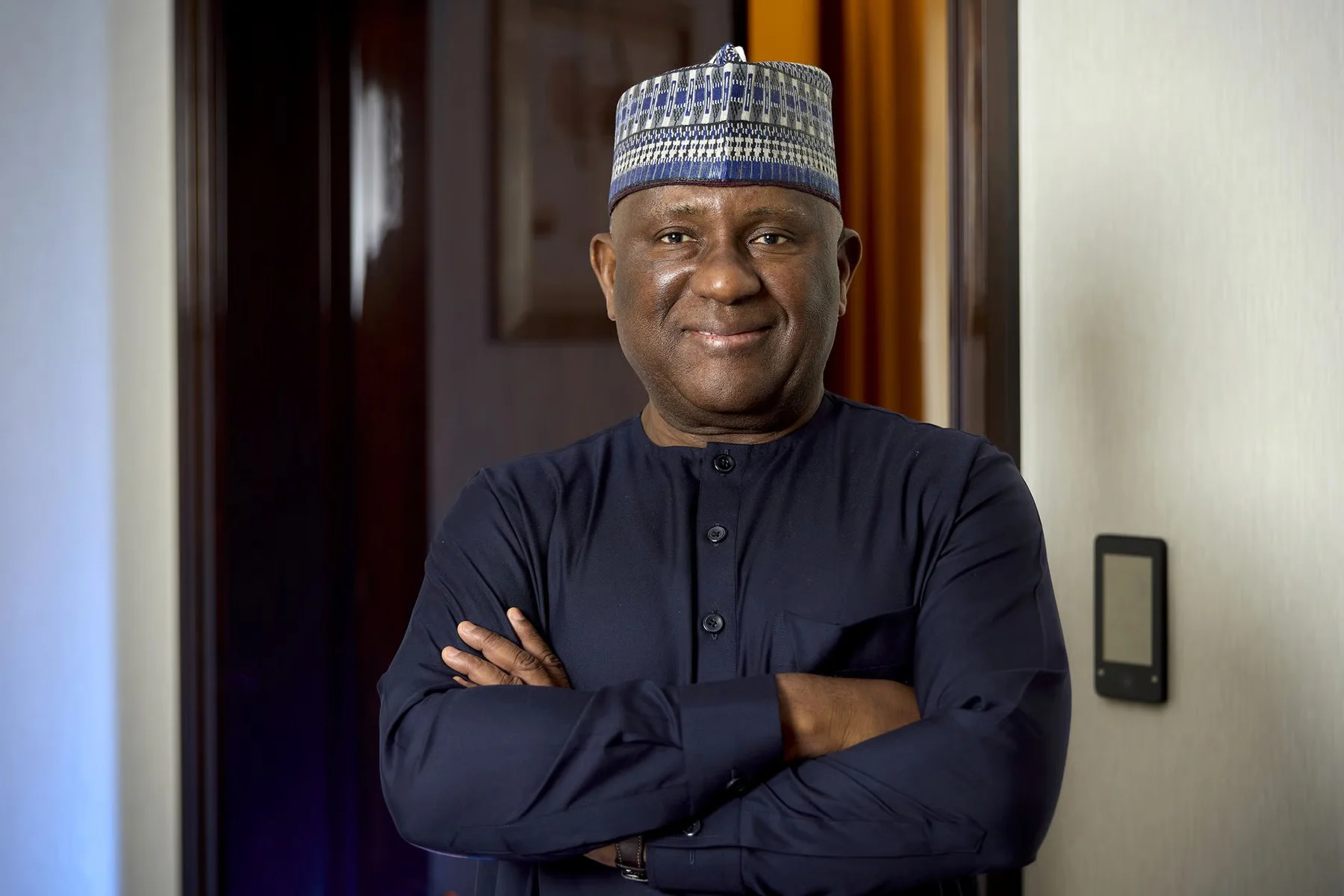
As global leaders, policymakers and business executives gathered in Nairobi for one of Africa’s most consequential conversations on economic transformation, one message stood out with unusual clarity: Africa can no longer afford to remain a continent rich in resources yet poor in value creation. For the Chairman/CEO of BUA Group, Abdulsamad Rabiu, the conversation about Africa’s future is no longer about potential. It is about execution.
Speaking during high level engagements that brought together more than 30 heads of state and over 40 leading business executives from across the continent, Rabiu laid out what may be one of the clearest business cases for Africa’s next growth chapter: capital, policy, integration and value addition. These, he argued, are not abstract development concepts. They are the foundations upon which Africa’s economic transformation must be built.
The gathering, convened by Emmanuel Macron and William Ruto in Nairobi, sought to deepen collaboration between African nations and global partners while addressing structural barriers slowing the continent’s rise. For Rabiu, however, the conversation repeatedly returned to one fundamental challenge: Africa exports too much of its wealth and retains too little of its value.
YOU CAN ALSO READ: How Jude Anele is Positioning NOVA Bank for Nigeria’s Banking Future
“Africa has resources, but resources alone do not create prosperity,” his remarks suggested. “Prosperity comes when those resources are transformed, processed and converted into products that generate wealth, jobs and industrial capacity.” His most compelling example came from cocoa.
Four West African nations — Ivory Coast, Ghana, Nigeria and Cameroon — collectively produce approximately 75 percent of the world’s cocoa supply. Yet despite feeding a global industry worth roughly $200 billion annually, Africa captures only a small fraction of that value. The imbalance, in Rabiu’s view, illustrates one of the continent’s greatest economic contradictions. The raw materials originate in Africa. The wealth largely does not.
For decades, African economies have relied heavily on exporting commodities in their unprocessed form, from agricultural produce and minerals to energy resources. The result has often been limited industrialisation, constrained job creation and weak domestic value chains. Rabiu believes that model must change. Instead of exporting raw commodities, he argues that Africa must process, refine and manufacture at home. By doing so, countries can capture larger portions of global value chains and create stronger domestic industries.
His argument is not theoretical. He points to Nigeria’s cement industry as proof that strategic policies and deliberate industrial planning can fundamentally alter economic outcomes. Fifteen to twenty years ago, Nigeria depended heavily on imported cement, with imports accounting for nearly 90 percent of domestic consumption. Today, the country has transformed into a net exporter.
That transition did not happen by chance. It was driven by policy decisions that encouraged local production, domestic sourcing of limestone and investments in industrial capacity. The result has been increased manufacturing output, job creation, reduced pressure on foreign exchange and the emergence of Nigeria as one of Africa’s leading cement markets. For Rabiu, the lesson is straightforward: when countries process local resources domestically, they create ecosystems of value rather than merely exporting opportunity.
Yet industrialisation alone, he argues, cannot unlock Africa’s full potential. Integration is equally critical. Even as African economies seek stronger collaboration, structural barriers continue to limit movement across the continent. Trade restrictions, fragmented regulations and visa requirements continue to create friction for businesses attempting to operate across borders.
Rabiu referenced a point made by Aliko Dangote, who noted the complexity of needing multiple visas to travel across African countries. The observation highlighted a broader issue. If business leaders face barriers moving across Africa, scaling trade and investment becomes significantly more difficult.
For Rabiu, economic integration is not merely a diplomatic aspiration. It is a business necessity. A more connected Africa would enable larger markets, deeper partnerships and more efficient movement of goods, talent and capital. And for Nigeria, the opportunities could be particularly significant.
With approximately 30 to 35 percent of the world’s mineral resources located within Africa, Rabiu believes the continent possesses immense untapped potential. Yet much of that potential remains underutilised because raw materials continue to leave African shores with little domestic processing. Greater collaboration among African nations, he argues, could alter that equation. The vision is not limited to trade alone. It extends to building stronger ecosystems around investment, innovation and industrial development.
That broader vision was reflected in another major moment during the gathering: the launch of Africa House in Paris. The initiative, championed by President Macron, seeks to create a dedicated platform where Africans can connect, collaborate and build partnerships across business, culture, innovation and enterprise.
Rabiu played a central role in the launch, serving as one of the project’s lead champions. What made the initiative especially notable was its ownership structure. Rather than positioning Africa House as a French government project, the concept was designed to be supported and driven by African business leaders themselves. France provided the platform. Africans would build the institution.
For Rabiu, the symbolism was powerful. Africa House represents more than a building in Paris. It reflects a growing recognition that African voices, businesses and institutions increasingly require spaces that facilitate dialogue, partnerships and global engagement on their own terms.
The project also reflects a broader shift occurring across the continent. Africa is no longer content with participating only at the margins of global economic conversations. Increasingly, African business leaders are seeking to shape those conversations directly.
YOU CAN ALSO READ: “Money Must Be Managed, Not Wasted” – Africa’s Richest Woman Warns
That evolution mirrors Rabiu’s wider outlook. His vision for Africa is built not around dependency but around capacity. Not around exporting raw abundance, but around creating enduring value.
The message is increasingly resonating across boardrooms and policy circles. Africa possesses abundant natural wealth. It has one of the world’s youngest populations. It holds immense entrepreneurial energy and strategic relevance within the global economy. But resources and demographics alone are not enough.
Without capital to finance ambition, policies that enable growth, integration that unlock markets and industries capable of creating value, potential can remain permanently unrealised. For Rabiu, the path forward appears increasingly clear. The question is no longer whether Africa has what it takes to compete. The question is whether the continent is ready to fully process, connect and build its own future.