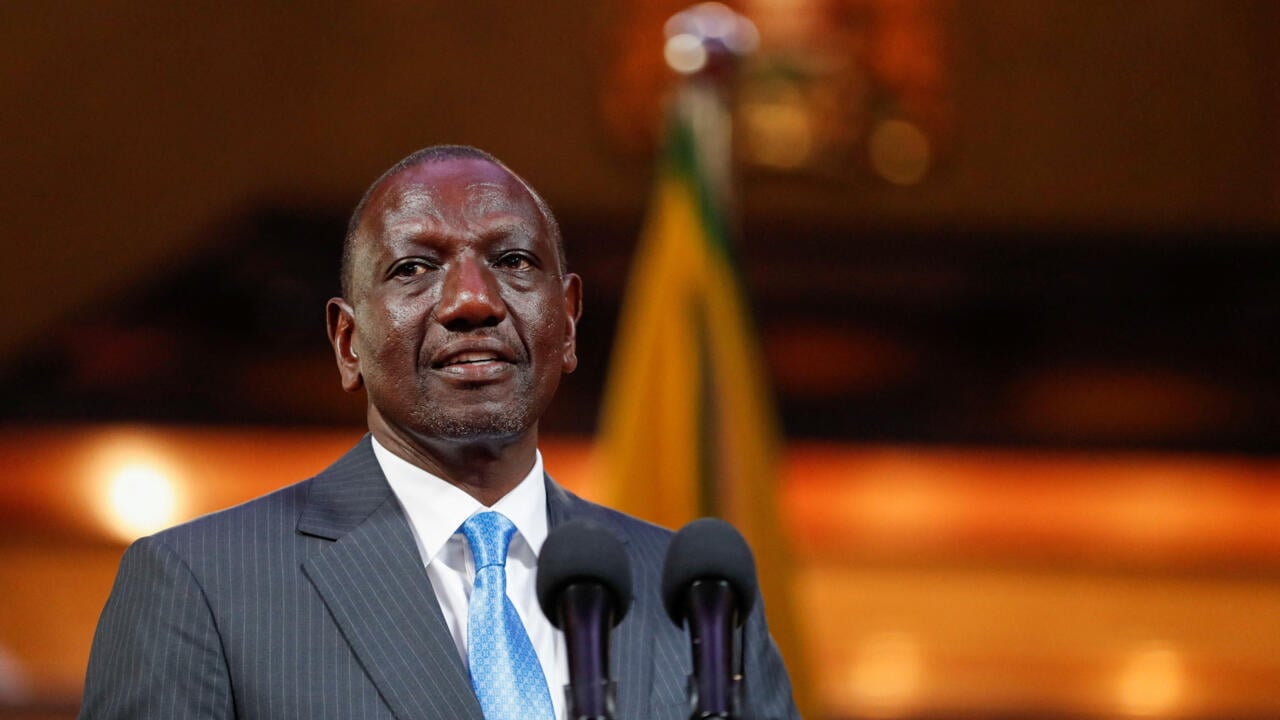
At the Africa Forward Summit 2026 in Nairobi, Kenya’s President William Ruto did more than deliver a diplomatic address. He issued a declaration of economic independence for a continent determined to redefine its place in the world.
Standing before heads of state, investors, policymakers, and global business leaders at the Kenyatta International Convention Centre, Ruto presented a bold vision for Africa’s future, one rooted not in aid, dependency, or extraction, but in industrialization, financial sovereignty, and strategic investment.
His speech carried the tone of a continent tired of being described through the language of crisis and eager instead to be recognized as the center of the next era of global growth.“Africa is not part of the global problem,” Ruto declared. “Africa is in fact the solution to the global challenges that exist today.”
It was one of the defining moments of the summit and perhaps one of the clearest articulations yet of the emerging African economic philosophy now reshaping political conversations across the continent.
YOU CAN ALSO READ: Jensen Huang Tells Graduates to “Run, Don’t Walk” Into the AI Revolution
The summit itself was framed around a central question: how can Africa industrialize at scale in a way that is sustainable, inclusive, and globally competitive while building partnerships based on equality rather than historical imbalance?
For Ruto, the answer begins with changing the entire framework through which Africa engages the world. For decades, development discussions around Africa have often centered on foreign aid, debt dependency, and external intervention. Ruto argued that this era must end.
“The age in which Africa’s development was principally framed through aid, dependency, and unsustainable borrowing must give way to a new paradigm grounded in investment, innovation, domestic resource mobilization, and strategic partnerships built on sovereign equality and mutual benefit,” he said.
The address signaled a broader shift underway among African leaders seeking to reposition the continent not as a recipient of global generosity but as an equal participant in shaping the future global economy.
Throughout the speech, Ruto repeatedly emphasized one idea: Africa possesses the resources necessary to finance its own transformation. He pointed to the continent’s vast reserves of natural resources, critical minerals, renewable energy potential, expanding consumer markets, and perhaps most importantly, its youthful population. By 2050, he noted, one in every four people on earth will be African.
“That reality alone,” he said, “will shape the future of labor, markets, urbanization, energy demand, and global economic growth.”
Yet despite this demographic and economic potential, Africa continues to face structural disadvantages within the global financial system. Ruto criticized what he described as deeply unequal international financing structures that impose high borrowing costs on African countries and discourage long term investment.
He argued that distorted global credit rating systems continue to penalize African economies unfairly, limiting access to affordable capital for infrastructure, industrialization, and climate adaptation.
“This imbalance is neither sustainable nor just,” he said. In response, Ruto championed the creation of an African credit rating agency designed to provide fairer and more context sensitive assessments of African economies. The proposal forms part of a wider push toward what he described as a new African financial architecture capable of reducing dependency on external financial institutions.
One of the most powerful sections of the address focused on a simple but transformative idea:
“Africa must increasingly finance Africa.” Ruto revealed that the continent currently holds more than $4 trillion in long term domestic savings, including over $1 trillion in pension and insurance assets and hundreds of billions in central bank reserves. The problem, he argued, is not a lack of capital but weak risk structures and fragmented investment systems.
This vision has already begun taking shape in Kenya itself. Ruto highlighted the country’s newly established National Infrastructure Fund, which reportedly mobilized nearly $1 billion within just four months. He also pointed to Kenya’s affordable housing initiative, which has generated close to $4 billion through domestic financing mechanisms over the last three and a half years.
For Ruto, these examples prove that African economies can mobilize substantial internal resources when institutions are credible and citizens become active participants in national development. The speech also reflected Africa’s growing ambition to industrialize beyond raw material exports.
For generations, African economies have largely functioned as suppliers of unprocessed commodities while higher value manufacturing occurred elsewhere. Ruto insisted that this model must be abandoned, particularly as the world transitions toward green energy and advanced technologies.
“Africa cannot accept a future in which it simply exports raw green minerals while industrial value addition and technological innovation take place elsewhere,” he declared. “That model belongs to the past.”
Instead, he envisioned Africa becoming a globally competitive industrial hub powered by renewable energy, advanced manufacturing, innovation, and regional trade integration.
The emphasis on green industrialization reflected a larger strategic ambition. Africa possesses some of the world’s greatest renewable energy potential, from geothermal energy in the Rift Valley to massive opportunities in solar, wind, hydroelectric power, and green hydrogen production.
For Ruto, the global climate transition presents Africa not only with an environmental responsibility but also with a once in a generation economic opportunity.
Equally central to his message was the role of Africa’s youth. In one of the speech’s most compelling sections, Ruto described Africa’s young population not as a demographic burden but as the continent’s greatest strategic advantage.
YOU CAN ALSO READ: ‘What’s the Worst That Can Happen?’- Anne Muraya’s Story From Accidental Intern to Deloitte CEO
“Our youth population is not a burden to be managed,” he said. “It is an extraordinary strategic advantage to be invested in.”
He spoke passionately about the rise of African innovation hubs from Nairobi to Lagos and Kigali to Cape Town, where young entrepreneurs are transforming industries through fintech, digital commerce, agricultural technology, and artificial intelligence.
But he warned that demographic potential alone is not enough. Without education, digital infrastructure, access to capital, and economic opportunity, Africa risks wasting one of the greatest human capital opportunities in modern history.
The speech also moved beyond economics into geopolitics and governance. Ruto criticized the imbalance in global power structures, particularly within the United Nations Security Council, where Africa still lacks permanent representation despite its 54 sovereign states and population of nearly 1.5 billion people.
“No global governance architecture can credibly claim to be democratic, representative, or just while a substantial part of humanity remains absent from the table where the world’s most consequential decisions are made,” he said.
His remarks reflected a growing frustration among African nations seeking greater influence within global institutions that continue to shape international security, trade, and finance.
Yet despite the criticism, Ruto’s tone throughout the address remained collaborative rather than confrontational. He repeatedly called for stronger partnerships with France and other global allies, but partnerships grounded in mutual respect, shared prosperity, and sovereign equality. “Africa does not seek confrontation,” he said. “Africa seeks partnership.”
That distinction mattered. At a time when geopolitical competition is intensifying between major powers across Africa, Ruto appeared determined to position the continent not as a battleground for external interests but as a confident and strategic actor capable of negotiating from a position of strength.
By the conclusion of the speech, it was clear that Ruto was articulating more than Kenya’s national agenda. He was giving voice to a broader continental movement increasingly focused on ownership, self determination, and economic transformation.
“The Africa we envision,” he said, “is an Africa of confidence, an Africa of ideas, an Africa of innovation, an Africa of enterprise, an Africa that believes in itself.”
It was a vision of Africa not waiting to be included in the future, but actively building it.
And in Nairobi, before a global audience, William Ruto made it unmistakably clear that Africa intends to move from the margins of the world economy to its very center.