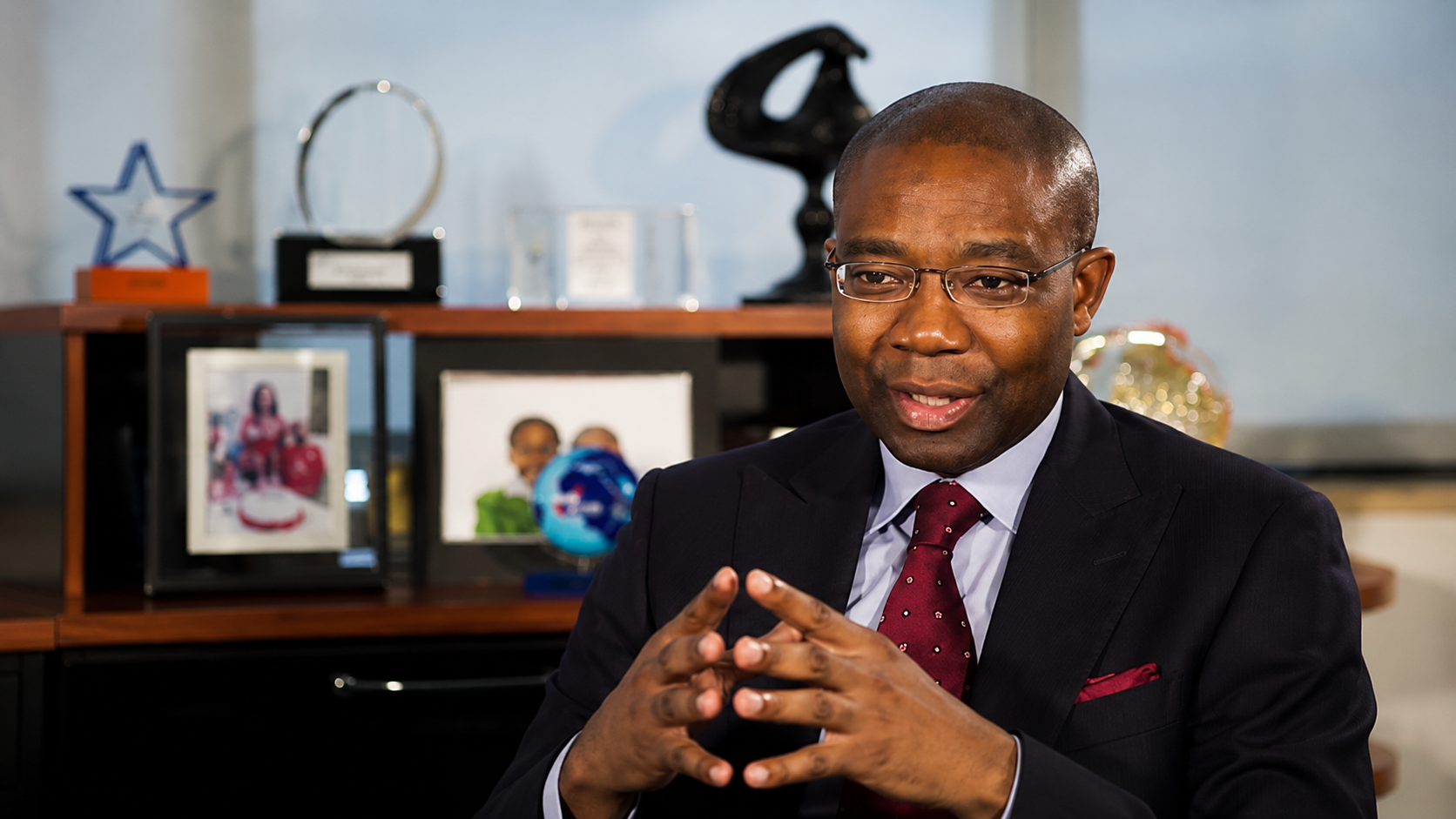
At the Africa Forward Summit 2026 in Nairobi, a gathering defined by urgency, ambition, and a rethinking of Africa’s place in the global order, few voices carried as much weight as that of the Chairman of Access Holdings and veteran Nigerian banker, Aigboje Aig-Imoukhuede. Speaking on the sidelines of the high-level forum at the University of Nairobi, he offered a clear, unembellished thesis: Africa is no longer asking to be included in the global economy, it is positioning itself to define it.
The summit itself, Africa Forward Summit 2026, has become a symbolic meeting point for policymakers, financiers, and industrial leaders wrestling with a central question: how does Africa transition from a resource-rich continent dependent on external capital to a self-directed engine of investment, innovation, and industrial value creation?
For Aig-Imoukhuede, the answer begins with perception but does not end there.
One of the most striking threads in his conversation was his insistence that Africa must reject outdated narratives of dependency. In his view, the continent is often miscast as a passive recipient of aid rather than a strategic partner in global progress.
YOU CAN ALSO READ: BUA Chairman Pushes New Growth Agenda for Africa
Africa, he argued, already contributes what the world increasingly lacks: a young and expanding workforce, entrepreneurial energy, cultural adaptability, and resilience forged through complex economic environments. Natural resources matter, he acknowledged, but the deeper competitive advantage lies in human capital.
“We should not be viewed as a continent that only needs help,” he suggested in essence, warning that overly charitable framing often obscures Africa’s real economic leverage. Instead, he positioned Africa as a demographic powerhouse that will supply much of the global labour force and innovation potential over the next three decades.
In this framing, Europe and Africa—particularly through evolving relationships such as Africa-France cooperation—are not donor and recipient, but potential equal partners in a shared economic future.
As Chairman of Access Holdings PLC, Aig-Imoukhuede placed special emphasis on the role of African financial institutions in shaping—not just funding—the continent’s development trajectory.
He described capital as “oxygen” for growth, but argued that the real responsibility of banks goes far beyond liquidity provision. In his view, Africa’s financial institutions must evolve into continental-scale enablers capable of mobilising large pools of capital across fragmented markets, expanding cross-border reach beyond national silos, developing deep technical and leadership talent, structuring financial products tailored to Africa’s development realities, and leveraging digital transformation and emerging technologies.
Access Holdings, he noted, already operates across multiple continents and plays an active role in executing and supporting major financial and development initiatives. But the broader message was sector-wide: African banks must scale up in ambition if they are to match the scale of Africa’s economic challenges.
No topic at the summit generated more tension between optimism and caution than artificial intelligence.
Aig-Imoukhuede acknowledged the widening gap between Africa and advanced economies in AI readiness, particularly in the development of national AI policies and regulatory frameworks. Fewer than a dozen African countries, he noted, have structured approaches to AI governance and deployment.
However, he resisted the narrative that African policymakers are indifferent or slow-moving. Instead, he located the challenge in competing priorities: many governments are still grappling with foundational issues such as energy access, food security, and infrastructure deficits.
For him, AI is undeniably transformative but also resource-intensive, requiring capital, skills, and institutional readiness that are unevenly distributed across the continent. The risk, he warned, is that the AI revolution could deepen global inequality if Africa is not adequately supported to participate.
Yet he also pointed to an underappreciated advantage: Africa’s energy potential. With growing demand for data centres and digital infrastructure, the continent’s oil and gas resources, particularly natural gas, could become strategic assets in powering the next wave of technological development.
Beyond technology, Aig-Imoukhuede widened the lens to global instability. He referenced how geopolitical tensions, including conflicts beyond Africa, can quickly ripple into African economies through inflation, trade disruption, and shifts in investor sentiment.
Even countries making progress on macroeconomic stability, he warned, remain exposed to external shocks that can reverse gains quickly.
This reality, he argued, strengthens not weakens the case for deeper international partnerships. But those partnerships, he stressed, must be grounded in mutual interest rather than asymmetric dependency.
A central pillar of his argument was the concept of a just transition in global climate and energy policy. Africa, he noted, contributes minimally to global emissions but bears significant pressure in climate negotiations.
At the same time, the continent holds substantial hydrocarbon reserves that remain essential for industrialisation and energy security.
He cautioned against policies that prematurely restrict Africa’s ability to develop its oil and gas sectors, arguing that natural gas in particular remains a critical bridge fuel for powering economies, industries, and even emerging technologies like AI.
YOU CAN ALSO READ: Nigeria’s Corporate Titans Post Strong Q1 2026 Earnings Despite Tough Economy
In his framing, Africa’s energy resources are not just export commodities but foundational infrastructure for development, capable of powering industrial growth, digital transformation, and universal electrification.
As conversations from Nairobi feed into broader global forums, including upcoming G7 discussions, Aig-Imoukhuede distilled Africa’s message into a simple but firm proposition: Africa is not a development burden; it is a strategic global asset.
The continent, he argued, is seeking three things from the world: investment, technology and infrastructure, and trusted long-term partnerships.
But the tone has shifted. Africa is no longer appealing for assistance; it is negotiating for collaboration.
Looking ahead, Aig-Imoukhuede expressed cautious optimism about Africa’s trajectory over the next two decades. While challenges remain significant, he pointed to growing institutional strength, expanding financial systems, and the increasing ability of African institutions like Access Holdings to mobilise capital and execute large-scale initiatives.
He emphasised that execution, not just ideas, will determine Africa’s future competitiveness.
Ultimately, his message from Nairobi was less about aspiration and more about readiness: Africa is building the architecture of its own future, and increasingly, it is doing so on its own terms while remaining open to partners who understand the new balance of power.