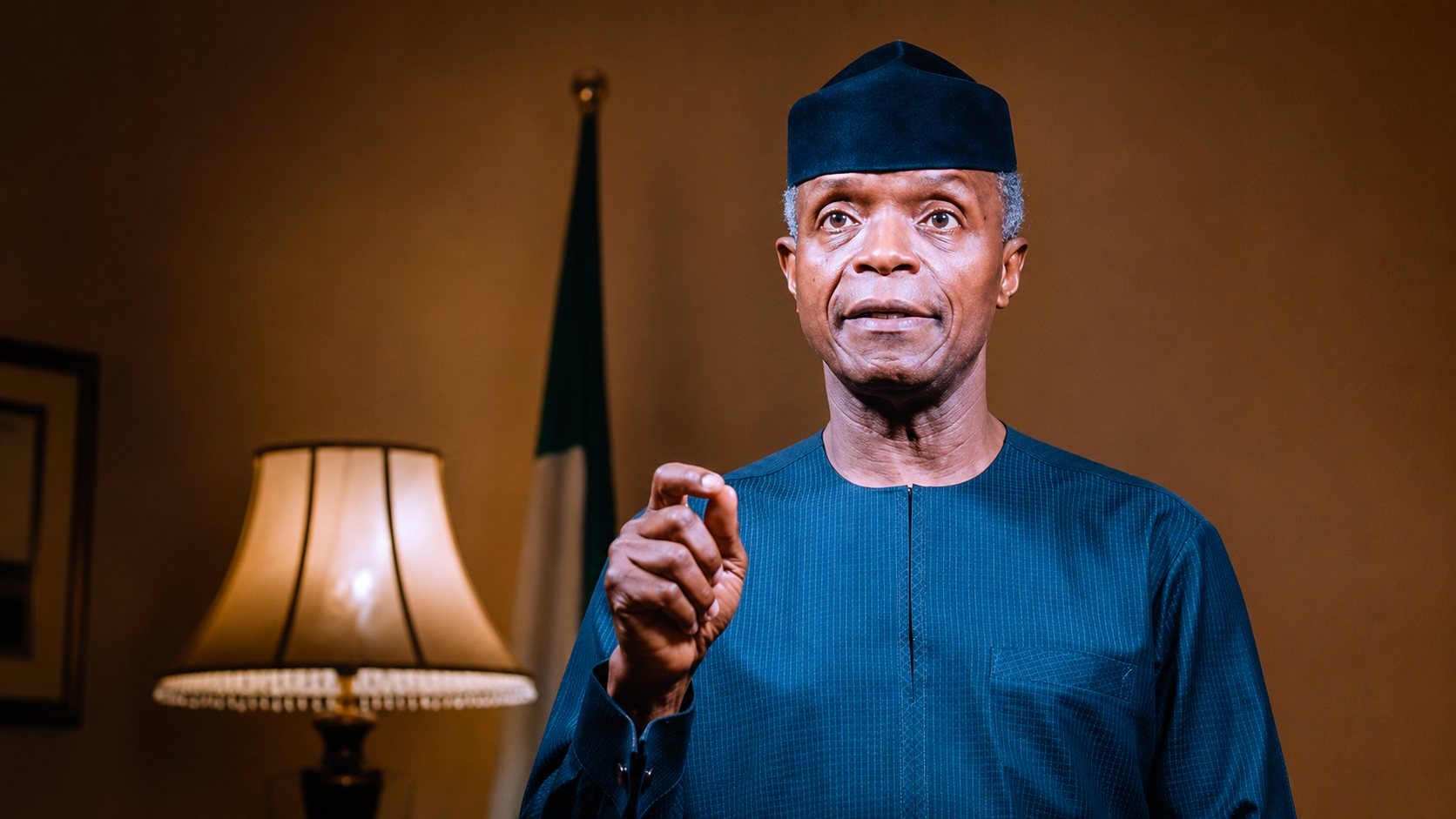
As artificial intelligence accelerates, social media platforms shape public discourse and digital technologies become inseparable from everyday life, a new question is emerging for governments, businesses and individuals alike. Who really controls the way we think?
For former Vice President of Nigeria, Prof. Yemi Osinbajo, SAN, the answer lies far beyond politics, economics or military power. It resides in the invisible algorithms that increasingly influence how billions of people see the world, form opinions and make decisions.
Speaking on the profound impact of technology on modern society, Osinbajo delivered a sobering reflection on what he describes as the defining struggle of the digital age. His message was not an attack on technology itself but a call for discernment in a world where attention has become the most valuable commodity and human consciousness the ultimate prize.
According to Osinbajo, humanity has entered an era unlike any before it. Today, more than five billion people are connected to the internet, placing nearly the entire global population within the reach of a handful of technology companies.
YOU CAN ALSO READ: After 52 Years in Business, Ayodele Ogundele Says Trust Is Every CEO’s Greatest Risk
These corporations, he argued, possess an unprecedented concentration of power, one that extends beyond financial dominance into the very architecture of human behaviour.
Unlike previous industrial giants, today’s technology platforms do not merely collect names, addresses or demographic information. They gather behavioural data on an extraordinary scale. Every click, every search, every purchase, every video watched, every location visited and every interaction contributes to an ever-expanding digital profile.
Equally valuable are the social networks people build online. Technology companies know who users interact with, what communities they belong to and what ideas they engage with most frequently.
To Osinbajo, this combination of global reach, behavioural intelligence and control over critical digital infrastructure represents one of the greatest concentrations of influence in human history.
“A digital kingdom is here with its own leadership,” he observed, describing an ecosystem that quietly underpins economies, governments and everyday human interaction.
While billions of people log into platforms such as YouTube, TikTok and other digital services each day, few pause to consider how those experiences are curated.
Every swipe, recommendation and video suggestion appears effortless, yet behind each interaction sits an algorithm designed with a specific objective. According to Osinbajo, that objective is rarely the pursuit of truth. Instead, it is the pursuit of attention.
These algorithms are engineered to maximise engagement by presenting content users are most likely to watch, share or react to emotionally. Over time, they construct personalised digital environments that reinforce existing preferences, amplify emotional responses and gradually reshape perceptions of reality.
Rather than presenting the world as it is, technology increasingly presents a version of reality individually tailored for every user.
The consequences, Osinbajo warned, extend far beyond entertainment.
Repeated exposure to particular ideas, opinions and narratives has the power to influence beliefs. Familiarity can become mistaken for truth, not because information has been critically examined, but because it has been encountered repeatedly.
In this environment, opinions gradually assume the authority of facts, creating what Osinbajo described as perhaps the most sophisticated form of mass persuasion ever witnessed.
“It is the most profound mass brainwashing with the full consent of the brainwashed in human history,” he said.
His observation highlights one of the defining paradoxes of the digital era. Unlike traditional propaganda imposed through force or censorship, modern influence is often embraced willingly. Individuals voluntarily participate in systems that continuously shape their thinking, often without recognising the extent of that influence.
For Osinbajo, this reality transforms the nature of conflict itself.
The greatest battles of the twenty-first century, he argued, are no longer fought primarily over territory, military superiority or natural resources. Instead, they are contests for the human heart and mind.
Drawing on biblical wisdom, he referenced Proverbs 4:23, which urges believers to guard their hearts above all else because everything in life flows from them. The relevance of that ancient instruction, he suggested, has never been greater.
In today’s digital environment, the heart is subjected to relentless pressure. Endless notifications interrupt concentration. Infinite streams of content compete for attention. News, opinions, fears, aspirations and ideologies arrive continuously, often without invitation or reflection. What once required deliberate effort to seek out now enters daily life automatically through screens carried in every pocket.
As a result, Osinbajo believes the most important question confronting society has fundamentally changed. The issue is no longer simply what people choose to believe. Instead, the deeper challenge is understanding what is shaping those beliefs without conscious awareness.
How are opinions being formed? Which voices receive repeated exposure? What assumptions are quietly becoming accepted truths?These, he argues, are the defining questions of the digital generation. Osinbajo also recalled the words of Jesus in Mark 4:24: “Take heed what you hear.”
To him, this instruction is not merely spiritual advice but a practical framework for navigating a world saturated with information. Discernment has become an essential leadership quality, requiring individuals to examine not only the information they consume but also the unseen systems determining what reaches them in the first place.
YOU CAN ALSO READ: Africa Is No Longer on the Sidelines of Global Growth, Says Taiwo Oyedele
His reflections carry significant implications for leaders across government, business, education and civil society.
In an age where algorithms increasingly shape markets, elections, consumer behaviour and public opinion, leadership can no longer focus solely on managing institutions or economies. It must also address the ethical challenges created by technologies capable of influencing billions of minds simultaneously.
Osinbajo’s message ultimately serves as both a warning and an invitation. Technology has delivered extraordinary opportunities for innovation, education and global connectivity. Yet those same tools possess immense power to shape thought, identity and culture in subtle but far-reaching ways.
Navigating this new reality, he argues, demands more than digital literacy. It requires moral clarity, critical thinking and the discipline to guard one’s heart and mind amid an endless flow of information competing for attention.
As humanity enters an era increasingly defined by artificial intelligence and algorithmic decision-making, Prof. Yemi Osinbajo believes the greatest responsibility is not simply learning how to use technology wisely. It is ensuring that, in a world designed to capture attention, people do not surrender the freedom to think for themselves.