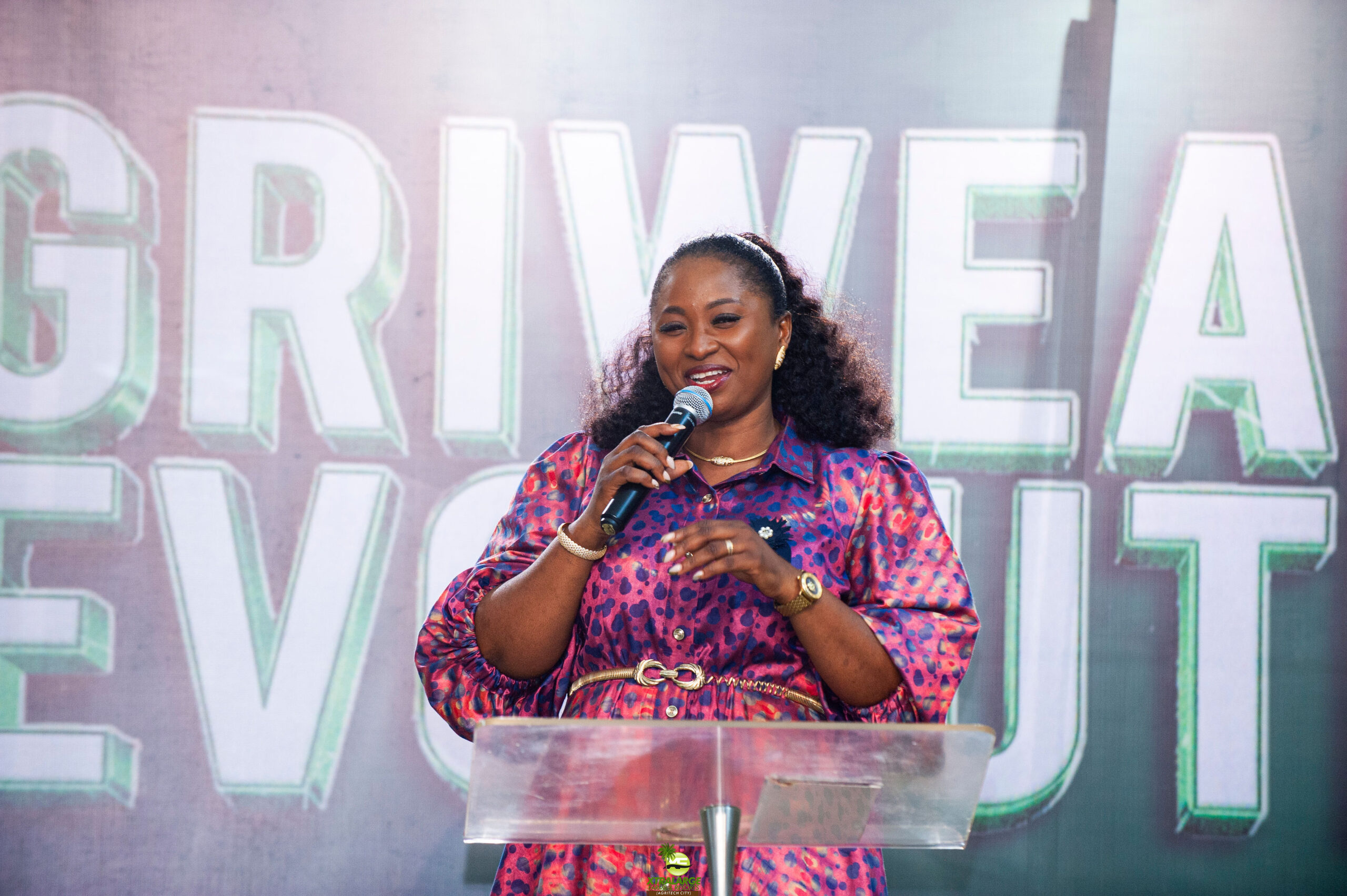
At the recently held Agriwealth Revolution Summit hosted by Xtralarge Farms & Resorts in Lagos, the atmosphere felt less like an industry conference and more like a defining moment in the evolution of Nigeria’s agricultural future. It was a gathering charged with urgency and intent, where familiar conversations about farming gave way to a deeper interrogation of agriculture as a system of wealth, structure, and national transformation.
In her keynote address as Group Managing Director, Dr. Moji Davids delivered a defining intervention that reframed not just how agriculture is discussed, but how it is fundamentally understood in Nigeria. Her speech moved beyond reflection on the sector’s challenges; it confronted the assumptions that have shaped it for generations.
Within a hall filled with farmers, entrepreneurs, policymakers, and development stakeholders, she challenged a deeply entrenched national belief that agriculture is synonymous with manual labour and subsistence survival. In its place, she presented a more expansive and disruptive vision, one that positions agriculture as an interconnected ecosystem of value creation, structured systems, and scalable enterprise with the capacity to transform economic outcomes at scale.
YOU CAN ALSO READ: Tilewa Adebajo Warns Nigeria’s Economy Is Stabilized but Not Transformed
Her central message landed with deliberate force: “Nigeria does not need more farmers, we need more agripreneurs.”
From that point, her address became a sustained argument for redefinition. Agriculture, she insisted, must no longer be treated as a survival activity driven solely by effort, but as a structured enterprise where systems determine outcomes and value determines prosperity. The real challenge, she explained, is not the absence of hard work within the sector, but the absence of frameworks capable of converting that work into lasting wealth.
Dr. Davids argued that Nigeria has spent years celebrating participation in agriculture without building the architecture required to turn production into prosperity. The consequence, she noted, is a persistent imbalance: widespread agricultural activity on one hand, and limited, uneven economic transformation on the other.
As she illustrated through a familiar proverb: “No be who plant cassava dey chop the biggest garri.”
For her, this simple expression captured a deeper structural flaw. A farmer operates within production, while an agripreneur operates within value. One concludes at cultivation; the other begins from it.
She expanded on this distinction by outlining how agripreneurs move beyond the farm gate into processing, branding, packaging, logistics, and market access—intervening at every stage where value is created and extracted. In doing so, agriculture is transformed from a labour-intensive activity into a structured, scalable business system.
In practical terms, she underscored a difficult truth: it is entirely possible to produce successfully and still remain economically constrained, just as it is possible to convert the same output into an integrated value chain that generates sustained and expanding income. She reinforced this idea with another local wisdom: “If you follow road wey person don clear, you go reach faster.”
According to her, that “cleared road” is what Xtralarge Farms & Resorts is actively building within Nigeria’s agricultural ecosystem. Dr. Davids emphasized that this vision is not aspirational rhetoric but an operational reality. Over the past decade, she noted, the Xtralarge ecosystem has enabled more than 200,000 Nigerians to generate income through agriculture and agribusiness. In parallel, it has developed one of the country’s most integrated agritourism and agriwealth platforms, connecting food production with tourism, wellness, and enterprise development in a unified system.
Yet she was clear that this achievement represents only an early phase of a larger ambition. The organisation is now focused on developing 1,000,000 agripreneurs across Africa, individuals equipped not just to farm, but to build, scale, and sustain agricultural wealth systems.
At the centre of her address was a broader economic warning: labour, on its own, is no longer a sufficient pathway to prosperity.
Across Nigeria, she observed, effort is increasing while returns are diminishing. Rising living costs, stagnant incomes, and widening economic pressure have exposed the limitations of hard work without structure.
This reality, she argued, demands a fundamental shift from labour to ownership, from hustle to systems, from effort to structure, and from income to wealth creation.
In her words: “Person wey dey carry elephant no dey pursue rat.” The implication was unmistakable: incremental thinking cannot produce transformational outcomes.
She further repositioned agriculture as a strategic sector increasingly defined by economics, control, and value distribution rather than production alone. With Nigeria’s vast land resources, large population, and strong consumer base, she argued that the constraint is no longer opportunity, but mindset and structure.
YOU CAN ALSO READ: The Lawyer Who Bet on Airports: Wale Babalakin and the Rise of Private Infrastructure in Nigeria
Agriculture, she concluded, must no longer be understood merely as what is produced, but as what is deliberately built around production.
Addressing participants directly, Dr. Davids urged a reorientation of ambition beyond survival, stressing the importance of building systems capable of outliving individual effort. In her view, agripreneurship remains one of the most powerful pathways to long-term wealth creation on the continent.
She also acknowledged the leadership and stakeholders driving the Xtralarge vision, including Chairman and CEO Dr. Seyi Davids, alongside partners, board members, panelists, and supporters whose collective effort continues to expand the initiative’s reach.
As she reminded the audience: “One tree no fit make forest.” And in her framing, that forest is no longer theoretical, it is already taking shape. Her closing message remained firm and unambiguous:
Nigeria does not need more farmers. Nigeria needs more agripreneurs. And, she emphasized, that transition is no longer a future aspiration, it is an immediate necessity.