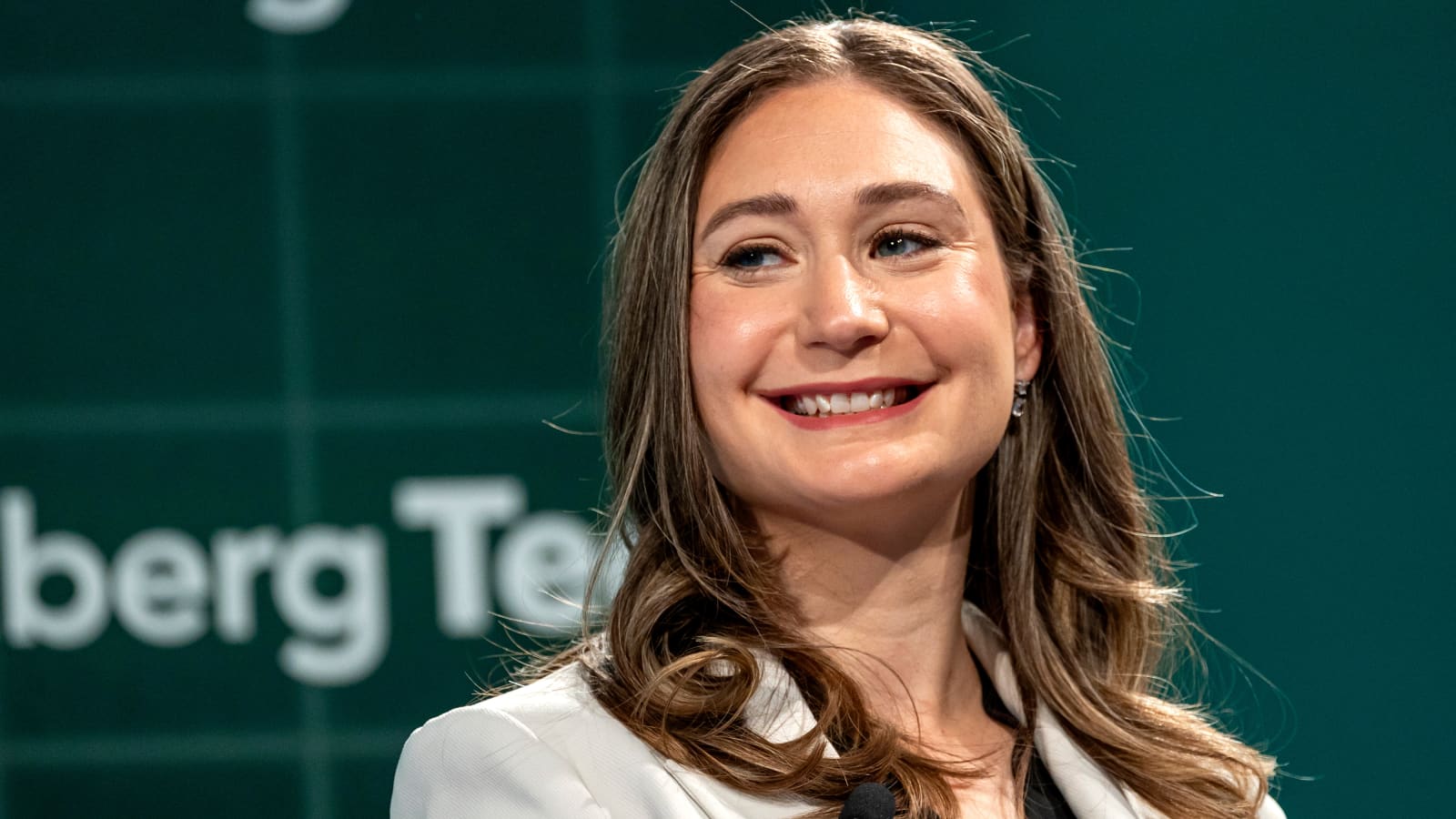
At a time when artificial intelligence is rapidly reshaping industries, economies, and even the way people think about work itself, few voices in technology carry the combination of intellectual depth, moral clarity, and strategic realism that defines Daniela Amodei.
Speaking at Stanford’s View From the Top, the Co-Founder and President of Anthropic delivered more than a conversation about AI. What unfolded was a deeply human reflection on ambition, ethics, leadership, innovation, and the future of society in the age of intelligent machines.
Warm, reflective, and sharply insightful, Daniela Amodei dismantled the myth that the architects of the AI revolution are solely computer scientists who spent their childhoods preparing for Silicon Valley dominance. Her own journey tells a radically different story.
She studied English literature. She worked in politics and global health. She cared about fairness, human dignity, and social impact long before she ever entered a room discussing neural networks or scaling laws. Yet today, she stands at the forefront of one of the world’s most consequential AI companies, helping shape technologies that may redefine the future of humanity itself.
YOU CAN ALSO READ: “The Future Costs Money” – Ezekiel Solesi’s Unfiltered Truth About Entrepreneurship
What makes her story remarkable is not merely the scale of Anthropic’s rise or the success of Claude, the company’s AI assistant. It is the philosophy behind it all: the conviction that technological advancement and human responsibility must evolve together.
Amodei spoke candidly about graduating in 2009 with an English literature degree during one of the toughest economic climates in recent memory. There was no grand master plan. No carefully orchestrated blueprint toward becoming an AI executive.
Instead, her career evolved through curiosity, purpose, and an obsession with impact.
Her early work in international development and global health was driven by a desire to understand inequality and improve access to life’s most basic necessities. That mission later led her to Capitol Hill, political campaigns, and eventually Silicon Valley, where she joined Stripe when it was still a little-known startup with only around 40 employees.
From there, the path accelerated into OpenAI and eventually the founding of Anthropic alongside her brother, Dario Amodei, and five other co-founders.
But beneath the transitions was a consistent theme: the refusal to let academic background define future possibility.
Amodei described herself as a “generalist,” someone driven less by credentials and more by curiosity, adaptability, and a desire to contribute meaningfully. In a world increasingly obsessed with specialization, she argued that broad intellectual curiosity remains one of the most underrated strengths in leadership.
Her message was especially resonant for young professionals navigating uncertain futures: the most important skill may no longer be mastering a single discipline, but developing the ability to continuously learn across many.
One of the most compelling parts of the discussion centered on why the Anthropic founders left OpenAI in 2020 to build a new company.
According to Amodei, the decision was not motivated by conflict, but by vision.
The founding team wanted to create an organization where safety, responsibility, and long-term societal impact were foundational rather than secondary considerations. That vision ultimately shaped Anthropic into a public benefit corporation, a structure designed to balance commercial success with broader public interest.
In an industry often defined by relentless speed and competitive pressure, Anthropic has positioned itself differently: advancing frontier AI capabilities while simultaneously emphasizing safeguards, transparency, and responsible deployment.
For Amodei, AI safety is not an abstract slogan. It is a practical and urgent responsibility.
She drew comparisons to the unintended societal consequences of social media platforms, arguing that earlier generations of technology companies often optimized aggressively for growth without fully anticipating downstream harms. AI developers, she suggested, now have the rare opportunity to learn from those mistakes before repeating them.
That means thinking deeply about issues such as misinformation, cyber warfare, election integrity, child safety, and even the possibility of AI-assisted chemical or biological threats.
In her framing, safety is not about slowing innovation for its own sake. It is about ensuring society does not inherit catastrophic unintended consequences from technologies developing at unprecedented speed.
Perhaps the most important insight from the conversation was Amodei’s nuanced perspective on AI and jobs.
Rather than predicting simplistic mass replacement, she described a more complex transformation in which AI changes the nature of work itself.
According to her, many professions will not disappear entirely but will evolve significantly. Software developers may spend less time writing repetitive code and more time collaborating, designing systems, and communicating with people. Doctors may rely increasingly on AI diagnostics while human empathy and patient relationships become even more valuable.
This shift, she argued, elevates deeply human capabilities.
Communication. Creativity. Emotional intelligence. Curiosity. Leadership. Collaboration.
In an AI-driven world, these traits may become more valuable, not less.
Amodei repeatedly returned to one central truth: people fundamentally want human connection. Even as machines become extraordinarily capable, humans will continue seeking meaning, trust, empathy, and understanding from one another.
That insight reframes the future entirely. The winners in the AI era may not simply be those who know how to use the most advanced tools, but those who remain profoundly human while using them.
Despite her optimism, Amodei did not ignore the psychological risks of AI dependence.
One of the more thought-provoking moments came when she described a growing phenomenon where people stop engaging deeply with problems because AI tools make it easier not to think.
Instead of wrestling with ideas, users can instantly outsource reasoning to machines.
She warned that while AI can dramatically expand human capability, it can also weaken intellectual engagement if used carelessly. The difference lies in whether AI functions as a tutor that sharpens human thinking or as a shortcut that replaces it entirely.
Anthropic’s vision, she explained, leans heavily toward the former.
The goal is not to create systems that encourage intellectual passivity, but tools that help people learn faster, think better, and unlock abilities they previously believed were inaccessible.
In a revealing glimpse into her daily life, Amodei described how she personally uses Claude as a management coach and leadership assistant.
By analyzing years of employee feedback, the AI helps identify behavioral patterns, recurring management blind spots, and opportunities for personal growth. She even admitted that Claude occasionally gives her uncomfortable feedback about her own leadership habits.
Beyond work, she also shared how AI became unexpectedly useful during one of parenting’s most stressful experiences: potty training.
The anecdote humanized the conversation in a powerful way. Behind all the discussions about models, compute, and regulation lies a simpler reality: AI is increasingly entering ordinary human life.
Parents, students, doctors, creators, entrepreneurs, and managers are all beginning to integrate these systems into everyday decision-making. The question is no longer whether AI will shape society. It already is.
The real question is how humanity chooses to shape AI in return.
Toward the end of the discussion, Amodei offered advice that may define the ethos of a new generation of founders and innovators.
Follow what genuinely matters to you. Not trends. Not hype. Not prestige.
YOU CAN ALSO READ: Africa’s Strategic Future Takes Center Stage at the Abuja Conclave
She argued that the hardest moments in entrepreneurship can only be survived when people remain anchored to a mission they truly believe in. Passion, meaning, and purpose are not soft ideals in her worldview; they are strategic necessities for enduring difficult periods.
Equally significant was her belief that business success and social good are no longer opposing forces.
For decades, many assumed that companies had to choose between profitability and ethical responsibility. Amodei sees the future differently. She believes the next era of innovation will increasingly be driven by founders who build commercially successful companies while also striving to improve society.
That mindset may ultimately become one of Anthropic’s most enduring contributions to the AI era.
Because beneath all the technical complexity, Daniela Amodei’s message was remarkably simple: the future of artificial intelligence will not only be determined by how powerful the technology becomes, but by the values of the people building it.