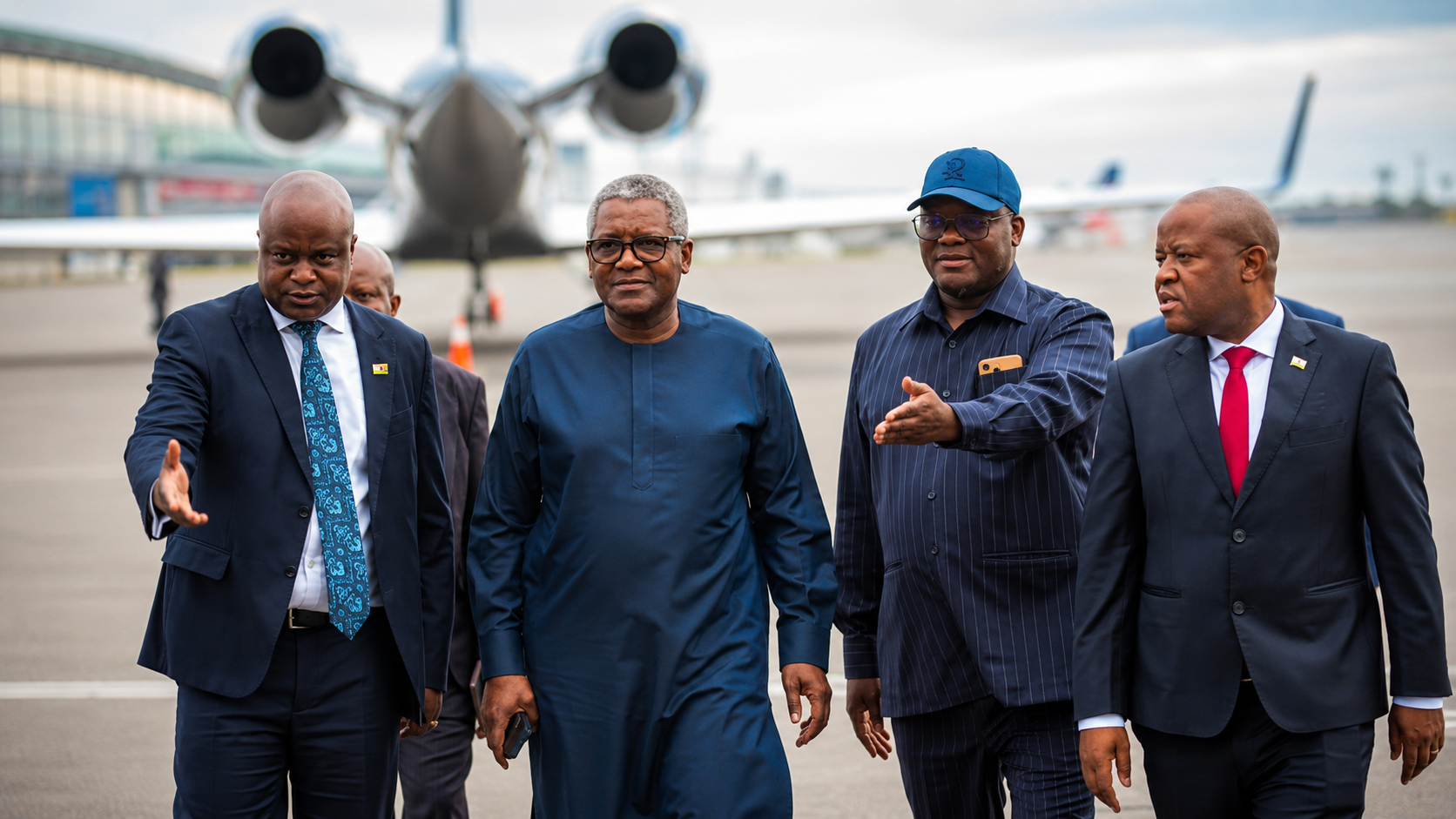
For decades, Africa has lived with an economic contradiction that has long frustrated policymakers and entrepreneurs alike. The continent is rich in crude oil, minerals and agricultural resources, yet it exports raw materials only to import finished products at many times their original value. Every shipment leaving African shores has often carried away not just commodities but jobs, industrial capacity and economic opportunity. Few people have challenged that model as boldly as Aliko Dangote.
Africa’s richest businessman is no longer simply building companies. He is attempting to rewrite the continent’s economic story. At the heart of that ambition stands the Dangote Refinery, a project that many considered impossible and which today has become one of the most powerful symbols of Africa’s industrial awakening.
“We want to industrialize, not only in Nigeria. I want to industrialize Africa,” Dangote declares. That single statement captures a vision far larger than a refinery, a fertilizer plant or even a business empire. It reflects a belief that Africa’s future prosperity will not come from exporting its wealth but from transforming it at home. For Dangote, industrialisation is not merely an economic strategy. It is Africa’s pathway to genuine independence.
One of the greatest paradoxes of Nigeria’s economy has been that Africa’s largest crude oil producer also became one of the continent’s biggest importers of refined petroleum products. For years, crude oil left Nigerian ports only to return as petrol, diesel and aviation fuel at significantly higher prices. According to Dangote, the consequences went far beyond higher fuel costs.
YOU CAN ALSO READ: FG Clarifies IMF Report, Insists Every Naira Spent Is Backed by Law
“By exporting crude and importing refined product, you’re essentially exporting wealth and importing poverty,” he says. Countries that merely export raw materials surrender the highest-value stages of production to others. Manufacturing jobs are created overseas, technology is developed elsewhere, and the profits that come from processing natural resources remain outside Africa. “We don’t want to be taking our raw materials out, and then somebody will process them and bring it back, and we’ll pay 12 or 15 times the price.”
The Dangote Refinery was never intended to be an ordinary infrastructure project. Designed to process 650,000 barrels of crude oil per day, it is the largest single-train refinery in the world, surpassing many facilities built by governments and international oil majors. But its scale tells only part of the story.
Dangote made an even more audacious decision. Rather than relying entirely on external engineering firms, his company assumed responsibility for engineering, procurement and construction itself. “The refinery is a massive project. We took the challenge to build a 650,000 barrels refinery, and we also took the challenge of being the EPC contractors. We did it on our own.” It was a gamble unlike any he had taken before. “It was the riskiest thing that I’ve ever done in my life. If the thing didn’t work out, I would have actually lost everything.”
Only a few years ago, the site that now houses the refinery looked nothing like the industrial city it has become. The location was largely swamp land sitting between the Atlantic Ocean and Lagos Lagoon, an area particularly vulnerable to rising sea levels caused by climate change. Before construction could even begin, engineers had to reshape nature itself by pumping more than 65 million cubic metres of sand into the area to raise its elevation by approximately one and a half metres.
Unlike many mega-refineries financed primarily through sovereign wealth or government-backed funding, Dangote initially financed much of the project with his own resources before attracting institutional capital. Among those partners was the Africa Finance Corporation (AFC), whose executives viewed the refinery as exactly the type of transformational project capable of changing an entire continent. “When you see a visionary person who is ready to tackle a problem that we all have to deal with, then we have to ensure that that vision matches with capital,” an AFC executive explains. The institution ultimately deployed close to $10 billion to support the refinery and associated industrial projects.
The refinery’s significance extends far beyond petroleum production. Operating at full capacity, it is expected to supply more than all of Nigeria’s domestic demand for gasoline, diesel and aviation fuel while exporting refined products across Africa and beyond. In doing so, it dramatically reduces dependence on imported fuel, eases pressure on foreign exchange reserves and strengthens regional energy security.
Its impact is already being felt by consumers. Following recent reductions in petroleum prices announced by Dangote Refinery, motorists have begun enjoying lower pump prices and shorter waiting times at filling stations. Scenes that once saw vehicles queuing for days have largely disappeared. “Ever since the refinery started producing, all the queues have vanished. People just come in, buy and move on,” one observer noted.
Although refineries are often associated with environmental concerns, sustainability was integrated into the project’s design from the outset. The facility has been engineered to become one of the world’s most energy-efficient refineries on a per-barrel basis. Previously, Nigerian crude travelled thousands of kilometres to ageing foreign refineries before refined products were shipped back to Africa, generating enormous carbon emissions along the way. Refining crude much closer to production sources is now eliminating more than one million tonnes of carbon dioxide emissions annually, creating environmental benefits alongside economic gains.
Dangote’s industrial ambitions do not stop with energy. Adjacent to the refinery stands what has become the world’s largest single-train urea fertiliser plant, positioning Nigeria as one of the world’s leading fertiliser exporters while strengthening agricultural productivity across Africa. Dangote believes agriculture represents the continent’s next major economic revolution. “The availability of arable land is coming down globally. Availability of water is coming down. Only Brazil and sub-Saharan Africa have enough arable land and more than enough water. This will become the breadbasket for the whole world.”
Beyond infrastructure, the refinery is creating something even more valuable: human capital. Thousands of engineers, technicians, managers and skilled workers have developed expertise through the project. Many joined as trainees and have risen into senior leadership positions. Today, more than 3,000 people support refinery operations, while thousands more are employed indirectly across supply chains, logistics, maintenance and supporting industries.
Dangote believes Africa’s greatest resource is not oil, cement or natural gas but its young people. “We haven’t really even scratched the surface,” he says. To help unlock that potential, the Dangote Foundation has launched a $700 million education intervention programme to be implemented over the next decade. His company’s new guiding philosophy reflects that conviction. “Our new slogan in Dangote is Africa First. That’s what we want to concentrate on.”
The Dangote Refinery is frequently described as Africa’s largest industrial investment, yet its deeper significance lies in what it represents. It demonstrates that African capital, African expertise and African leadership can successfully execute projects previously thought possible only in advanced economies. It also sends a powerful message to global investors.
“What attracts a foreign investor is a domestic investor,” Dangote observes. “When the domestic investor risks his own capital, then foreigners will come and partner with you.” By committing billions of dollars of his own resources before seeking external partnerships, Dangote showed confidence in Africa long before asking others to do the same.
YOU CAN ALSO READ: Margaret Omovbude Hosts One-Day Leadership Conference Focused on Career Growth and Workplace Success
As the refinery reshapes regional energy markets, reduces fuel imports, creates skilled employment, supports agriculture and strengthens intra-African trade, its impact is extending well beyond Nigeria’s borders. For Dangote, however, the refinery is not the destination but the beginning of a much bigger mission.
“The country will be very prosperous. Electricity will be available for the 650 million people that don’t have electricity,” he says. Ultimately, his vision reaches beyond business success to something much larger. “This is the economic independence that we seek for the continent.”
The Dangote story is no longer just about building Africa’s largest refinery. It is about proving that the continent can finance, design, construct and operate world-class industrial projects while creating wealth at home instead of exporting it abroad. It is a story of conviction, calculated risk and an unwavering belief that Africa no longer has to export its future to import its prosperity.