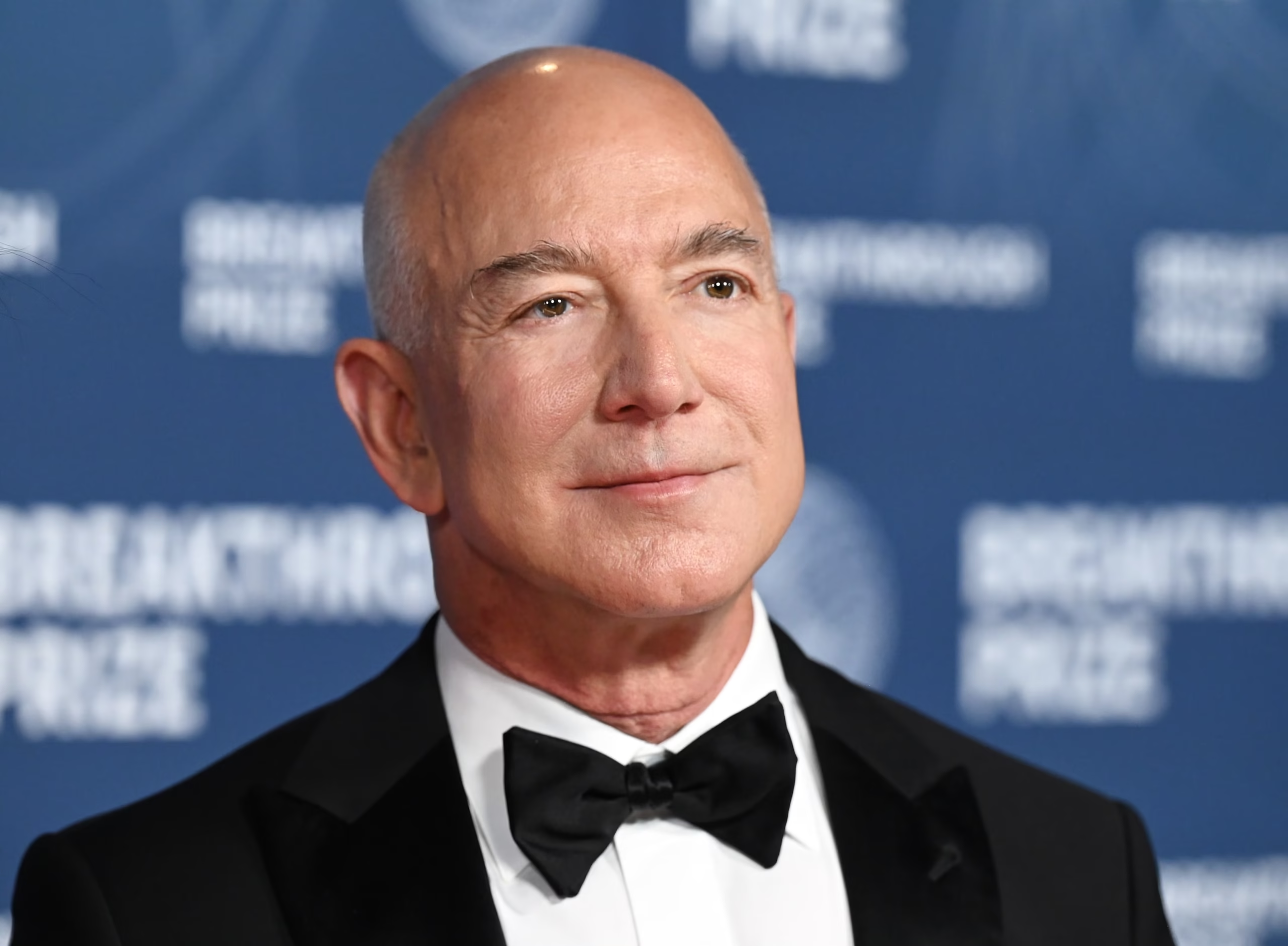
There was a time when building breakthrough technology demanded extraordinary patience. Designing a modern jet engine, for example, could consume an entire decade before it reached commercial production. Years disappeared into engineering, testing, certification and manufacturing. For many industries, that timeline was simply accepted as the price of innovation. But Jeff Bezos believes that assumption is about to be rewritten.
Speaking during a conversation on the future of technology and innovation, the Amazon founder and Blue Origin executive chairman argued that artificial intelligence will not simply automate existing work. Its greatest impact, he suggested, will be compressing the distance between imagination and execution, allowing innovators to transform ideas into reality at speeds previously considered impossible.
To illustrate the opportunity, Bezos pointed to one of engineering’s most demanding challenges: building a new jet engine with 10 percent greater thrust. Even after decades of experience, he explained, such a project traditionally requires around ten years from concept to production. The question occupying his thinking is no longer whether that timeline can be improved, but by how much. Can ten years become five? Five become three? Three become two? Eventually, can entirely new engineering tools reduce that journey to a single year? “If we can really accelerate that dream-build loop,” Bezos said, “it changes everything.”
YOU CAN ALSO READ: Africa’s Energy Future Will Be Built by Institutions, Not Resources Alone
That phrase, “dream-build loop,” captured perhaps the central idea of the discussion. Innovation has never been constrained by imagination. Human beings have always generated more ideas than they could realistically pursue. What limits progress, Bezos argued, is the enormous effort required to transform concepts into tangible products. Virtually everyone, he observed, has imagined a new business, product or invention that never progressed beyond a conversation or notebook because the cost, complexity and time involved made execution impractical.
Artificial intelligence has the potential to change that equation. Rather than replacing human ingenuity, Bezos believes AI will dramatically expand humanity’s capacity to act on it. As technology reduces the friction involved in design, engineering and manufacturing, entrepreneurs will increasingly find themselves limited not by technical capability but by the quality of their imagination. “I totally disagree” with predictions that AI will make people redundant, Bezos said. Instead, he foresees a future where AI creates an even greater demand for human creativity because people will discover countless new opportunities worth pursuing. “We have an endless set of things to invent,” he explained.
That optimism was echoed by Blue Origin Chief Executive Officer Dave Limp, who described how AI has already transformed his own productivity. Although formally trained as a computer scientist, he admitted he once lacked the practical programming speed now made possible through modern AI coding assistants. Today, ideas that once required specialist teams can often be translated into working software prototypes within hours. The same transformation, he believes, is now beginning to reach the physical world, where engineers may soon move seamlessly from concept to manufactured prototype using AI-driven design and advanced fabrication tools. For Limp, that possibility represents one of the most exciting frontiers in technology.
The conversation also offered a rare glimpse into the working relationship between two executives who spent nearly two decades together at Amazon before reuniting at Blue Origin. Limp described Bezos as possessing an unusual leadership combination that initially seemed contradictory but has consistently defined his management philosophy. “He is the most tactically impatient person I’ve ever met and the most strategically patient person I’ve ever met,” Limp observed. The apparent contradiction, he explained, reflects Bezos’ ability to demand relentless execution on immediate priorities while simultaneously maintaining an exceptionally long-term vision. Whether building Amazon or Blue Origin, Bezos consistently remains the longest-term thinker in the room, willing to invest years pursuing ambitious goals while expecting daily operational excellence.
Limp admitted he originally assumed Bezos’ business instincts were largely confined to e-commerce. After spending two and a half years working alongside him in the aerospace sector, however, he reached a different conclusion. According to Limp, Bezos now possesses a level of technical understanding of rockets and propulsion systems that rivals the expertise he once demonstrated in online retail. “Jeff knows more about rockets and rocket engines than he knows about e-commerce,” Limp said. Bezos responded with characteristic humility, shifting attention away from technical expertise towards something he values even more: trusted relationships. Recalling a piece of advice he has come to embrace over time, Bezos remarked, “When you’re under 40, never hire your friends. When you’re over 40, only hire your friends.” Behind the humour lay a serious leadership philosophy. High-performing organisations, he suggested, are ultimately built on deep trust, mutual respect and shared values rather than technical competence alone.
If trust defines leadership, speed defines execution. Bezos argued that decisiveness has become one of the most important competitive advantages any organisation can develop. As companies expand, however, they often lose this capability, gradually replacing agility with bureaucracy. The problem, he explained, is that many organisations begin treating every decision as though it carries identical levels of risk. Some decisions are indeed consequential and nearly irreversible. Those deserve extensive analysis, broad consultation and deliberate caution. Most decisions, however, are reversible. Those, Bezos argued, should be made rapidly by capable individuals exercising sound judgment rather than becoming trapped inside endless committees. “You start making all decisions as if they’re all the same size,” he explained. That mindset may appear prudent, but it quietly erodes competitiveness.
YOU CAN ALSO READ: The Next Chapter at UBA: Emmanuel Nnorom Succeeds Tony Elumelu as Chairman
It also explains why startups frequently outperform far larger organisations. Small companies move quickly because founders remain close to every decision, enabling rapid experimentation and continuous learning. Large organisations often surrender that advantage as complexity increases. Even Blue Origin, now employing roughly 15,000 people, faces that challenge. Traditional aerospace, Bezos noted, has historically been especially vulnerable to slow decision-making because safety-critical missions naturally encourage extensive review processes. Yet allowing that caution to spread indiscriminately across every operational decision risks creating institutional paralysis. Not every decision, he insisted, should be treated as life-or-death.
For Bezos, speed is no longer merely an operational preference. It is becoming a defining element of corporate culture. Looking beyond Blue Origin, he described today’s technological landscape as one of the most extraordinary periods in modern history. Artificial intelligence, biotechnology, commercial space exploration and digital entrepreneurship are simultaneously creating opportunities unmatched by previous generations. “We live in the most incredible moment,” he said. That reality carries a particularly powerful message for younger entrepreneurs. Rather than fearing technological disruption, Bezos encouraged founders to recognise that the tools now emerging dramatically reduce the barriers that once prevented ambitious ideas from becoming successful businesses.
The next generation of great companies, he suggested, will not necessarily belong to those with the largest budgets or longest histories. They will belong to those capable of imagining boldly, deciding quickly and executing faster than ever before. In the age of artificial intelligence, competitive advantage may no longer depend primarily on who has the best ideas. It may belong to whoever can build them first.