Africa’s next energy revolution will not be defined solely by oil discoveries, billion dollar investments or the next Final Investment Decision (FID). It will be shaped by something far more enduring: the quality of its people, the strength of its institutions and the courage of leaders willing to invest in capacity before opportunity arrives. That powerful message echoed throughout one of the most engaging conversations at the Rollout Initiative Conference, where policymakers, regulators, industry executives and private sector leaders gathered to examine how local content can evolve from a national policy into a continental growth strategy.
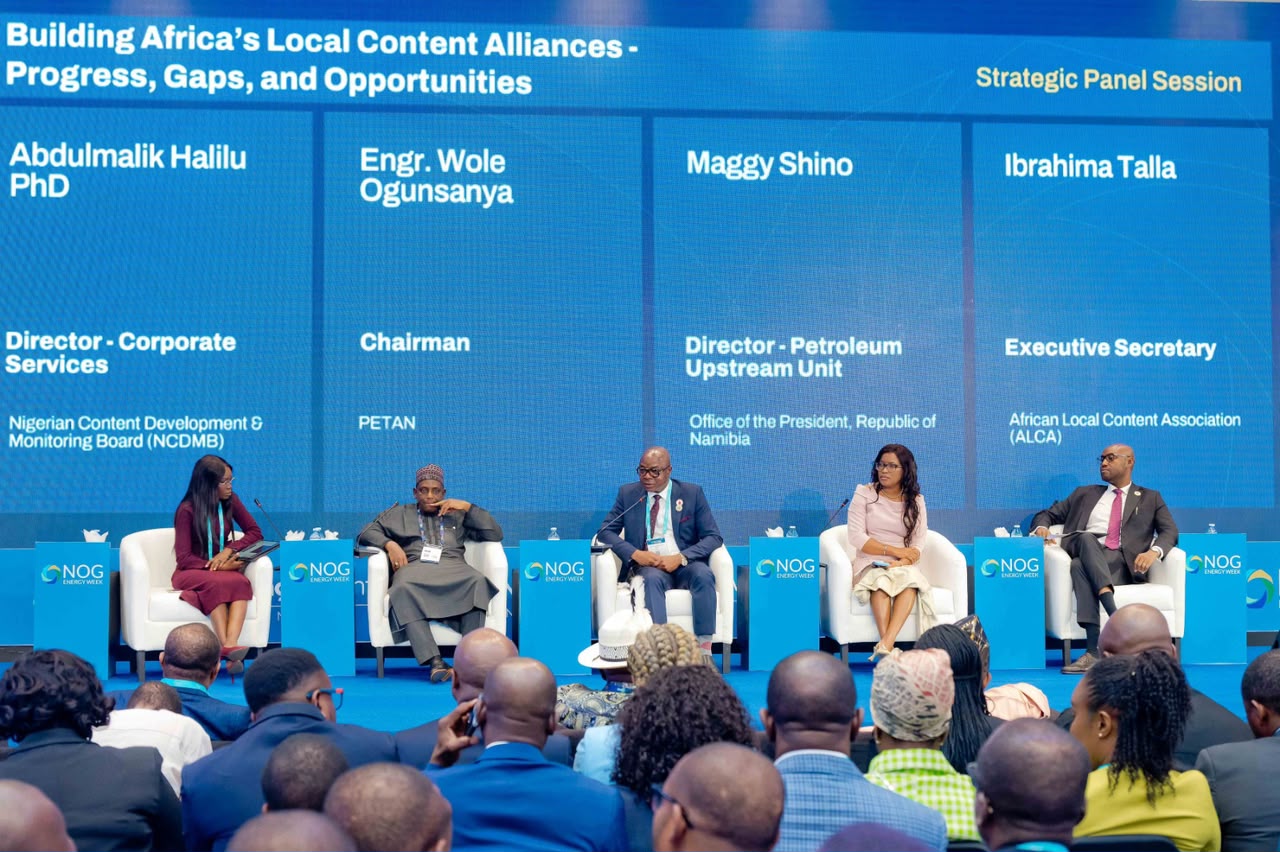
Moderating the session with confidence and clarity was Adviser, Diplomatic Relations, NNPC Limited, Hadassah Hussaini, who immediately elevated the conversation beyond familiar discussions about indigenous participation, inviting the panel to explore how Africa could build an interconnected energy ecosystem capable of creating value across borders. “Local content has been a powerful tool for driving value creation,” she observed, noting that Africa must now move beyond developing indigenous capacity to fostering collaboration capable of creating an African energy hub. Her thoughtful moderation ensured the discussion flowed seamlessly between policy, business, investment and regional cooperation, allowing each panelist to build upon the other’s insights.
Joining her on the panel were Director, Corporate Services, Nigerian Content Development and Monitoring Board (NCDMB), Dr. Abdulmalik Halilu; Chairman, Petroleum Technology Association of Nigeria (PETAN), Engr. Wole Ogunsanya, FNSE; Executive Secretary, African Local Content Association (ALCA), Ibrahima Talla; and Acting Petroleum Commissioner, Ministry of Industries, Mines and Energy, Namibia, Aune Amutenya. Collectively, they painted a compelling picture of an Africa determined to transform its natural resources into industrial growth by investing in people, institutions and collaboration.
YOU CAN ALSO READ: Can Humanity Stay Wise in a World Governed by Algorithms?
Responding to the opening question on Nigeria’s local content journey, Director, Corporate Services, Nigerian Content Development and Monitoring Board (NCDMB), Dr. Abdulmalik Halilu described the country’s achievements not as isolated successes but as the product of deliberate institution building. For him, local content rests on three interconnected pillars: strong governance, targeted capacity development and transparent enforcement.
Nigeria’s greatest achievement, he explained, has been creating a governance framework that gives investors confidence while ensuring local content survives changes in government and economic cycles. What began as a policy initiative eventually became law through the Nigerian Oil and Gas Industry Content Development Act, creating a dedicated institution, funding mechanism and measurable targets that transformed local content from aspiration into national strategy. Just as importantly, almost every major operator and service company now operates dedicated local content divisions, making Nigerian content an integral part of business planning rather than simply another regulatory requirement.
Dr. Halilu, however, argued that legislation alone cannot build industries. Real transformation happens when organisations possess the competence to execute projects successfully, and that conviction lies at the heart of the Rollout Initiative. “We are proud to be part of the Rollout Initiative,” he said. “It seeks to promote the philosophy of local content and industry best practices.” Rather than simply enforcing compliance, the initiative is designed to develop competent professionals within organisations who understand ISO certification, statutory reporting, quality assurance and every regulatory obligation required to keep projects moving efficiently.
According to him, many compliance failures arise not because organisations deliberately ignore regulations but because employees lack adequate understanding of the required processes. “Many organisations receive compliance queries because of avoidable lapses,” he explained. “Some staff simply are not doing what they are supposed to do.” The Board’s response is to build internal expertise by developing specialised curricula that equip compliance officers, contract administrators and technical personnel with practical knowledge capable of preventing costly mistakes before they occur. “It is about developing that ecosystem,” he noted. “You have an SME within your organisation that can provide guidance on virtually anything.”
What distinguished Dr. Halilu’s presentation was his insistence that NCDMB would hold itself to the same standard expected of industry. “As we are training people outside, we are also training our own staff,” he remarked, underscoring that institutional credibility begins with internal excellence. The Board is creating a continuous learning culture where organisations receive annual training schedules covering certification programmes and business related courses, while simultaneously strengthening the competence of its own workforce.
His remarks became particularly inspiring when he shifted attention from today’s executives to tomorrow’s industry leaders. Pointing to one of the conference’s emerging professionals, Dr. Halilu revealed that the individual would soon be taking the stage as part of another panel session. “A few years from now,” he predicted confidently, “those are the people you will see on this stage speaking.” It was a powerful reminder that sustainable industries are built not only by celebrating today’s experts but by deliberately preparing the next generation long before leadership transitions become necessary.
Turning to compliance, Dr. Halilu issued one of the day’s strongest warnings, drawing attention to the Nigerian Content Development Fund (NCDF). While its statutory one percent contribution may appear insignificant, he cautioned that organisations ignore it at their own peril. “That one percent may seem insignificant,” he said, “but if you don’t contribute it, the NCDF is going to suffer.” To simplify the process, NCDMB has introduced an online NCDF Compliance Certificate, enabling companies to complete their obligations before enforcement becomes necessary. “It is just like tax,” he warned. “You may think it is not a problem, but the day the authorities come knocking, you’ll have to pay.”
Yet, for Dr. Halilu, compliance was never the end goal. The ultimate objective remains economic development, and that depends entirely on projects moving from approval to execution. Repeatedly, he returned to what became the defining message of the session: “No projects, no local content.” Without new investments, he argued, factories remain idle, engineers cannot gain practical experience, manufacturers lose demand and indigenous businesses cannot grow. “Capacity cannot grow in isolation,” he stressed. Every delayed Final Investment Decision postpones jobs, industrial growth, technology transfer and opportunities for Nigerian businesses.
That conviction has inspired one of NCDMB’s boldest advocacy proposals, a dedicated annual FID Day during major industry events to celebrate projects that successfully achieve Final Investment Decision. Each FID, he argued, represents far more than corporate investment; it signifies new opportunities for manufacturers, contractors, host communities and local service providers. At the same time, he challenged investors to match the urgency regulators have shown in shortening approval timelines.
YOU CAN ALSO READ: NCDMB Pushes Capacity Building, Compliance as Key to Accelerating Energy Investment
“It has to be a handshake,” he observed, arguing that regulators and investors must work together to move projects from paperwork to production.
Looking beyond Nigeria, Dr. Halilu reflected on how shifting geopolitical realities, from the Russia Ukraine conflict to instability in the Middle East, have changed global investment patterns. International oil companies increasingly recognise that every producing region presents its own challenges, making stable regulatory environments more valuable than ever. Nigeria, he revealed, is experiencing renewed investor interest because of growing confidence in its institutions.
“NCDMB is here to enable you,” he assured participants. “We are here to promote businesses. We are here to provide support.” Perhaps the most memorable moment came when he reminded the audience why the agency exists. “When you look at NCDMB,” he smiled, “the ‘D’ is there for a reason. It stands for Development.” That philosophy, developing people, businesses and national capacity rather than merely enforcing regulations, set the tone for a conversation that would soon expand beyond Nigeria’s borders to examine how Africa can collectively build a globally competitive energy future.