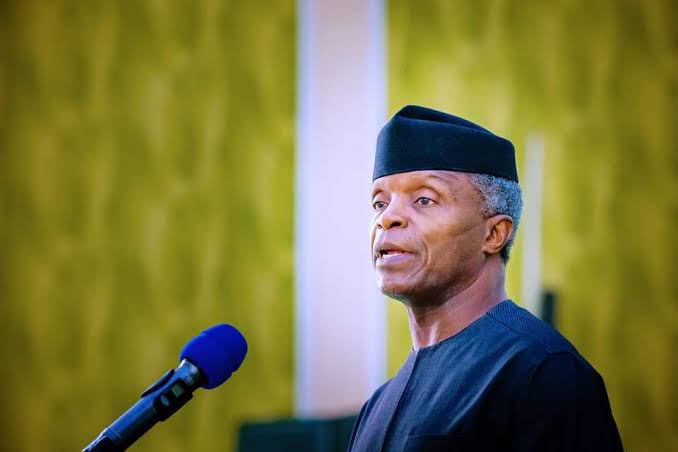
Artificial intelligence is writing speeches, algorithms are shaping opinions, smartphones are replacing libraries, and digital platforms now influence how billions of people think, communicate and make decisions. Never before has technology possessed such extraordinary power to transform human civilisation. Yet, according to former Vice President of Nigeria, Professor Yemi Osinbajo, SAN, GCON, the greatest challenge of the digital revolution is not technological advancement itself but whether humanity can retain the wisdom to govern it.
Delivering the keynote address at the 25th edition of the Bazzo Conference hosted by Jesus House DC, Osinbajo offered a profound reflection on leadership in an age increasingly dominated by algorithms, artificial intelligence and digital influence. Speaking on the theme Leading with Wisdom in a Digital World, he argued that while technology continues to reshape economies, governments, businesses and faith communities, true leadership will ultimately be measured not by technological sophistication but by the ability to exercise discernment, preserve independent thought and remain anchored in timeless values.
His address moved effortlessly across law, technology, economics, leadership and faith, presenting a compelling case that the digital revolution is creating remarkable opportunities while exposing humanity to unprecedented risks.
YOU CAN ALSO READ: Maria Sharapova Is Winning Again – This Time in Business
At the heart of his message was a simple but sobering observation: technology has become one of the most powerful forces shaping modern civilisation, yet its influence extends far beyond convenience. Modern society now depends on digital infrastructure to power financial systems, healthcare, commerce, education, government and national security. A handful of technology companies increasingly control not only the platforms people use but also the information they consume, the conversations they join and, in many cases, the narratives that shape public opinion.
To illustrate the point, Osinbajo reached back to his years as a lawyer, recalling how his firm sued multinational tobacco companies on behalf of Nigerian governments after evidence revealed that cigarette manufacturers had deliberately engineered products to addict young smokers while concealing the health consequences. Internal documents exposed calculated strategies designed to recruit children into lifelong nicotine addiction. For him, the lesson extends well beyond the tobacco industry.
Today’s digital platforms, he argued, operate on a similarly powerful business model. Recent court decisions in the United States found that major social media companies intentionally designed features such as infinite scrolling, algorithmic recommendations, notifications and validation systems to maximise user engagement despite knowing the psychological harm excessive use could cause, particularly among young people. “If you can become addicted to a product,” he observed, “you become a source of unending wealth to the business that created the addiction.”
Unlike tobacco, however, the commodity being monetised today is human attention. Every click, search, like, purchase and interaction feeds sophisticated algorithms that learn individual preferences with extraordinary precision. Rather than simply presenting information, these systems curate personalised realities, repeatedly exposing users to ideas and content most likely to sustain engagement. Over time, familiarity begins to resemble truth, and repeated exposure quietly shapes beliefs, attitudes and behaviour.
“The battlefield of this age,” Osinbajo declared, “is no longer simply political or economic. It is the human heart and the human mind.”
Artificial intelligence, he argued, represents both the greatest promise and perhaps the greatest leadership challenge of this new era. He acknowledged AI’s remarkable capacity to transform productivity, innovation and economic growth, describing how legal research that once required days of painstaking analysis can now be completed within minutes by intelligent systems capable of reviewing statutes, precedents and legal opinions with astonishing speed. Many professional roles, particularly entry-level knowledge work, are already being redefined.
Yet technological capability, he cautioned, must never be mistaken for wisdom. Artificial intelligence can analyse data, generate content and simulate conversation, but it cannot exercise moral judgment, receive divine guidance or understand the deeper complexities of the human spirit. “AI can imitate insight,” he remarked, “but it cannot pray.” The real danger, he suggested, is not that machines will become more intelligent than humans, but that humans may gradually surrender their own capacity for discernment. “The greatest danger we face is not that machines will think like humans. It is that humans will stop thinking.”
That warning naturally evolved into a broader discussion on leadership. Whether in government, business, education, ministry or the home, Osinbajo argued that leaders must become intentional stewards of technology rather than passive consumers of it. Parents must guide children’s digital habits. Businesses must prepare workforces for an AI-driven economy. Universities must rethink research and assessment as artificial intelligence becomes increasingly difficult to distinguish from human work. Faith leaders must also equip believers with spiritual disciplines capable of surviving an age defined by endless distraction.
One of the keynote’s most personal moments came when Osinbajo reflected on his own struggle to read the Bible using a work-issued tablet constantly interrupted by emails, breaking news and notifications. Eventually, he purchased a separate device dedicated solely to Bible study after realising how fragmented his attention had become. The experience, he said, revealed a challenge confronting millions today: constant digital stimulation is steadily eroding humanity’s ability to concentrate, reflect and cultivate stillness.
“The attention of our hearts and minds is under constant pressure,” he observed, explaining that endless notifications and algorithm-driven feeds condition the brain to seek immediate rewards while making sustained reflection increasingly difficult. Yet wisdom, he argued, has always required silence. Drawing from the biblical account of Elijah hearing God through a “still small voice,” he suggested that today’s digital environment often leaves little room for the quietness necessary for discernment.
Despite these concerns, Osinbajo rejected the notion that technology itself is the enemy. On the contrary, he celebrated Africa’s digital transformation, highlighting Nigeria’s emergence as one of the continent’s leading fintech ecosystems, the rapid expansion of telemedicine, mobile banking, digital entrepreneurship and online commerce. He noted that Nigeria has produced multiple billion-dollar technology companies founded largely by entrepreneurs under the age of 35, while hundreds of innovation hubs now operate across Africa, creating new opportunities for wealth creation and inclusion.
Technology, he added, has also transformed the reach of the Christian faith. Churches that once ministered to thousands now reach millions through digital platforms, while advances in translation, streaming and artificial intelligence have made the gospel accessible to audiences across the globe in ways unimaginable just a generation ago. The same technologies capable of spreading misinformation can equally become powerful instruments for education, innovation and evangelism.
For Osinbajo, the challenge therefore is not whether technology should be embraced, but whether leaders possess the wisdom to govern it responsibly. Leadership in the digital age demands more than technical literacy. It requires discernment, emotional discipline and the courage to question information before accepting it, to resist manipulation before reacting and to deliberately cultivate independent thought.
YOU CAN ALSO READ: NCDMB Pushes Capacity Building, Compliance as Key to Accelerating Energy Investment
“Your attention is your power,” he reminded the audience. “What you give your attention to shapes your mind, and your mind shapes your life.”
By the conclusion of his address, Osinbajo had transformed what began as a conversation about technology into a compelling meditation on leadership itself. The defining challenge of this century, he argued, will not simply be mastering artificial intelligence or accelerating digital transformation. It will be preserving humanity’s capacity for wisdom, moral judgment and independent thought in a world increasingly shaped by intelligent machines.
Technology will continue advancing at breathtaking speed. Artificial intelligence will become more powerful, digital infrastructure more pervasive and algorithms more influential. But leadership, Osinbajo insisted, remains fundamentally a human responsibility.
“The wisdom of God,” he concluded, “supersedes all technology.”
It was a fitting conclusion to a keynote that challenged leaders not merely to keep pace with technological change, but to ensure that in an age where machines are learning to think, humanity never forgets how to discern.