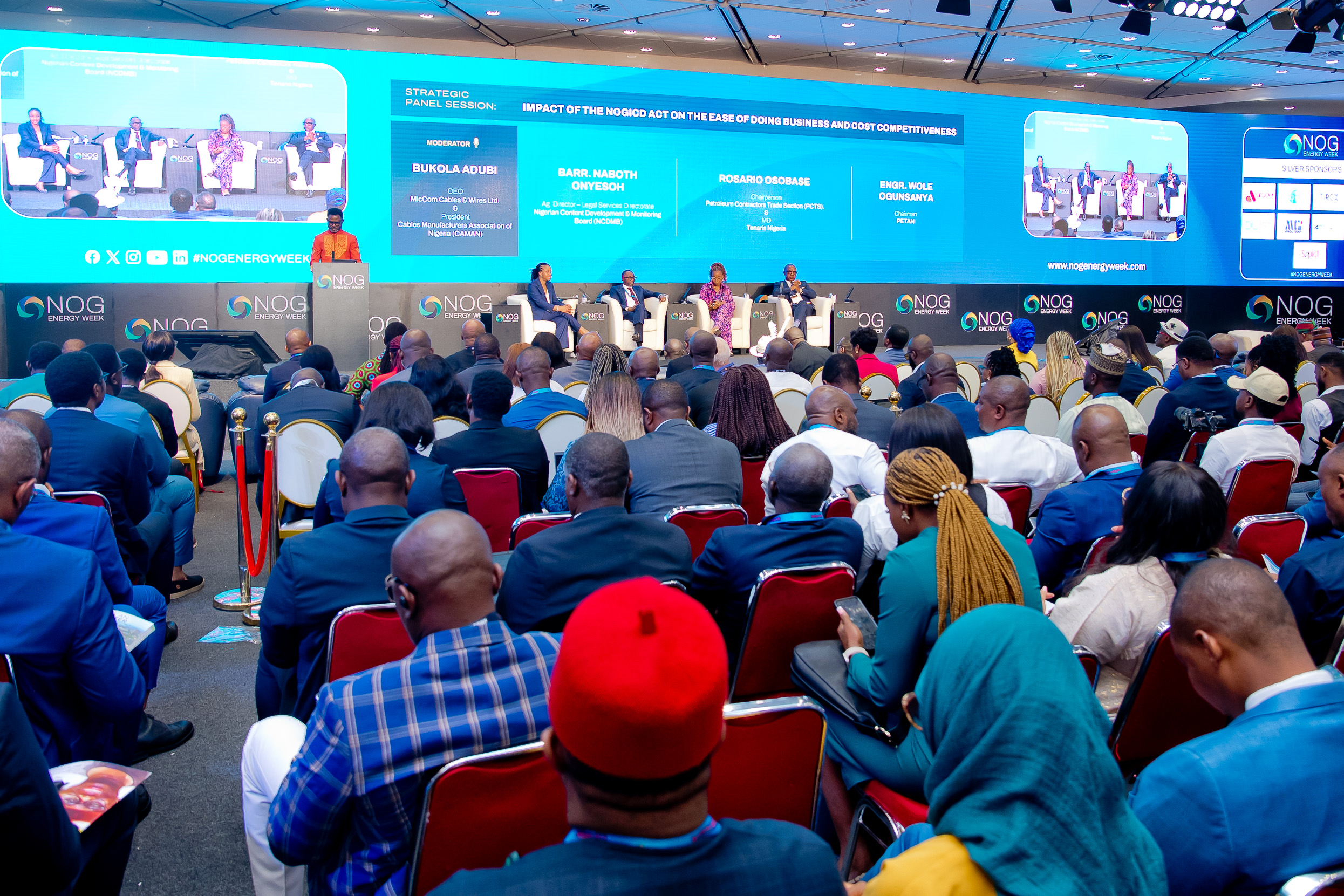
Nigeria’s maritime industry must shift its focus from asset ownership to developing world class talent, technical competence and operational excellence if it is to remain globally competitive. That was the central message from industry leaders during the strategic panel session titled “From Ownership to Competence: The Role of Maritime Training and Capacity Development,” held at the recently concluded NOG Energy Week 2026 in Abuja.
Moderated by Bassey Adie, Managing Director of Loyz Marine Services Limited, the session featured Dr. Taiwo Afolabi, Chairman of SIFAX Group; Abdul Kadir K. Ahmed, Managing Director and Chief Executive Officer of NLNG Shipping & Marine Services Limited (NSML); Silas Omomehin Ajimijaye, Acting Director of Planning, Research and Statistics at the Nigerian Content Development and Monitoring Board (NCDMB); Capt. Nicolas Bernard, Regional and Business Director of ABC Maritime AG and Managing Director of NBC Maritime Limited; Koni Duniya, President of the Female Seafarers Association of Nigeria (FESAN); and Temidayo E. Dahunsi, Head of Business Development and Commercial Strategy at XPO Marine Ltd.
YOU CAN ALSO READ: Why Jane Egerton-Idehen Left Meta for Nigeria’s Space Mission
Setting the tone for the discussion, Adie observed that although Nigeria has made significant progress in increasing indigenous ownership of maritime assets through local content policies, ownership was never intended to be the final destination.
She explained that the industry’s future would depend less on the number of vessels Nigerians own and more on the competence of the people managing them. With digitalisation, automation, evolving environmental regulations and higher international operational standards reshaping the maritime sector, she argued that competitiveness would increasingly be defined by knowledge, skills and execution.
“Ownership was never meant to be the destination; it was always the starting point,” she said. “Assets do not solve offshore challenges. People do. As our industry evolves, competitiveness will no longer be determined by who owns the assets but by what we know, how we operate, and how effectively we deliver.”
Responding to the moderator’s opening question, Abdul Kadir K. Ahmed surprised many in the audience by revealing that NSML does not own maritime assets. Instead, he explained, the company was established to provide technical ship management services and create opportunities for Nigerians to participate meaningfully in the global shipping industry.
Ahmed recalled how NSML deliberately invested in developing local expertise before assuming responsibility for managing vessels. Initially, vessel management was handled offshore while Nigerian professionals underwent rigorous international training through the LNG Cadetship Programme. Only after acquiring the necessary competence was technical management transferred to Nigerians.
“There is no shortcut,” Ahmed said. “Shipping operates on global standards. There is no local standard for shipping and maritime services. To compete internationally, you need strong systems, sound processes and, above all, competent people.”
He added that while effective systems are important, competent people ultimately determine whether organisations succeed, stressing that capacity development remains the industry’s most sustainable investment.
Building on that point, Capt. Nicolas Bernard argued that Nigeria’s next maritime milestone should be operational sovereignty rather than simply increasing vessel ownership.
Clarifying that NBC Maritime is a sister company within the ABC Maritime Group, Bernard said the organisation intends to transfer more than four decades of international technical ship management expertise into Nigeria.
According to him, the ambition is to establish the country’s first truly indigenous technical ship management capability outside the LNG sector. He maintained that vessels managed in Nigeria should command the same international confidence as those managed anywhere else in the world, adding that ship ownership and ship management require completely different skill sets.
“Ship ownership is a full time business. Ship management is another full time business,” he said, noting that developing technical management capability would ultimately strengthen Nigeria’s competitiveness in the global maritime industry.
Sharing XPO Marine’s growth story, Temidayo E. Dahunsi explained that competence had always preceded ownership in the company’s evolution.
He said XPO Marine began by representing international vessel owners when indigenous ownership was still relatively limited. Supported by opportunities created through Nigeria’s local content policy, the company deliberately focused on building technical knowledge, commercial understanding and industry reputation before acquiring assets of its own.
Although the journey was not without challenges, Dahunsi said continuous learning, strategic partnerships and steady improvement enabled the company to grow into an integrated offshore service provider, demonstrating that sustainable growth is built over time through competence.
Speaking from the regulatory perspective, Silas Omomehin Ajimijaye explained that the Nigerian Content Development and Monitoring Board has consistently prioritised collaboration in developing Nigeria’s maritime workforce.
He highlighted initiatives such as the Nigerian Content Consultative Forum and the Field Readiness Programme, which identify industry skills gaps and provide targeted training in sea time experience, engineering, offshore operations and safety certification.
According to him, the industry is evolving so rapidly that skills acquired years ago may no longer meet today’s operational requirements. This, he said, explains why the Board increasingly relies on data analytics, workforce mapping and industry demand to align training programmes with actual competence gaps.
Ajimijaye also disclosed that NCDMB is currently developing new policy frameworks that recognise competence as extending beyond ownership.
He explained that extensive stakeholder consultations would precede implementation and emphasised that companies need not necessarily own vessels to create value within the maritime ecosystem.
Drawing comparisons with the hospitality industry, he noted that businesses could specialise in technical ship management, maintenance, logistics, training and operational support while contributing meaningfully to Nigeria’s maritime development.
“What we discourage is passive participation,” he said. “We want companies that are genuinely building capacity and contributing value to the industry’s long term competitiveness.”
Offering a broader industry perspective, Dr. Taiwo Afolabi stressed that Nigeria’s ambition to become a globally respected maritime nation would require sustained investment in people, institutions and internationally recognised standards alongside infrastructure development.
He emphasised that leadership, continuous professional development and stronger collaboration across the maritime value chain remain critical to building a globally competitive industry capable of supporting long term national growth.
YOU CAN ALSO READ: Andy Burnham Becomes UK Prime Minister, Promises Economic Renewal and National Unity
The discussion also highlighted the importance of inclusion in developing the next generation of maritime professionals.
Representing the Female Seafarers Association of Nigeria, Koni Duniya called for greater investment in training, mentorship and opportunities for women entering the maritime profession. She noted that expanding female participation would strengthen Nigeria’s maritime talent pool and help prepare more professionals for leadership roles in an increasingly technology driven industry.
As the session concluded, one message resonated across every contribution. Nigeria’s maritime future will not be determined solely by the number of vessels flying its flag or the infrastructure it builds. Its long term success will depend on investing in people, strengthening technical competence, embracing global standards and developing professionals capable of competing confidently on the international stage.
For the panellists, ownership may have opened the door, but competence will determine how far Nigeria’s maritime industry can ultimately go.