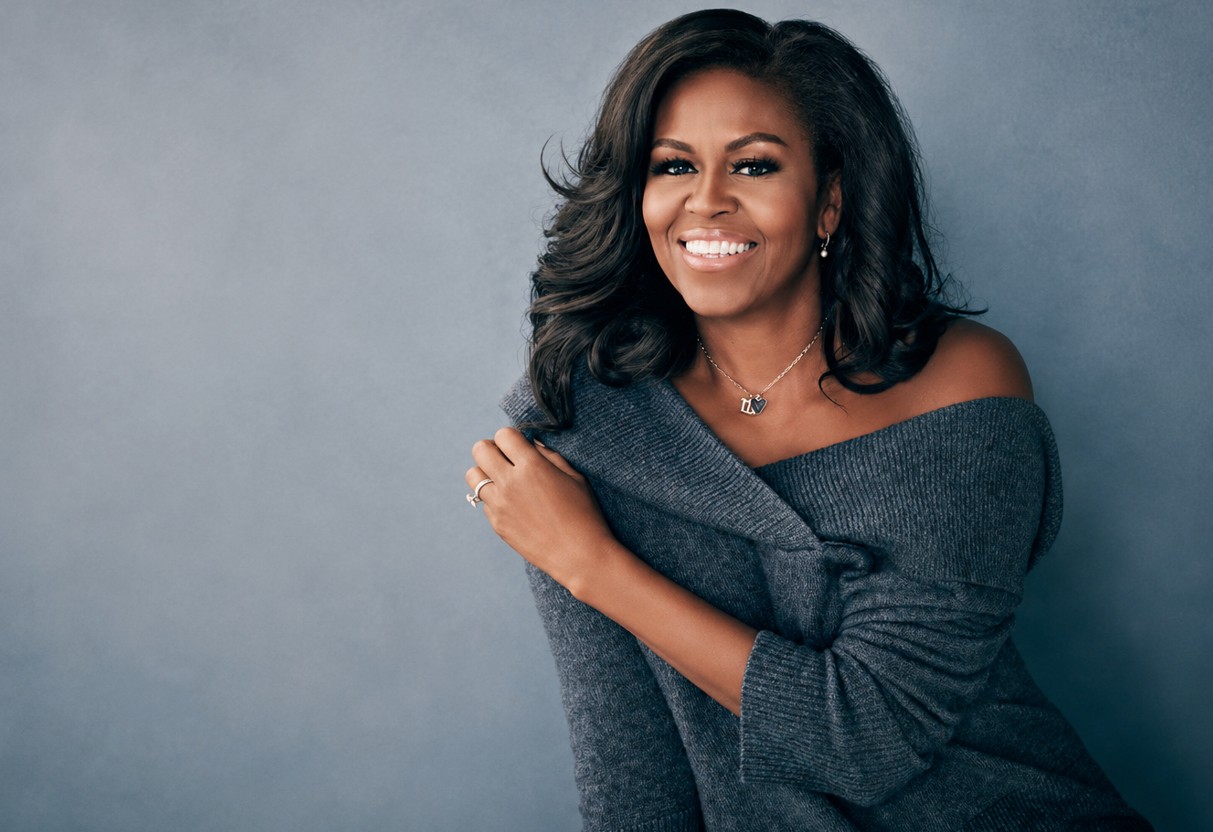
In an age defined by division, uncertainty and growing social fragmentation, perhaps the most radical act was not outrage, resistance or even ambition. Perhaps the most radical act was choosing hope. For Michelle Obama, hope was neither a slogan nor an abstract emotion. It was a deliberate decision, a daily commitment and an act of courage powerful enough to transform individuals, communities and entire nations.
Standing before a gathering at the opening of the Obama Presidential Center, the former First Lady delivered a message that stretched far beyond a tribute to her husband or a reflection on an extraordinary political journey. Instead, she offered something far more profound: a reminder that democracy was sustained not by monuments, politicians or institutions, but by ordinary people who chose every single day to show up for one another. For Michelle Obama, that was where the true story of America resided, not in headlines or political rhetoric, but in the quiet heroism of everyday lives.
She said she saw that story unfolding in teachers who spent their own money to give students opportunities they might never otherwise experience. She saw it in workers struggling to provide a better future for their children, in business owners who refused to shut their doors despite immense challenges, and in volunteers, caregivers, delivery workers and neighbours who continued to serve their communities without expecting recognition. These were the people she believed formed the beating heart of a nation.
YOU CAN ALSO READ: The Business of Becoming: Niyi Adesanya’s Formula for Leadership and Transformation
Throughout her public life, Michelle Obama had become one of the world’s most influential advocates for empathy, inclusion and collective responsibility. Yet what continued to distinguish her was her extraordinary ability to transform lofty ideals into deeply personal truths. She reminded people that democracy was not something that existed only within the walls of government buildings; it existed in everyday interactions, in acts of kindness and in the willingness to recognise the humanity in people who might look, pray, vote or live differently from ourselves.
For her, that recognition was essential because the moment societies began to deny the humanity of others, they started a dangerous descent that threatened the foundations of equality and justice. Her message carried particular urgency in a world increasingly consumed by polarisation, misinformation and social division. At a time when many were encouraged to retreat into ideological corners, Michelle Obama offered a radically different invitation: to reconnect, to put down phones, to have meaningful conversations, to laugh together, to cry together and to become neighbours again. In her view, these ordinary acts were not distractions from democracy; they were democracy itself.
This philosophy shaped the years she and Barack Obama spent in the White House. During their administration, they intentionally opened the doors of America’s most iconic residence to people who rarely found themselves represented in positions of power. Families struggling to send their first child to university, military families sacrificing alongside loved ones in uniform, Indigenous communities preserving their cultural identity, immigrants pursuing impossible dreams and young people navigating difficult realities all found a place within that national story. For Michelle Obama, these individuals were never secondary participants in the American narrative; they were the narrative itself.
Beyond her civic message, she also offered an equally moving personal reflection on Barack Obama. She spoke about a journey marked not only by historic achievements but also by remarkable steadiness under extraordinary pressure. She praised his unwavering character, describing a leader who, despite relentless scrutiny and unprecedented challenges, remained grounded in optimism, decency and moral clarity. For eight years in one of the most demanding positions on earth, she said she watched him endure criticism without surrendering to bitterness. Instead of allowing pressure to diminish him, he allowed it to reveal his truest self.
Perhaps that was what had always made Michelle Obama such a compelling voice. She did not celebrate perfection; she celebrated perseverance. She did not ask people to become extraordinary overnight; she asked them to remain steadfast, even when circumstances became difficult. Her philosophy was rooted in a simple but transformative truth: lasting change was never sudden. It was built slowly, one decision at a time, one conversation at a time and one act of kindness at a time.
She compared this process to climbing a mountain, an arduous and often unglamorous journey that demanded patience, persistence and collective effort. Progress was not always visible in the moment, but eventually there came a point where people rose above the tree line and saw a breathtaking vista that made every difficult step worthwhile. That image perfectly encapsulated her worldview. Optimism was not naïve; it was disciplined. Hope was not passive; it was active. And democracy itself was not guaranteed; it was a responsibility.
YOU CAN ALSO READ: Building Without Borders: The Shuo Wang Story and the Future of Global Employment
Perhaps that was why Michelle Obama continued to resonate with millions of people across generations. Her influence had never depended on holding political office. It stemmed from her extraordinary ability to remind people of their own power. She taught that change did not begin with governments or institutions. It began with individual choices: choosing to speak up, choosing to participate, choosing to vote, choosing empathy over indifference, choosing community over isolation and choosing hope over despair.
Ultimately, Michelle Obama was not asking people to build monuments. She was asking them to build one another. Because true legacy, she argued, was not measured by awards, titles or the number of zeros in a bank account. It was measured by the lives people touched, the burdens they helped carry and the courage they inspired in others. That, she said, was how enduring societies were built. That was how democracies survived. And perhaps, in an anxious and divided world, that was Michelle Obama’s greatest lesson of all: when people truly saw one another, there was no limit to how high they could rise together.