There is an old saying that the best time to plant a tree was yesterday; the next best time is today. For Nigeria’s energy industry, that tree is leadership. As the sector races to attract investment, accelerate Final Investment Decisions (FIDs), deepen local content and navigate the global energy transition, another challenge is unfolding with equal urgency: the imminent retirement of a generation of experienced professionals whose knowledge has shaped the country’s oil and gas industry for decades.
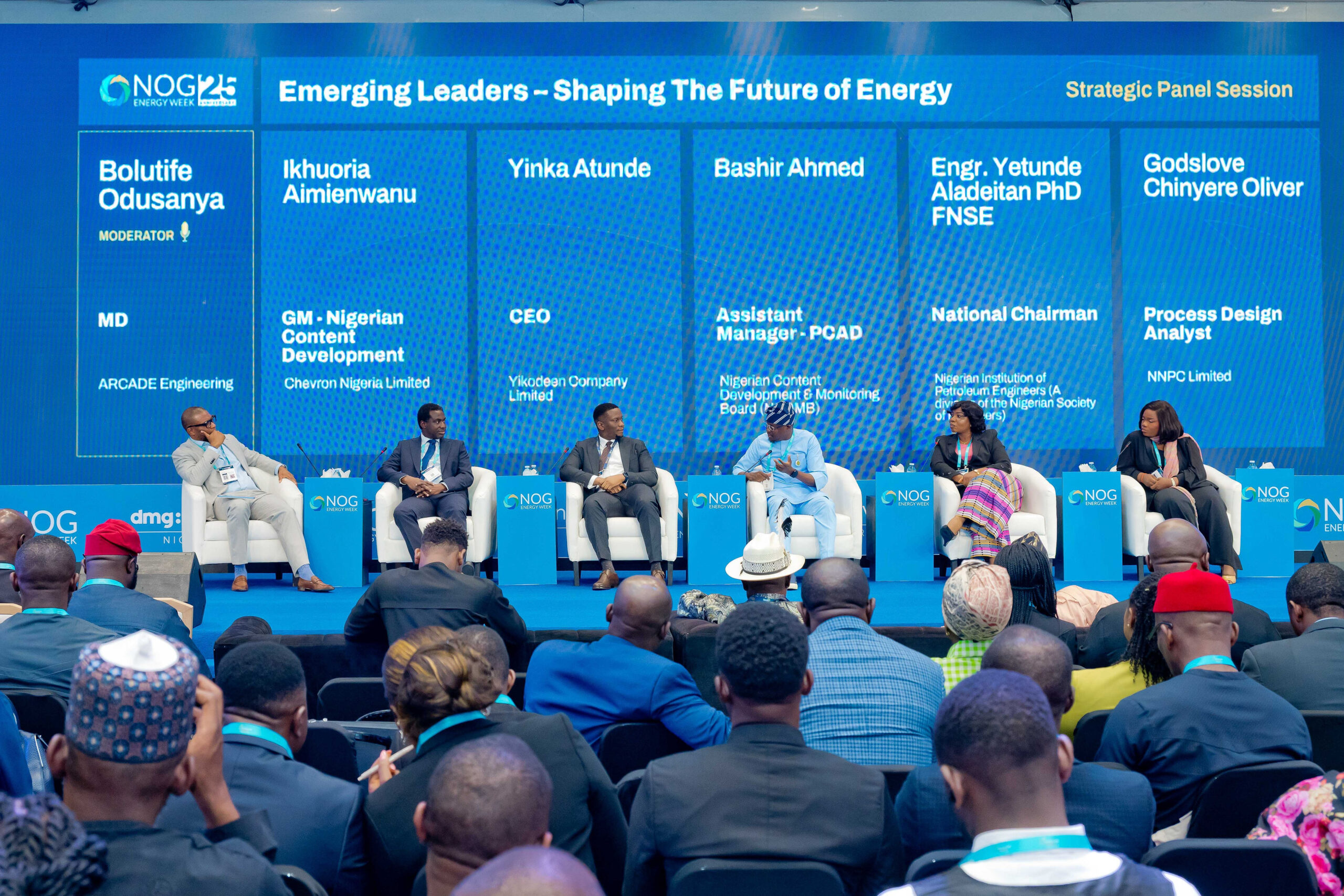
The question confronting operators, regulators, manufacturers and policymakers is no longer whether a new generation will emerge, but whether today’s institutions are intentionally preparing them to lead. It was this defining question that anchored one of the most compelling conversations at this year’s NOG Energy Week, where industry leaders gathered to explore what it truly means to develop emerging leaders capable of securing Nigeria’s energy future.
Rather than limiting the discussion to youth empowerment, the panel challenged conventional thinking about leadership itself. It argued that leadership is not determined by age, titles or years of experience, but by competence, responsibility, trust and the willingness of organisations to deliberately create opportunities for capable people to lead. Throughout the conversation, the panellists returned repeatedly to one powerful conclusion: Nigeria’s energy future will depend as much on developing people as it does on developing projects.
YOU CAN ALSO READ: Aliko Dangote’s Master Plan to Make Africa a Global Industrial Power
Setting the tone was Nigeria Content Development Manager, Chevron Nigeria Limited, Ikhuoria Aimienwanu, who observed that the industry is entering a period of unprecedented workforce transition. Thousands of experienced professionals are approaching retirement, creating both a challenge and an opportunity for the next generation. For him, succession planning cannot simply be about replacing individuals; it must be about preparing future leaders with the technical expertise, strategic thinking and commercial awareness required to manage increasingly complex energy projects.
Young professionals, he argued, should be exposed early to project management, engineering, subsurface operations, decision-making and leadership responsibilities while experienced mentors remain available to guide them. Technical competence may open the door, he noted, but understanding the entire value chain, thinking strategically and making informed decisions are what ultimately distinguish leaders from specialists.
That conversation naturally flowed into the question of trust, where Managing Director and Chief Executive Officer, Yikodeen Company Limited, Yinka Atunde, argued that organisations often speak about creating opportunities for young people, yet stop short of giving them real authority. Drawing from his own entrepreneurial journey, Atunde reflected on building Yikodeen alongside young Nigerians barely out of their teenage years, proving that age is not necessarily a predictor of capability. Experience, he insisted, is accumulated through execution rather than observation.
“We need to stop simply giving opportunities,” he said. “We must begin giving responsibilities.” Yet he cautioned emerging leaders against confusing visibility with preparedness, insisting that technical competence, financial discipline, organisational leadership and sound decision-making must always precede public recognition because visibility without substance can become professionally destructive.
The discussion broadened through the regulatory perspective of Assistant Manager, Project Certification and Authorisation Division (PCAD), Nigerian Content Development and Monitoring Board (NCDMB), Bashir Ahmed, who explained that regulation itself is undergoing a significant transformation. Nigeria, he observed, no longer competes only within its borders but against other energy-producing nations for investment capital and Final Investment Decisions. Regulators, therefore, can no longer afford to focus exclusively on compliance enforcement but must increasingly become enablers of investment while preserving national interest.
“Without projects,” he remarked, “there is no new workforce,” emphasising that every sanctioned project creates opportunities for engineers, manufacturers, contractors and emerging professionals to acquire practical experience. Local content, he argued, cannot grow independently of project development.
Ahmed extended that philosophy into leadership itself, insisting that leadership cannot be developed inside classrooms alone. Organisations must deliberately expose younger professionals to negotiations, policy discussions, stakeholder engagements and high-pressure environments where decisions carry significant commercial implications.
Drawing from his own experience at NCDMB, he described how younger officers have increasingly represented the organisation in complex engagements involving operators, ministries, the National Assembly and industry stakeholders. Leadership, he argued, develops when responsibility is delegated, not when authority remains permanently concentrated at senior levels. Sometimes, organisations simply have to trust emerging leaders enough to allow them to learn by doing.
Supporting that perspective from the standpoint of professional development, National Chairman, Nigerian Institute of Petroleum Engineers (A Division of the Nigerian Society of Engineers), Engr. Yetunde Aladeitan, PhD, FNSE, challenged one of the industry’s most enduring assumptions that academic excellence alone prepares professionals for leadership. Drawing on years of interviewing engineers, she observed that candidates with prior industry exposure consistently outperform those whose strengths exist only on paper.
The industry’s greatest challenge, she argued, is not an intelligence deficit but an exposure deficit. Through specialised reservoir simulation programmes, mentoring initiatives and structured industry engagement, the Nigerian Institute of Petroleum Engineers is helping bridge that gap by connecting young professionals directly with experienced practitioners and real-life projects. “We need to move beyond qualifications,” she stressed. “Practical experience is what prepares future leaders.”
Representing the very generation under discussion, Process Design Analyst, NNPC Limited, Godslove Chiyere Oliver, brought a refreshing perspective rooted in lived experience. She challenged the long-standing practice of expecting young professionals to spend years merely supporting senior colleagues before earning meaningful responsibilities. Organisations, she argued, must intentionally create opportunities for emerging professionals to lead projects, own outcomes and demonstrate their capabilities. Leadership cannot flourish where authority is endlessly postponed. She also urged young professionals to become strategic about their own development, insisting that visibility should never be pursued for its own sake but should always reflect genuine competence, measurable contribution and clearly defined career goals.
As the discussion progressed, the panellists found common ground on what distinguishes future leaders from technically competent professionals. Aimienwanu emphasised that systems thinking, stakeholder management, strategic influence, collaboration and intellectual curiosity are becoming just as important as engineering excellence. Atunde reiterated that organisations must trust young people enough to give them real responsibility rather than perpetual supervision. Ahmed argued that institutions must expose emerging professionals to real-world challenges instead of shielding them from pressure, while Aladeitan maintained that structured mentorship and practical exposure remain indispensable to developing industry-ready professionals. Oliver, meanwhile, encouraged young leaders to embrace continuous learning and adaptability as technology continues to reshape the energy industry.
Questions from the audience shifted the conversation beyond personal ambition towards institutional responsibility. Participants challenged industry leaders to create structured platforms capable of preparing thousands of young professionals rather than celebrating isolated success stories. Responding to those concerns, Ahmed highlighted NCDMB’s Industry Readiness Programme, explaining that the initiative marks a shift away from measuring success by the number of people trained towards assessing whether trainees possess the competencies the industry genuinely requires.
The emphasis, he explained, is no longer quantity but employability, a philosophy that resonated strongly with Aladeitan’s advocacy for practical exposure, Aimienwanu’s call for strategic mentoring, Atunde’s insistence on trusting young professionals with responsibility and Oliver’s appeal for organisations to provide meaningful leadership opportunities.
The conversation also looked ahead to the impact of artificial intelligence on the future workforce. Rather than viewing AI as a disruptive threat, Ahmed described it as a powerful tool capable of transforming decision making by enabling organisations to analyse vast amounts of operational data more efficiently. Emerging leaders, he suggested, must embrace technology not as a replacement for human judgment but as a catalyst that enables professionals to focus on more strategic, innovative and value-adding responsibilities.
YOU CAN ALSO READ: Technology Revolution African Healthcare Cannot Afford to Ignore
Oliver agreed that adaptability would become one of the defining qualities of tomorrow’s leaders, while Aimienwanu maintained that curiosity and continuous learning will increasingly distinguish those prepared to lead in a rapidly changing energy landscape.
By the conclusion of the session, the conversation had evolved into something far more profound than a discussion about youth empowerment. It became a compelling blueprint for leadership succession within Nigeria’s energy industry, one that places competence before recognition, mentorship before succession, responsibility before authority and trust before tenure. Collectively, the panellists challenged organisations to rethink how leaders are identified, developed and empowered, arguing that emerging leadership should not be treated as a future aspiration but as a present-day investment requiring deliberate action from regulators, operators, manufacturers, professional institutions and young professionals alike.
The most enduring message from the discussion was perhaps the simplest. Nigeria’s energy future will not be secured solely by new discoveries, favourable policies or increased investment. It will be determined by whether today’s leaders are willing to trust the next generation with meaningful responsibility, equip them with practical experience and create the enabling environment in which leadership can flourish. Judging from the depth of conversation at this year’s NOG Energy Week, that future is already beginning to take shape.