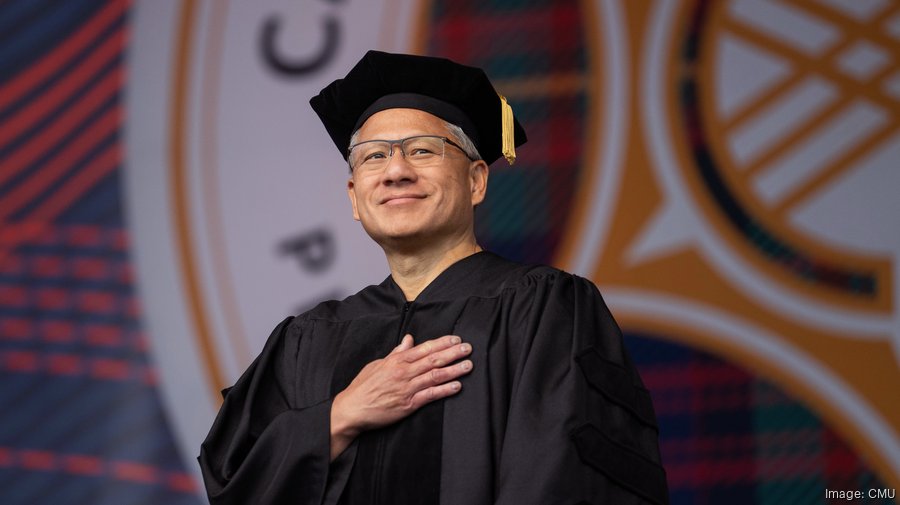
At a defining moment for technology, leadership, and the future of human innovation, Jensen Huang stood before the graduating class of Carnegie Mellon University not merely as the founder of one of the world’s most influential technology companies, but as a living embodiment of resilience, reinvention, and the immigrant dream that continues to shape modern America.
Receiving an honorary Doctor of Science and Technology degree, the founder and CEO of NVIDIA delivered a commencement address that felt less like a ceremonial speech and more like a blueprint for navigating the age of artificial intelligence.
His message to graduates was urgent, optimistic, and deeply personal. Jensen Huang
“You are entering the world at an extraordinary moment,” Huang declared. “A new industry is being born. A new era of science and discovery is beginning. AI will accelerate the expansion of human knowledge and help solve problems once beyond our reach.”
Then came the line that captured the spirit of the address and electrified the audience:
“We are all standing at the same starting line. This is your moment to help shape what comes next. So run. Don’t walk.”
YOU CAN ALSO READ: Uche Ugboh: Banker Who Learned Early That Salary Alone Was Not Enough
The speech unfolded as both a reflection on the past and a warning about the pace of the future. But beyond the applause worthy statements about artificial intelligence and global transformation was something far more compelling: the story of a boy whose family arrived in America with almost nothing, and who would eventually help redefine modern computing.
Huang spoke candidly about his upbringing as a first generation immigrant. At just nine years old, he and his older brother were sent to the United States, eventually finding themselves at a Baptist boarding school in rural Kentucky. His parents later joined them, sacrificing stability and status for opportunity. His father, a chemical engineer, and his mother, who worked as a maid at a Catholic school, embodied the immigrant pursuit of possibility. Those early years were far from glamorous.
Huang recalled waking up at 4 a.m. to deliver newspapers and later working as a dishwasher at Denny’s, a job he jokingly described at the time as a “major career advancement.” Yet in those moments of hardship, he discovered something foundational about ambition in America: not certainty, but possibility.
“How can we not be romantic about America?” he asked.
The emotional core of the speech rested not in Silicon Valley mythology, but in humility. Huang dismantled the illusion that success arrives through brilliance alone. Instead, he described failure as the defining engine behind innovation.
When he co founded NVIDIA at age 30 alongside Chris Malachowsky and Curtis Priem, he admitted they had little understanding of how to build a company. Their early technology failed. Money disappeared rapidly. The company stood on the edge of collapse.
One of the most dramatic moments in his recollection involved traveling to Japan to meet executives at Sega after realizing NVIDIA could not deliver the technology it had promised. Huang described the experience as humiliating, forcing him to ask not only to be released from the contract but also to request payment that would ultimately keep the company alive. To his surprise, Sega agreed.
That experience, Huang explained, permanently reshaped his understanding of leadership.
“Being CEO is not about power,” he said. “It is about the responsibility that comes with keeping the company alive.”
The lesson became foundational to NVIDIA’s culture of constant reinvention. For more than three decades, the company repeatedly rebuilt itself, evolving from a graphics chip manufacturer into the central infrastructure provider powering the global AI revolution.
What made Huang’s address particularly significant was its timing. The world is currently witnessing an unprecedented acceleration in artificial intelligence, with NVIDIA positioned at the center of that transformation. The GPUs developed by the company have become the backbone of modern AI systems, powering everything from machine learning models to advanced robotics and autonomous technologies.
Yet Huang resisted framing AI purely as a technological breakthrough. Instead, he presented it as a societal turning point comparable to electricity, the internet, and the industrial revolution.
“Artificial intelligence has reinvented computing,” he explained. “From human coding to machine learning. From software running on CPUs to neural networks running on GPUs. From following instructions to understanding, reasoning, planning, and using tools.”
In Huang’s view, AI is not merely another software trend. It is the emergence of “intelligence manufacturing at scale,” a shift capable of transforming every sector of the economy.
Importantly, he did not dismiss the anxieties surrounding AI. He acknowledged concerns about automation, job displacement, and the concentration of technological power. But rather than advocating fear, Huang urged society to approach the future with responsibility and ambition.
“History shows that societies that retreat from technology do not stop progress,” he warned. “They only surrender the opportunity to shape it and to benefit from it.”
Perhaps the most striking aspect of the speech was Huang’s insistence that AI should democratize opportunity rather than restrict it.
“Only a fraction of people in the world know how to write software,” he said. “Now anyone can ask AI to build something useful. Everyone is now a programmer.”
For Huang, this is the true promise of artificial intelligence: not replacing human capability, but amplifying it. He described a future where shopkeepers can create digital businesses, carpenters can design advanced projects using AI powered tools, and professionals across industries can solve problems previously inaccessible without technical expertise.
At the same time, he issued one of the most memorable warnings of the address:
“AI is not likely to replace you, but someone using AI better than you might.” It was a statement that captured the reality of the emerging economy. Adaptation, not resistance, will determine relevance.
YOU CAN ALSO READ: Why Moyosore Ola-Oludiya Left PwC to Lead Oakwood Knowledge Academy
Huang also framed AI as an opportunity to rebuild industrial capacity, particularly in the United States. He predicted massive investments in chip factories, data centers, advanced manufacturing facilities, and energy infrastructure, arguing that AI would trigger one of the largest industrial buildouts in modern history.
“This is your time,” he said, referring not only to engineers and programmers, but also to electricians, builders, technicians, and skilled laborers.
The speech ultimately transcended technology. It became a meditation on work itself.
Drawing inspiration from Carnegie Mellon’s motto, “My heart is in the work,” Huang challenged graduates to pursue careers not defined solely by prestige or financial success, but by meaningful contribution.
“Build something worthy of your education, your potential, and the people who believed in you long before the world did,” he urged.
In an era increasingly shaped by uncertainty, disruption, and accelerated change, Huang’s message resonated because it balanced realism with hope. He did not promise an easy future. He promised a consequential one. And perhaps that is what made the address unforgettable.
At a time when artificial intelligence dominates headlines with fear and speculation, Jensen Huang reframed the conversation around responsibility, opportunity, and human potential. His story reminded graduates that revolutions are rarely built by people who feel fully prepared. They are built by those willing to move forward anyway.
The age of AI, Huang suggested, belongs not to those who hesitate, but to those willing to run toward the future before the world fully understands what it is becoming.