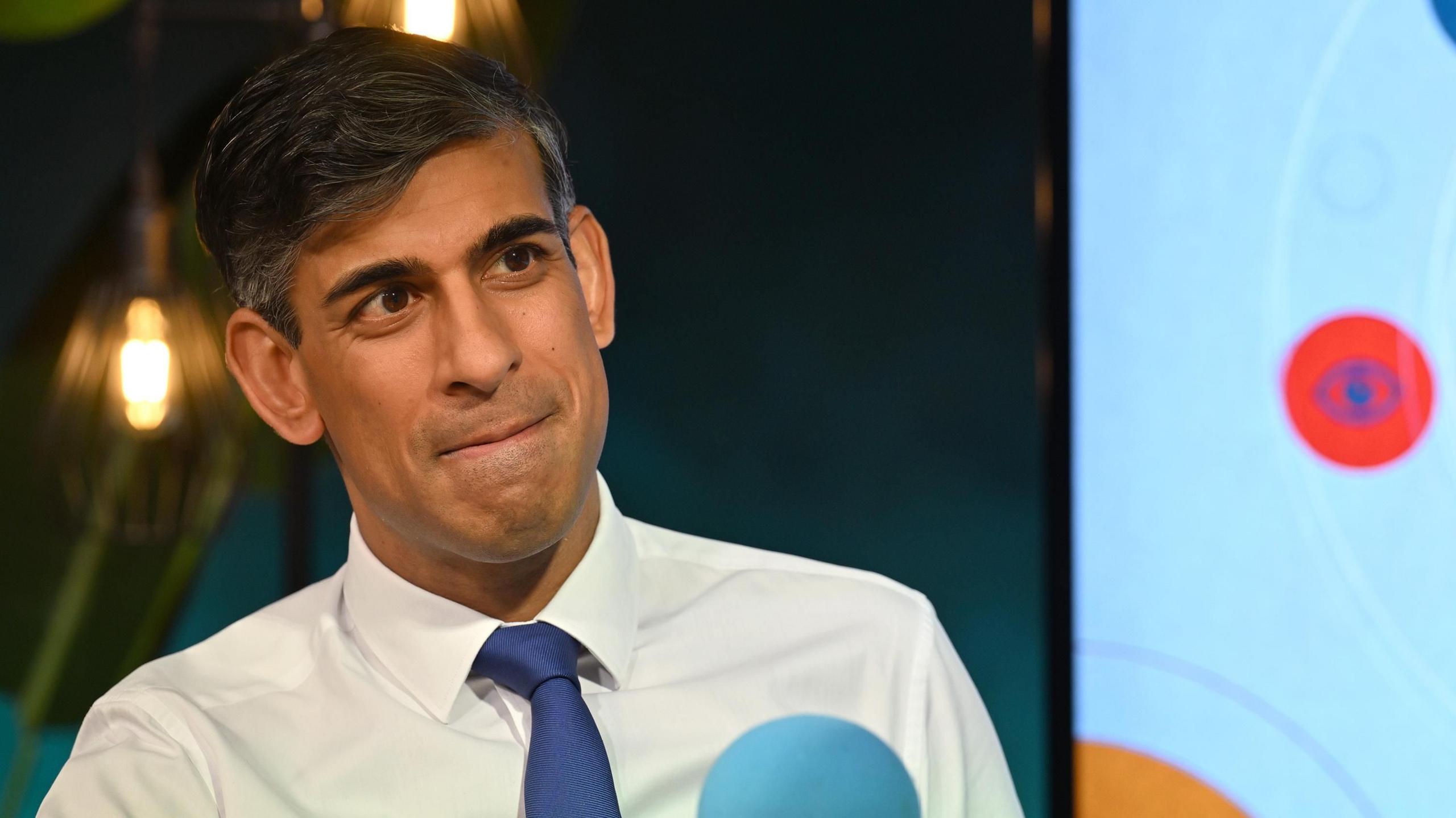
At a time when artificial intelligence is reshaping economies, workplaces, and the future of global competition, former UK Prime Minister Rishi Sunak delivered more than a speech about technology. Standing before entrepreneurs, founders, and business leaders gathered through Goldman Sachs’ 10,000 Small Businesses programme, Sunak offered a deeply personal reflection on ambition, resilience, leadership, and the urgent need for Britain’s small businesses to embrace the AI revolution before they are left behind. From the very beginning, the conversation felt less like a policy address and more like a return to first principles. Sunak did not open with economic statistics or political rhetoric. Instead, he began with memories of his childhood, recalling the small pharmacy his mother built when he was just 13 years old.
He remembered stocking shelves, delivering prescriptions across the neighborhood on his bicycle, and eventually handling bookkeeping for the family business. Those early experiences, he explained, shaped his understanding of entrepreneurship long before he entered politics, attended Stanford, or walked through the doors of Downing Street.
For Sunak, small businesses are not abstract economic units. They are deeply personal stories of sacrifice, aspiration, and survival. His mother, he said, was not simply a pharmacist. She was a woman searching for independence, financial stability, and the ability to create opportunities for her family. Like millions of entrepreneurs across Britain, she made the difficult decision to step out on her own despite uncertainty and risk. That experience, he explained, gave him lifelong respect for founders and business owners who carry the burden of building something from nothing.
YOU CAN ALSO READ: How TUBO Became the Creative Force Behind Olori Ivie Emiko’s Royal Identity
Throughout the discussion, Sunak repeatedly returned to one central belief: small businesses are the backbone of Britain’s economy and identity. They are not only engines of growth but also anchors within local communities, high streets, and families. Yet while he celebrated entrepreneurship, he also issued a warning. Artificial intelligence, he argued, is not a distant technological trend waiting somewhere on the horizon. It is already transforming industries at a pace most people still underestimate. According to Sunak, AI will likely have “twice the impact of the Industrial Revolution in half the time.” It was one of the defining moments of the conversation.
Sunak compared AI to historic breakthroughs like steam power and electricity, describing it as a “general-purpose technology” capable of transforming every sector of society. But unlike previous industrial shifts that unfolded over decades, he believes the AI revolution is accelerating at unprecedented speed. His confidence stems partly from his current work advising companies such as Anthropic and Microsoft after leaving office. Through those roles, he said, he has gained firsthand exposure to just how quickly AI capabilities are evolving.
Still, the most compelling part of Sunak’s argument was not about Silicon Valley or global AI supremacy. It was about what he called “the race for everyday AI.” While headlines focus on whether the United States or China will dominate artificial general intelligence, Sunak believes the real competition lies elsewhere: which countries and businesses can successfully integrate AI into daily operations, decision-making, customer experience, and productivity. And in that race, adoption matters more than hype. “The countries and companies that adopt, adopt, adopt will be the biggest winners,” he declared.
But he warned that Britain risks creating a dangerous “K-shaped economy” if small businesses fail to keep pace while large corporations accelerate ahead. Such an imbalance, he argued, would erode one of the defining characteristics of British society, the strength and diversity of local enterprise. For Sunak, AI is not simply about efficiency or cost reduction. He believes it has the power to democratize opportunity globally. He described a future where AI could give ordinary people access to world-class healthcare, education, and expertise regardless of geography or wealth. In his view, the technology has the potential to “lift the floor for humanity.”
Yet despite his optimism, Sunak acknowledged the anxieties many business owners feel. Across the discussion, entrepreneurs spoke candidly about fears surrounding job displacement, misinformation, governance risks, and uncertainty about where AI truly fits within their businesses. One marketing executive described how a client demanded “double the output for a third of the price” after the emergence of ChatGPT. Another explained how AI initially caused confusion and overconfidence among employees before the company established clearer boundaries and safeguards. What emerged from the conversation was not blind enthusiasm but a practical, grounded approach to adoption.
Sunak repeatedly emphasized that leaders do not need to become software engineers overnight. They do not need advanced coding expertise or expensive infrastructure. What matters most, he argued, is mindset. Leadership, curiosity, and willingness to experiment are the real competitive advantages. “The responsibility for AI cannot sit in the IT department,” he said. “It has to start with the leaders.”
The entrepreneurs on stage echoed that sentiment. Several described AI not as a replacement for workers but as a tool that removes repetitive administrative burdens, allowing employees to focus on creativity, judgment, and meaningful problem-solving. One business owner explained how AI transformed communication workflows, turning scattered thoughts into polished emails and business documents within seconds. Another revealed how her company used AI to analyze customer complaints about competitor products, helping them redesign their own offerings and outperform rivals in online sales rankings.
Perhaps the most striking theme throughout the event was accessibility. Unlike previous technological revolutions that demanded massive infrastructure spending, Sunak argued that AI adoption is surprisingly affordable. Some entrepreneurs admitted that their AI education began with £15 online courses and experimentation using publicly available tools. According to Sunak, this levels the playing field dramatically for small businesses. Large corporations may possess scale and resources, but they are often slowed by bureaucracy and complex systems. Small businesses, by contrast, can move quickly, adapt faster, and implement change with agility. In many ways, he suggested, the AI era favors entrepreneurial thinking.
The discussion also explored the importance of workforce inclusion. Sunak stressed that AI adoption succeeds only when employees are part of the process rather than passive recipients of change. Business owners shared stories of weekly AI training sessions, collaborative experimentation, and involving teams in identifying operational “pain points” that technology could solve. This cooperative approach, several speakers argued, reduced fear and encouraged enthusiasm among staff.
Another major topic was responsible deployment. In sectors involving sensitive information such as healthcare and social care, entrepreneurs described how they built AI systems with safeguards to protect personal data while still benefiting from automation and operational efficiency. Sunak acknowledged that governance concerns remain legitimate, but he argued strongly against introducing excessive new regulations that could stifle innovation before businesses have the chance to adapt. Instead, he encouraged firms to establish practical guardrails internally while continuing to experiment and evolve.
YOU CAN ALSO READ: “Whoever Feeds You Can Enslave You”: Obasanjo’s Stark Warning on Africa’s Future
As the session drew to a close, Sunak’s message became increasingly clear. The future will not belong simply to the largest companies or the most technically advanced organizations. It will belong to businesses willing to learn quickly, adapt continuously, and move decisively. AI, he insisted, is not a luxury reserved for tech giants. It is a tool that could empower ordinary entrepreneurs in extraordinary ways.
Reflecting again on his mother’s pharmacy, Sunak imagined how transformative AI could have been for her small business decades ago, improving customer service, reducing administrative stress, and creating new opportunities for growth. That personal connection gave the conversation its emotional center. Behind the policy discussions and technology forecasts was a broader philosophy about economic opportunity itself. Sunak’s vision was ultimately less about machines and more about people, founders trying to build better futures for their families, employees seeking more meaningful work, and communities hoping to remain economically vibrant in an age of rapid technological disruption.
For Britain’s small businesses, his message was unmistakable: the AI revolution is already here, and those willing to embrace it now may define the next chapter of economic leadership.