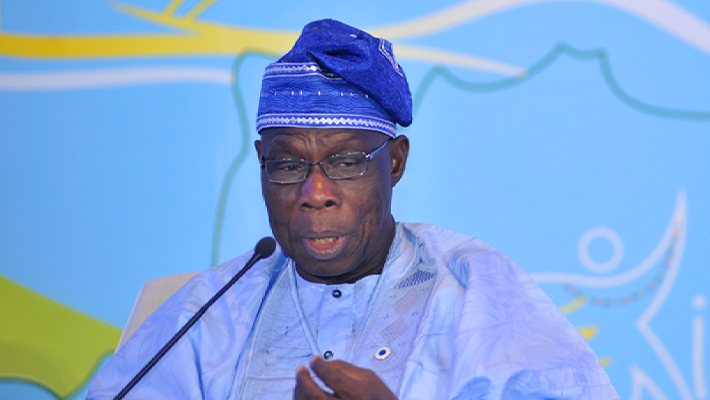
For many African leaders, history is something studied. For former Nigerian President Olusegun Obasanjo, history is something lived. Inside the Wilson Center in Washington D.C., a room filled with diplomats, policymakers, scholars, and members of the African diaspora gathered for a conversation that quickly evolved into something much larger. Introduced by Oge Onubogu, Director of the Wilson Center’s Africa Program, Obasanjo was described in terms that reflected not just his political journey, but his stature across the continent. Known widely as “Baba,” a title carrying weight, wisdom, and reverence, he arrived not with prepared remarks but with decades of experience spanning military leadership, democratic governance, diplomacy, and continental institution-building.
The discussion was framed around a pressing question: what does leadership in Africa require at a time of democratic uncertainty, renewed coups, economic frustrations, and shifting geopolitical alliances? Obasanjo’s answer stretched across history, personal experience, and hard-earned lessons. He argued that Africa’s leadership story cannot be painted entirely in success or failure. Rather, it exists somewhere in between. There have been moments when African nations acted together and achieved historic outcomes. There have also been moments when fragmentation carried significant consequences.
To understand Africa’s present, Obasanjo insisted one must revisit its post-independence beginnings. Following independence, African leaders recognized that individual nations could not move forward in isolation. That realization led to the creation of the Organization of African Unity (OAU), which carried two ambitious objectives: eliminate colonialism and advance Africa’s development through collective progress. On one front, he believes history delivered a clear verdict: the continent succeeded.
YOU CAN ALSO READ: The Woman Designing Fashion That Women Could Feel Before They Saw It
Colonial rule was dismantled, and by the turn of the century, apartheid itself had collapsed in South Africa. Yet the second ambition, economic and political integration, proved more complicated. According to Obasanjo, Africa attempted to pursue both political and economic integration simultaneously and failed to establish the right sequence. “We did not know whether we should put the horse before the cart or the cart before the horse,” he reflected.
That realization led to the transition from the OAU to the African Union and a stronger emphasis on economic integration, institutional reform, and continental coordination. The conversation soon shifted toward one of Obasanjo’s most revealing stories: the origins of the New Partnership for Africa’s Development (NEPAD). He recalled a moment in 2000 involving himself, former South African President Thabo Mbeki, and Algeria’s leadership, who represented separate international groupings at a meeting with major global powers in Tokyo. The encounter, he recounted with dry humor, ended almost as quickly as it began. “In 25 minutes, we were dismissed.”
What followed would become a defining lesson. Gathering afterward in a hotel room, the leaders confronted an uncomfortable question: if global powers had asked Africa for its development blueprint, what exactly would the continent have presented? The answer was not immediately clear. That realization eventually sparked the collaborative effort that evolved into NEPAD, an initiative designed to establish Africa’s development priorities on African terms. For Obasanjo, the lesson remains relevant today: “Africa’s 54 countries cannot act in silos and expect outcomes that serve the collective interest.”
Throughout the discussion, he returned repeatedly to one recurring theme: collective leadership. He cited the close working relationship among himself, Thabo Mbeki, and Libyan leader Muammar Gaddafi during crucial periods in African diplomacy. Responsibilities were shared, regions were coordinated, and decisions often emerged through consultation rather than competition. That model, he suggested, helped Africa navigate difficult moments. But fragmentation created consequences.
Libya became a central example. Obasanjo argued that Africa believed it could manage the crisis internally but was ultimately sidelined. The result, he suggested carefully, was a crisis whose consequences remain visible today. “We haven’t gotten out of the mess of Libya,” he said. He extended the point further, referencing Iraq and the removal of Saddam Hussein. Recounting discussions with international leaders, he described concerns over regional stability and warned that externally driven interventions often leave behind long-term complications. Across his reflections, one message became clear: when African institutions lead and global partners work with them rather than around them, outcomes improve.
The conversation later turned toward the future of U.S.–Africa relations. Obasanjo rejected any lingering need to justify Africa’s relevance in global affairs. “You cannot say that 1.2 billion people do not matter,” he said. For him, Africa’s significance is not an argument; it is a reality. Its demographic scale, natural resources, expanding markets, and increasingly educated populations position the continent as central to future global conversations.
Yet he also expressed concern that influential African nations, including Nigeria, are not always playing the leadership roles history demands of them. Pointing to instability in the Sahel region, he warned that neglecting neighboring crises creates risks not only for individual countries but for broader regional stability. He emphasized that security, food systems, and economic coordination can no longer be treated separately. His hierarchy was simple: personal security first, health security second, food security third.
And on food, he delivered perhaps one of his most striking observations: “Whoever feeds you can enslave you.” For Obasanjo, food sovereignty is not merely agricultural policy. It is national security.
YOU CAN ALSO READ: Why Nigeria’s Next Tech Success Story Will Be Built on Structure, Not Hype
As the conversation approached its conclusion, questions from the audience expanded the discussion to healthcare, youth unemployment, trade, and democracy itself. On Western liberal democracy, he offered one of the session’s more provocative arguments, suggesting that African nations should rethink inherited governance models and develop systems grounded in local realities and traditions. For him, Africa does not need to reject democracy. It needs democracy with African context and African content.
By the end of the discussion, one thing had become unmistakably clear: this was never simply a conversation about the past. It was a challenge directed toward Africa’s future. Leadership, Obasanjo suggested, will not be defined by speeches or institutions alone. It will be shaped by whether African nations rediscover the discipline of collective action and whether those entrusted with influence choose cooperation over fragmentation.
At a moment when Africa stands at another crossroads, Baba’s message carried the weight of someone who has seen the continent at its highest moments and its deepest challenges. The question now is whether a new generation of leaders is listening.