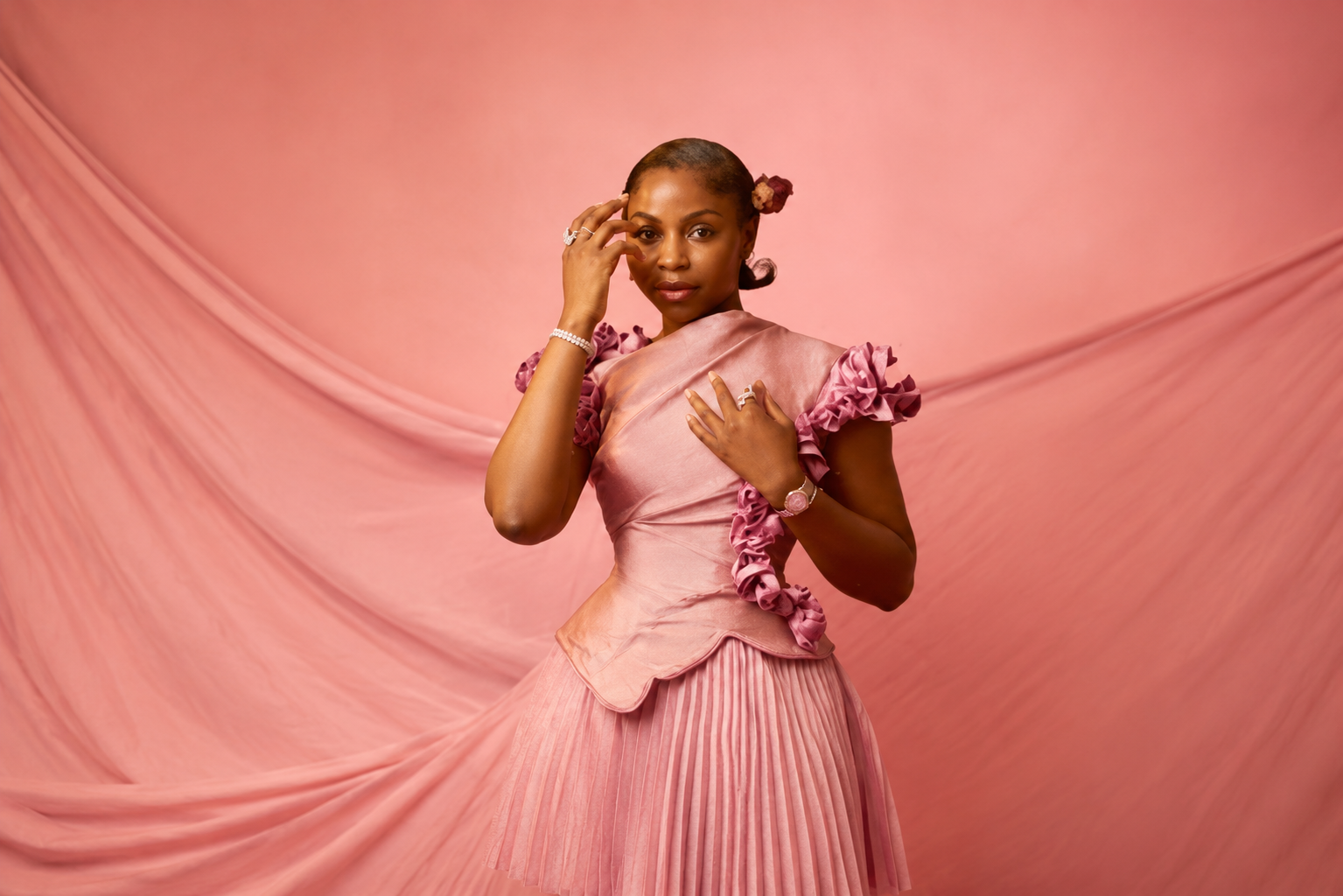
For more than a decade, the creative partnership between Nigerian couture house TUBO and Her Majesty, Olori Ivie Aiyivieruewinoya Emiko had unfolded like a carefully written visual biography, one stitched not only in fabric, but in memory, identity, and intention.
At the centre of this story was Sandrah Tubobereni, the designer widely regarded as the Olori’s “queendresser,” a title earned through years of translating presence into couture and vision into wearable narrative. What began as a chance introduction years earlier had matured into one of the most defining royal fashion collaborations on the continent, an alliance rooted in trust, precision, and a shared language of African elegance.
To mark Her Majesty’s milestone 40th birthday, TUBO released a series of short films that documented not only the celebration, but the philosophy behind it, a decade long creative journey between designer and muse, and a forward looking vision for African womanhood.
YOU CAN ALSO READ: “Whoever Feeds You Can Enslave You”: Obasanjo’s Stark Warning on Africa’s Future
For Ivie Aiyivieruewinoya Emiko, the moment had been more than ceremonial. It was reflective. “They said I’ve broken some milestones, shattered some glass ceilings,” she said. “I’m looking forward to even more.”
Her words carried the tone of arrival without finality, less a conclusion than a continuation. Entering a new decade, the Olori’s attention remained firmly fixed on a singular idea, the elevation of the African woman. A vision mirrored in every ensemble created for her celebration, each one bespoke, each one shaped by symbolism, history, and craft.
The wardrobe, themed “Elements,” had been conceived over twelve months of design development, local and international sourcing, and narrative building. In TUBO’s hands, fashion became archive and prophecy at once, garments designed not only to mark a birthday, but to articulate a future.
“We worked with some of the most prolific women on the planet,” a voice from the TUBO house reflected in the documentary. “For these women, it was always deeper than the clothes. It was about her vision.”
That philosophy defined the relationship between designer and client. The Olori recalled a beginning rooted in urgency and instinct, an early occasion that required a dress, a recommendation, and a fast introduction to a designer who would eventually become indispensable.
“I walked in and said, ‘This is what I wanted to look like,’” she shared. “She got the brief very quickly. Within a week, it was ready. I looked absolutely beautiful. And I said, I was going to carry you everywhere.”
From that moment, collaboration evolved into continuity. Over time, briefs became unspoken, ideas became intuitive, and designer and muse operated within a shared creative frequency.
“It was a decade long relationship,” the Olori noted. “She understood me then without me speaking.”
For Sandrah Tubobereni, that intimacy of understanding was the essence of the craft. “With Olori, you had to get your inspiration from the Holy Spirit,” she said with characteristic candour. “But beyond that, it was about listening to what she wanted to communicate to the world through how she appeared.”
One of the most striking ensembles from the anniversary series drew directly from the Olori’s heritage in the Niger Delta. The design embodied the landscape itself, creeks, rain, water movement, marine life, and oil elements interpreted through couture symbolism. Raindrops were embedded in texture, seashells and periwinkles formed tactile detail, and motifs of boats and rivers referenced both culture and daily life in Warri Kingdom.
Even petroleum elements were referenced at the base of the garment, a deliberate artistic choice that reflected the complexity of place, identity, and modern African reality.
“On this look, I wanted her to embody the full culture of the Niger Delta,” Tubobereni explained. “Everything she wore spoke to what she carried in her office, in her influence, in her vision for Africa.”
The result was fashion as authored identity, clothing that did not decorate leadership, but interpreted it.
As the celebration unfolded, what emerged most clearly was not only the milestone of age, but the milestone of partnership. The Olori described TUBO as “intentional,” a word that recurred throughout their exchange.
“Everything she did was excellently intentional,” she said. “That is why I trusted her completely.”
That trust became the foundation of a working relationship that spanned appearances, state moments, and personal milestones. It also became, in the Olori’s words, ease, the rare luxury of not needing to explain oneself fully in order to be fully seen.
For Sandrah Tubobereni, the admiration was mutual and deeply personal. “I’ve seen her through so many stages of life,” she said. “Mother, sister, bride, queen. If I had to dress only her, I would be happy. She gets the essence of simplicity and elegance.”
YOU CAN ALSO READ: The Woman Designing Fashion That Women Could Feel Before They Saw It
She described the relationship in artistic terms. “She was the Valentino to my Audrey.”
But beyond aesthetic alignment, both women framed the collaboration as something larger, an ongoing cultural project.
Looking ahead, the Olori’s ambitions remained expansive but grounded. She spoke of territories yet to be influenced, of education as a renewed priority, and of a continent where African women were not only seen but structurally empowered.

“I’m looking forward to elevating the African woman,” she said. “Her voice, her mind, her identity beyond appearance. Her intelligence matters just as much as her beauty.”
In that next decade, she envisioned impact that stretched beyond ceremony into community, education, and legacy.
What the TUBO collaboration ultimately captured was not just royal fashion, but a philosophy of visibility, how African identity was presented, preserved, and projected. It was a reminder that behind every commanding public presence was often a quiet architecture of creative trust, built over years and sustained by shared purpose.
For Olori Ivie Aiyivieruewinoya Emiko, the milestone was not an ending. It was a threshold.
And for TUBO, it was another chapter in an ongoing commitment, to dress not just women of influence, but the ideas they carried into the world.