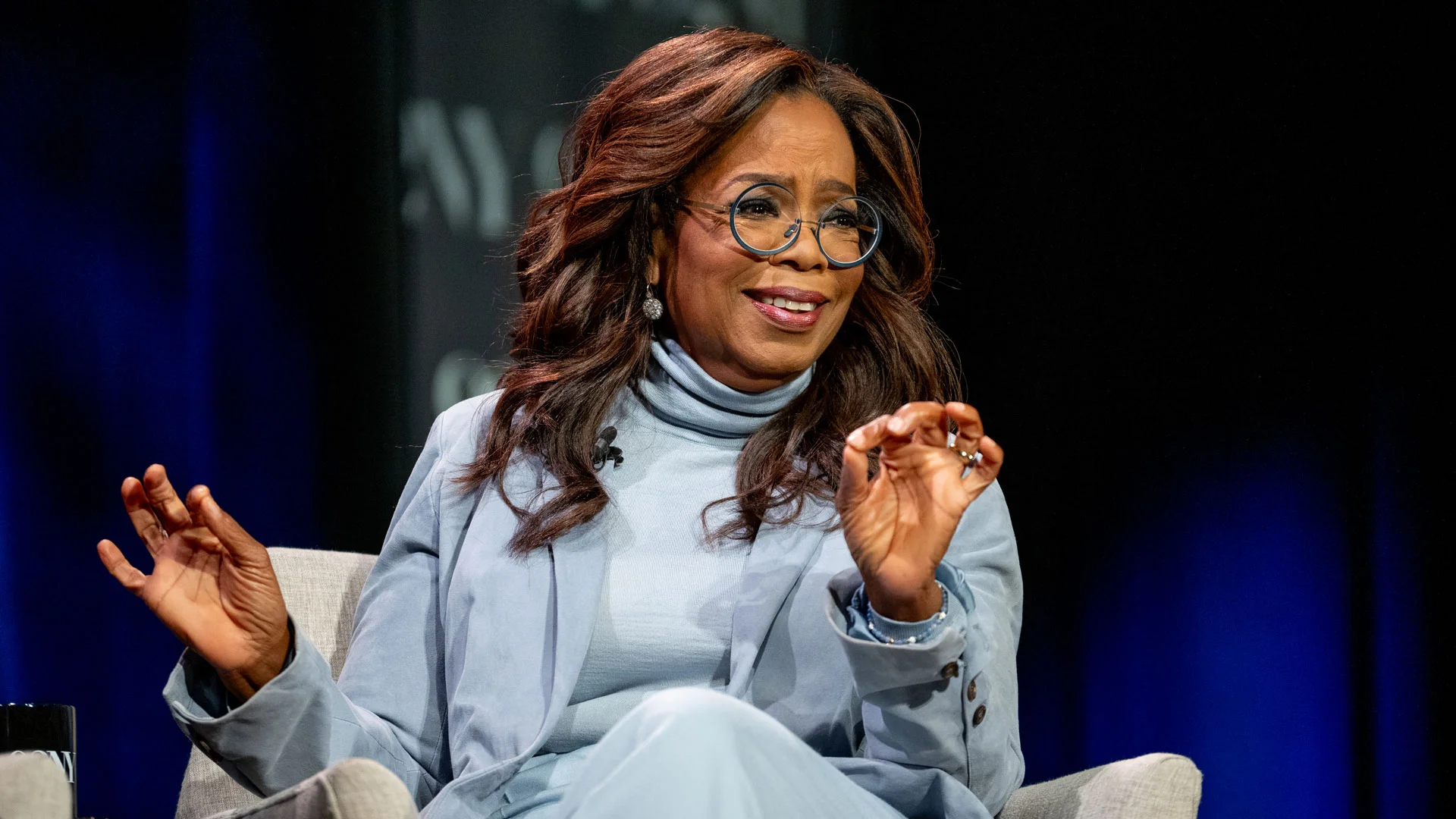
At a time when the world often glorifies wealth as the ultimate marker of success, Oprah Winfrey offers a far more profound definition of achievement. It is not about the billions accumulated, the awards collected, or even the global empire built over decades. It is about distance traveled, obstacles overcome, and lives transformed along the way. Standing before an audience of accomplished entrepreneurs, innovators, and self-made leaders, Oprah did not speak as a media mogul or cultural icon.
She spoke as a woman who never forgot the dirt roads of rural Mississippi, the nights without electricity, the absence of running water, and the grandmother who prayed she would one day find “good white folks” to work for. Her story was not merely one of extraordinary success; it was a masterclass in resilience, faith, and the extraordinary possibilities that emerge when people dare to believe in a future larger than their circumstances.
For Oprah, perhaps the greatest honor was not being recognized as one of the world’s most successful self-made individuals. It was being acknowledged for the sheer distance she had traveled. Success, she reminded the audience, is not a destination but a journey measured by every obstacle overcome and every impossible expectation shattered.
YOU CAN ALSO READ: The Billion-Dollar Business Behind Football’s Biggest Celebration
The journey from a small Mississippi porch to a sprawling Montecito estate is difficult to quantify. The physical distance is measurable, but the emotional, psychological, and societal barriers she crossed are immeasurable. Growing up in 1950s America as a Black girl in Mississippi came with almost no expectation of greatness. There were no visible pathways, no examples to emulate, and very few people who looked like her occupying positions of influence. Yet even then, she believed her life was part of something bigger.
Faith, she explained, was her earliest source of confidence. Though her understanding of God evolved over time, she always believed there was a divine purpose attached to her existence. She believed she was part of a larger force connecting every human being and that her life carried a responsibility beyond personal ambition. That conviction became her compass. Her grandmother’s dreams for her were simple and reflective of the era they lived in.
As a domestic worker, she hoped Oprah would grow up and find “good white folks” to work for, just as she had. Those families, in her grandmother’s eyes, represented opportunity because they provided food, hand-me-down clothing, and occasional kindness. Today, Oprah often laughs at the irony. Her grandmother could never have imagined a future where she would not only surpass those expectations but build an empire employing countless people across industries and continents. Yet Oprah never dismisses where she came from. Instead, she celebrates it as the foundation of her strength.
She recalls pivotal moments that planted seeds of possibility in her young mind. Watching Sidney Poitier win an Academy Award for Lilies of the Field was transformative. For the first time, she saw a Black man portrayed with dignity, grace, and excellence on a global stage. She also remembers watching Diana Ross and The Supremes perform on television and realizing that perhaps she, too, could occupy spaces previously unimaginable. Those moments became tiny declarations of possibility, but possibility alone was not enough. Her life would soon be marked by unimaginable pain.
From the age of nine, Oprah endured years of sexual abuse that eventually resulted in a teenage pregnancy. Her son died shortly after birth, a tragedy that could have permanently altered the trajectory of her life. At that moment, she believed her future had ended. Then her father gave her a gift that would redefine everything. “You now have a second chance,” he told her. Those words became a turning point. She returned to school with renewed determination and transformed herself into a relentless achiever. Public speaking, a skill nurtured in church from childhood, became her gateway to opportunity. She embraced education not merely as a pathway out of poverty but as a tool to fulfill a larger purpose. That sense of purpose followed her into every room she entered.
Long before discussions around impostor syndrome became mainstream, Oprah had already developed a powerful antidote. She never felt like she was pretending to belong because she believed she never arrived anywhere by accident. If an opportunity appeared before her, she assumed she was meant to occupy that space. She often recalls the words of Maya Angelou: “I come as one, but I stand as ten thousand.” Those words shaped her worldview.
She never walks into a room alone. She carries with her the sacrifices, dreams, and struggles of every ancestor who came before her. She carries the hopes of those who were denied opportunity and the strength of those who endured unimaginable hardship. Among them is her great-grandfather, Constantine Winfrey, an enslaved man who negotiated with his slave owner for eighty acres of land in exchange for harvesting ten thousand bales of cotton in a year. Though he could neither read nor write, he understood ownership, perseverance, and the importance of creating opportunities for future generations. His story became part of her own.
That understanding of ownership would later transform her career. While many admired Oprah as a gifted television personality, she understood early that true power lies in ownership. After filming The Color Purple, she realized she never again wanted external systems determining her future. Guided by wise counsel, she took an extraordinary risk by betting on herself rather than settling for a larger salary. The decision changed everything. Instead of simply becoming a highly paid television host, she became a media owner.
Over time, she increased her ownership stake until she controlled the overwhelming majority of her enterprise, creating one of the most influential media empires in history. Ironically, she credits being underestimated as one of her greatest advantages. Because so few people anticipated her eventual success, opportunities emerged that might never have existed otherwise. She turned doubt into leverage and transformed underestimation into a strategic advantage.
Yet wealth itself never became her destination. The deeper lesson Oprah learned was that philanthropy is far more complex than writing checks. Early in her success, she believed money could solve most problems. She adopted children from disadvantaged communities, bought homes for struggling families, and created opportunities wherever she could. But she soon discovered that financial assistance alone rarely changes lives. People need more than resources. They need healing, support systems, and a new way of thinking. Her experiences eventually led her to South Africa, where she founded a leadership academy for young girls. There, another lesson emerged. Despite providing world-class education and facilities, many students struggled emotionally.
YOU CAN ALSO READ: Nigeria Is Too Big to Fail: EU Ambassador Guillaume Mignot Outlines a Shared Future
The answer came from trauma experts who explained a simple but devastating truth: poverty is war. Living without certainty about food, safety, or the future creates wounds that cannot be healed through money alone. Sustainable change requires emotional support, mentorship, and an environment that restores dignity alongside opportunity. That revelation reshaped her entire philosophy of giving.
Today, Oprah believes service is not measured by the size of one’s donation but by the depth of one’s impact. Real philanthropy empowers people to believe in themselves and equips them with tools to sustain their own growth. Perhaps her most profound lesson about legacy came from Maya Angelou. When Oprah proudly described her South African school as her greatest legacy, Angelou gently corrected her. Legacy, she explained, is never one thing.
It is not a building. It is not a name etched onto stone. It is not even the millions donated to worthy causes. Legacy is every life you touch. It is the woman who leaves an abusive relationship because she heard a message that changed her perspective. It is the student who returns to school because someone inspired them to believe in their potential. It is the parent who chooses compassion over violence because they learned a different way to raise their children. Legacy is created daily through ordinary moments of human connection. People may forget accomplishments and titles, but they will always remember how someone made them feel.
For Oprah Winfrey, that has become the ultimate mission: to use her life, her influence, her wealth, and her voice to remind others that they matter. Because true greatness is never measured by what we accumulate. It is measured by what we awaken in others. And perhaps that is why Oprah Winfrey’s greatest achievement is not the empire she built, but the millions of people she taught to believe that impossible journeys are possible after all.