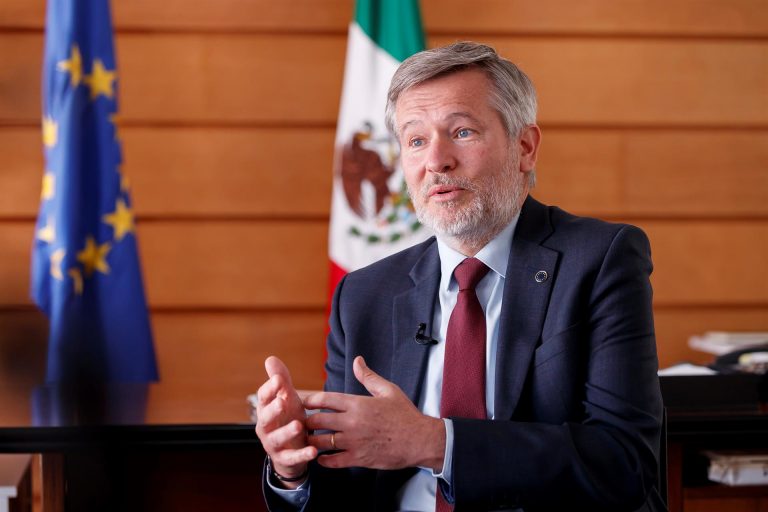
For decades, the relationship between Nigeria and the European Union has often been viewed through the narrow lens of aid and development assistance. Today, however, that narrative is rapidly changing. At the center of this transformation is Gautier Mignot, the European Union Ambassador to Nigeria and ECOWAS, who is championing a new framework built not on charity, but on shared prosperity, mutual interests and long-term economic collaboration.
Speaking about the future of Nigeria-EU relations, Mignot painted a picture of a partnership that is becoming increasingly strategic, sophisticated and investment-driven. For him, Nigeria is not simply another African nation within Europe’s foreign policy considerations; it is the anchor upon which the future stability and prosperity of West Africa largely depends.
YOU CAN ALSO READ: Nigeria Cannot Build Its Digital Future on Foreign Infrastructure – Dr. Krishnan Ranganath
As the continent’s largest economy and most populous nation, Nigeria occupies a unique position between West and Central Africa. Its successes, he argued, inevitably create ripple effects across the entire subregion. In many ways, Nigeria’s fortunes are inseparable from Africa’s broader economic trajectory. As Mignot aptly noted, Nigeria is “too big to fail.”
Yet, his perspective extends far beyond economic statistics. He believes Nigeria and Europe share fundamental values that make the relationship particularly important in an increasingly uncertain world. Both parties remain committed to multilateralism, international cooperation and respect for international law, creating a foundation upon which deeper collaboration can flourish.
Perhaps the most significant shift, according to the ambassador, is the evolution of the relationship itself. The traditional donor-recipient model is gradually being replaced by a partnership among equals. Europe is no longer interested in merely providing assistance; instead, it seeks to align with Nigeria’s development priorities, support local value chains and unlock sustainable investments that can transform entire sectors of the economy.
This philosophy is embodied in the European Union’s Global Gateway strategy, an ambitious initiative designed to mobilize both public and private capital at unprecedented levels. The approach acknowledges a simple reality: official development assistance alone cannot deliver sustainable development goals. Private investment, local ownership and strategic partnerships are essential ingredients for meaningful progress.
The numbers already tell a compelling story. The European Union remains Africa’s largest investor, with over €300 billion invested across the continent. In Nigeria specifically, approximately one-third of all existing foreign direct investment originates from EU member states. But for Mignot, these figures represent only a fraction of what is possible.
The ambassador sees immense opportunities in sectors that will define Nigeria’s future over the next decade. Digital infrastructure, renewable energy, climate-smart agriculture, transportation systems, healthcare and pharmaceutical manufacturing are among the areas where Europe intends to deepen its engagement.
At the same time, he acknowledges that investment cannot thrive in isolation. Education, rule of law, democratic governance and security remain critical pillars of sustainable development. Without these foundations, attracting long-term capital becomes significantly more challenging.
Among the flagship initiatives already underway is the Omi Eko water transportation project in Lagos. With an investment package worth €410 million, the project will deploy 75 electric ferries across the Lagos lagoon, transforming urban mobility while simultaneously reducing carbon emissions and connecting underserved communities.
For Mignot, projects like these represent more than infrastructure development. They are examples of how carefully designed interventions can reshape entire urban ecosystems, stimulate economic activity and improve quality of life over the long term.
Yet, one of the most important questions surrounding the evolving relationship concerns reciprocity. If this is truly a partnership of equals, what tangible opportunities exist for Nigeria?
The ambassador points to trade as evidence that progress is already underway. The European Union is Nigeria’s largest export destination, particularly for non-oil products, and Nigeria consistently maintains a trade surplus of approximately $10 billion annually with Europe. Import tariffs on almost all African products entering Europe have already been eliminated, creating pathways for Nigerian exporters to expand their reach.
However, Mignot believes much more can be achieved. He envisions a future where Nigeria diversifies beyond oil exports and becomes a major supplier of agricultural products, manufactured goods and industrial outputs.
Sectors such as cocoa, ginger and tomato production are already receiving strategic support. European institutions are also helping Nigerian producers prepare for evolving global regulations, including new sustainability standards that will shape international trade in the coming years.
Underpinning this entire vision is the belief that Nigerians themselves must remain at the center of the country’s transformation. Europe, Mignot insists, is not coming to dictate Nigeria’s future. The role of the European Union is to accelerate progress, support local ambitions and create enabling conditions for Nigerian businesses and institutions to thrive.
That philosophy will be on full display at the 10th EU-Nigeria Business Forum, where policymakers, investors, financial institutions and entrepreneurs will convene to identify new opportunities, address bottlenecks and forge strategic partnerships.
YOU CAN ALSO READ: The Future Is Animated: Damilola Solesi’s Vision for Africa’s Creative Economy
Unlike previous editions, this year’s forum signals the arrival of a different era. The conversations are expected to move beyond ceremonial speeches and focus instead on pragmatic outcomes, investment opportunities and concrete business deals that can generate jobs and stimulate economic growth.
For Gautier Mignot, success will not be measured by headlines or diplomatic declarations. It will be measured by factories built, businesses financed, exports expanded and livelihoods improved.
In an increasingly fragmented global landscape, his message is clear: the future of Europe and the future of Nigeria are more interconnected than ever before. What emerges is a partnership defined not by dependency, but by shared ambition—a partnership that recognizes Nigeria not as a recipient of aid, but as a strategic force capable of shaping the future of Africa and influencing the global economy itself.