He received a seven-day eviction notice while on a cruise. At first, it felt absurd, almost like a clerical error that would resolve itself with a few calls. It didn’t. What followed was the demolition of over $30 million in assets, the loss of $10 million in revenue, and the sudden disappearance of livelihoods for 3,000 people. Entire ecosystems built over years were reduced to rubble in days.
But this is not a story about loss. It is a story about endurance. About a man who has spent a lifetime building, losing, and choosing, deliberately, to build again.
Paul Onwuanibe’s journey begins far from the coastline of Lagos. Growing up in London, his childhood dream was surprisingly simple: he wanted to be a dustbin driver. Not out of lack of ambition, but admiration. He watched waste collectors move from house to house with purpose, solving real problems with quiet dignity. They seemed content, grounded, and useful. That, to him, was success.
His father saw a different path. At the age of ten, Paul was sent to boarding school in Nigeria, a decision that would fundamentally reshape his worldview. The transition was jarring. The comforts he had taken for granted, order, infrastructure, predictability, gave way to a more demanding environment where competition was intense and resilience was non-negotiable. What began as culture shock became a crucible. Nigeria sharpened him.
That early dislocation planted something deeper: perspective. Moving between two worlds forced him to confront inequality, opportunity, and the fragile nature of certainty. It also gave him an instinct that would later define his career, the ability to see not just what is, but what could be.
Years later, that instinct would carry him across 167 countries in just six years while working at a then scrappy startup called Regus. It was a formative experience. He learned scale, speed, and the mechanics of global business. He also learned hard lessons about risk and reward. When the company once struggled to make payroll, employees were offered equity in place of salaries. Paul declined. Others accepted. When Regus went public, some of his colleagues walked away with millions. He walked away with experience.
That experience proved invaluable. He moved to Africa with a vision and began building serviced office spaces across 14 cities, laying the foundation for what would become a significant enterprise. Eventually, he sold that business for over $20 million to his former boss, Mark Dixon. For many, that would have been the peak. For Paul, it was just capital, fuel for something far more ambitious.
He turned his gaze to Lagos.
At the time, the city was expanding eastward, its growth outpacing its infrastructure. Where others saw congestion and chaos, Paul saw direction. He understood the trajectory of urban expansion and made a calculated bet: find where the city is going and get there first.
A helicopter ride over Victoria Island revealed a stretch of marshland, unattractive, underutilized, and largely ignored. It had a reputation for being unsafe, undesirable. But from above, with a bird’s-eye view shaped by his architectural training and global exposure, Paul saw possibility. Waterfront property in the heart of a growing city. A blank canvas.
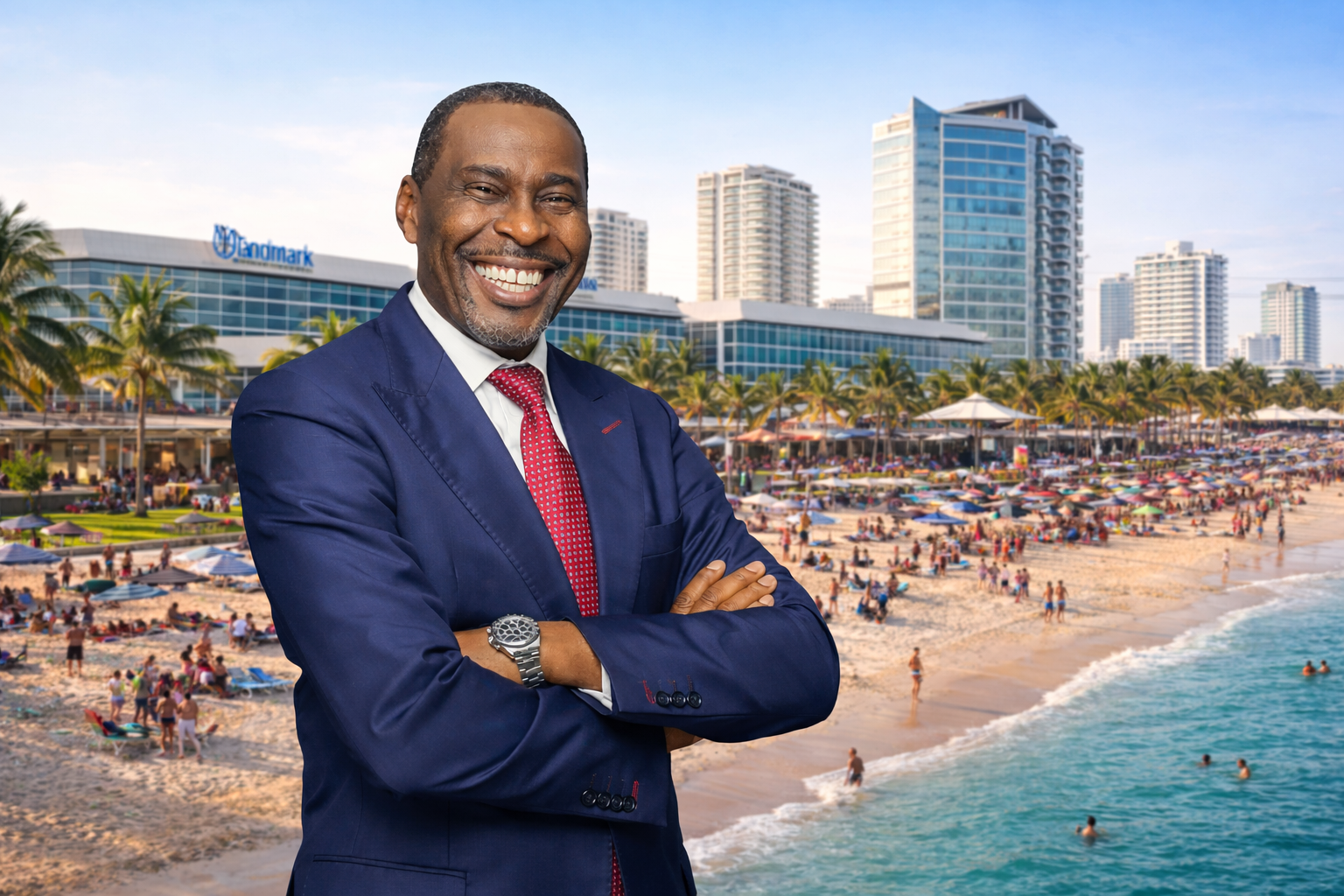
He acquired five hectares of that land and began building what many considered impossible: a fully integrated live, work, and play ecosystem. There were no roads. No electricity. No water. He built everything from scratch, roads, drainage, sea defenses, power systems. What started as marshland evolved, over 15 years and more than $150 million in investment, into one of West Africa’s most vibrant destinations.
Landmark became a city within a city. It housed businesses, restaurants, leisure facilities, and global brands. It created over 4,000 jobs and attracted 4.5 million visitors annually. It wasn’t just infrastructure; it was an experience, a model for modern urban development in Africa.
And then, in 2024, it was taken away.
The eviction notice arrived while he was away, celebrating his brother’s birthday. Seven days. That was all. The disbelief quickly gave way to a cascade of emotions, denial, anger, negotiation, acceptance. Years of work erased in a week.
Yet, even in that moment, Paul’s response was not defined by outrage but by perspective. He had seen loss before. He understood that in business, as in life, control is limited. What matters is response.
He refunded customers, even when many didn’t expect it. He prioritized people over profit, empathy over expediency. In doing so, he transformed goodwill into something more enduring than physical structures. Trust became his new currency.
For Paul, entrepreneurship has always been an extreme sport. Not in the glamorous sense often portrayed, but in its raw, demanding reality. It is, as he describes it, like jumping out of a plane and assembling the parachute on the way down. It demands endurance, discipline, and a tolerance for uncertainty that few truly understand.
He does not romanticize balance either. To him, the idea of having everything at once is an illusion. Life, especially at the highest levels of achievement, is defined by trade-offs. Sacrifice is not optional; it is foundational. The question is not whether you will sacrifice, but what.
Now at 60, an age when many begin to slow down, Paul shows no signs of retreat. If anything, the setback has expanded his vision. His focus has shifted beyond Nigeria, with plans to build across other African markets like The Gambia and Liberia. Diversification, resilience, and scale are no longer strategies, they are necessities.
Through it all, his guiding principle remains disarmingly simple: be a good person. In a world that often rewards aggression and speed, he sees opportunity in kindness. There is, he believes, very little competition in genuine decency.
It is an unusual philosophy for someone operating in high-stakes environments, but perhaps that is precisely the point. While structures can be demolished and revenues wiped out, character endures. And in the long arc of building, over decades, across continents, that may be the most valuable asset of all.
Paul Onwuanibe has spent over 40 years constructing ideas, businesses, and ecosystems. He has seen them rise, fall, and rise again. The latest chapter of his story is not defined by what was lost, but by what comes next.
Because for builders like him, the work is never really finished.