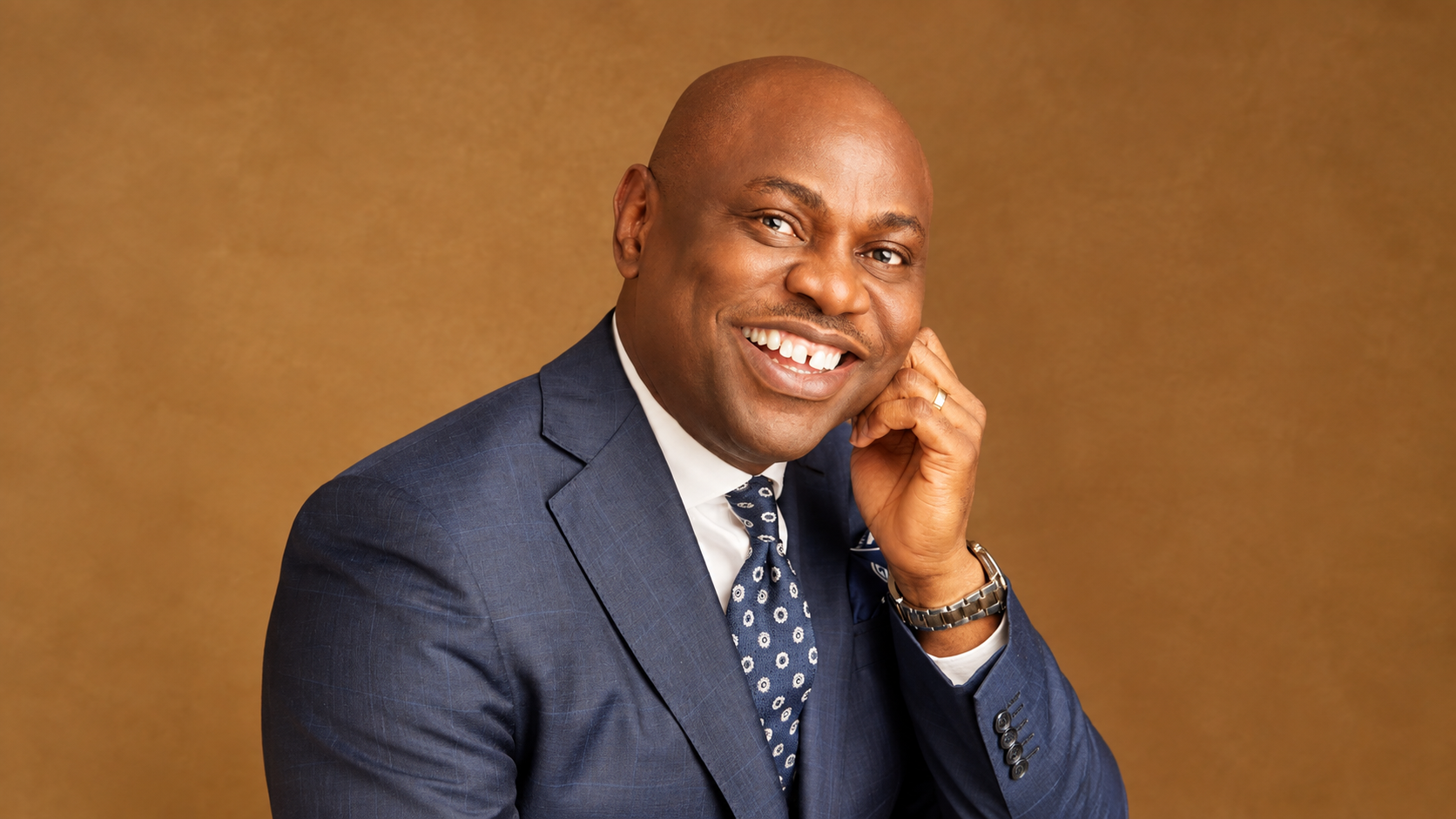
For Olugbenga Agboola, the story of entrepreneurship is not simply about having a big idea. It is about possessing the discipline, resilience and institutional ambition required to turn an idea into something capable of enduring. As Co-founder and Chief Executive Officer of Flutterwave, Agboola has spent more than a decade demonstrating what can happen when an African entrepreneur chooses to confront structural limitations not merely as obstacles, but as opportunities to build. Speaking to an audience in Nigeria, Agboola returned repeatedly to a question that has defined much of his entrepreneurial journey, Africa has no shortage of dreams, but can Africans build at the scale those dreams demand? It is a distinction he considers fundamental.
Nigeria, he explained, teaches its people from an early age how to dream despite their circumstances. Infrastructure may be inadequate. Capital may be difficult to access. Regulations may still be evolving. In some cases, the pathway to achieving an ambition may not even exist. Yet Nigerians continue to imagine possibilities beyond what is immediately visible. The harder challenge, however, begins after the dream.
“There’s a huge difference between having a great idea and building a company,” Agboola observed, pointing to Flutterwave’s evolution from a simple proposition into a major African payments technology company serving businesses and consumers across multiple markets. For him, that evolution represents a broader lesson about African enterprise, the real measure of ambition is not the size of the dream, but the capacity to build the systems that make the dream sustainable.
YOU CAN ALSO READ: Shuttlers’ Damilola Olokesusi Pushes New Approach to Urban Transportation
Flutterwave did not begin with the ambition of becoming a billion-dollar company, Agboola explained. Its starting point was considerably simpler, solving the difficulty of moving money across Africa. The problem was obvious but deeply structural. African businesses were operating within fragmented payment ecosystems, with different markets relying on different rails, systems and financial technologies. A business in Accra could face significant difficulty receiving payment from a customer in New York, despite the fact that both sides were participating in an increasingly global digital economy. Across individual countries, payment systems could work effectively. Kenya had M-Pesa. Nigeria had NIBSS and Verve. Other African markets had their own mobile money and financial infrastructures. The problem was the lack of seamless interoperability across borders.
Rather than simply complain about the fragmentation, Agboola and his team decided to build around it. That decision became the foundation for Flutterwave. Today, the company’s infrastructure has become part of the payment architecture used by businesses operating across Africa and beyond. Agboola highlighted global companies such as Uber, Netflix, Microsoft and Google as examples of organisations that have built on payment infrastructure developed in Africa. For him, the significance goes beyond Flutterwave’s corporate success. It is evidence that African companies can develop infrastructure capable of serving global markets.
That distinction matters. For decades, much of Africa’s technological narrative was shaped by consumption, African markets were often viewed primarily as destinations for products, services and technologies developed elsewhere. Agboola’s vision represents a different proposition, an Africa capable of creating technology, infrastructure and institutions that can compete internationally. But building such institutions, he stressed, requires far more than innovation.
The glamour of entrepreneurship tends to focus on the idea, the funding announcement, the valuation or the growth story. The less visible work happens behind the scenes. Nobody celebrates the reconciliation problems inside a financial technology company. Nobody posts photographs of a compliance system breaking during a transaction. Risk committees, backup systems, controls, audits and governance structures rarely become the most exciting part of a company’s public narrative. Yet these are precisely the mechanisms that transform an idea into an institution. For Agboola, the “boring” aspects of business are often the foundation of scale.
Innovation may create the initial breakthrough, but governance creates the conditions for that innovation to survive growth. As an organisation becomes larger, more complex and more exposed to different markets, systems have to become stronger. That is why, in his view, innovation and governance are not opposing forces. They are complementary requirements for sustainable scale.
Flutterwave’s journey has also not been without setbacks. Agboola acknowledged that the company’s growth has involved difficult markets, changing consumer behaviour, operational challenges and moments when assumptions had to be reconsidered. But he sees these experiences not simply as disruptions, but as part of the process of institutional learning. A fraud incident should result in stronger risk systems. A difficult market should produce a deeper understanding of local nuances. A bad hiring decision should inform the next hiring decision. A failed approach should improve the next iteration. The objective, therefore, is not to build a company without setbacks. It is to build an organisation capable of becoming stronger because of them.
This philosophy extends to leadership itself. Agboola argued that knowledge acquired in the past can become a liability if leaders become too attached to it. Markets change. Technology changes. Consumers change. Regulations change. Business models that worked a decade ago may require fundamental adaptation today. The leader who assumes that yesterday’s knowledge is sufficient for tomorrow’s market risks turning experience into arrogance. The antidote, he suggested, is humility.
Leaders must know their customers, understand their numbers, study their markets and recognise what they do not know. They must be willing to learn, acknowledge when they are wrong and change direction when circumstances demand it. That mindset is particularly relevant in Africa’s technology sector, where the operating environment can evolve rapidly.
Agboola’s own career reflects an unusual intersection of technology and business. Before co-founding Flutterwave, he worked as an application engineer at PayPal and as a product manager at Google. His technical experience, combined with business education, gave him exposure to both the engineering and commercial dimensions of technology. At Flutterwave, those capabilities became part of a broader leadership challenge, building engineering capabilities while simultaneously creating a business capable of navigating complex African markets.
The result has been a company whose story has increasingly become intertwined with a larger conversation about African entrepreneurship. Agboola believes the implications of building companies such as Flutterwave extend beyond individual shareholders, founders or employees. If one company can employ thousands of people, he argued, imagine the impact if Nigeria produced a thousand companies operating at similar scale. The result would not simply be more businesses. It would mean more employment, stronger supply chains, greater investment opportunities, increased tax revenues and a larger ecosystem of talent and innovation.
This, for Agboola, is where entrepreneurship intersects with national transformation. Countries are not transformed by isolated acts of brilliance. They are transformed when thousands of institutions, businesses and systems become stronger and begin working together over time. His argument is ultimately about institutional excellence becoming ordinary rather than exceptional. A country becomes stronger when excellence is no longer regarded as a heroic achievement but becomes part of everyday organisational culture.
That is also why Agboola’s message to entrepreneurs goes beyond the familiar instruction to “dream big.” Dreaming, he suggested, is only the beginning. Entrepreneurs must learn their craft. They must understand technology. They must understand people, money, infrastructure and their industries. They must understand the world beyond their immediate market. Most importantly, they must execute.
And execution requires a willingness to accept that not everything will work. Some ideas will fail. Some doors will close. Some people will insist that an ambition is impossible, and sometimes they may even be correct. The answer is not to become emotionally attached to the first version of an idea. Instead, entrepreneurs should remain committed to the mission while remaining flexible about the method.
That distinction between mission and iteration may be one of the most important lessons from Agboola’s entrepreneurial philosophy. A company can change its product, strategy, market approach or operating model without abandoning the fundamental problem it set out to solve. For Africa’s next generation of founders, that mindset could prove increasingly important.
The continent’s future will not be shaped by entrepreneurs working in isolation. Governments, businesses, investors, technology companies and institutions must participate in an ecosystem where progress is understood as collective rather than zero sum. Agboola’s vision is therefore larger than a payments company.
YOU CAN ALSO READ: From a 5 a.m. Phone Call to a Continental Empire: Obasanjo Tells the Dangote Story
He imagines an Africa where the continent’s largest infrastructure companies are built in Africa and serve the world. An Africa where technology developed in Lagos can power activity in London, New York, São Paulo or Singapore. An Africa where African companies are recognised not simply as successful regional businesses but as global institutions.
Most importantly, he wants the next generation to have something more powerful than motivation, evidence. Evidence that a company can be built from Nigeria and scaled across continents. Evidence that African talent can develop infrastructure trusted by global businesses. Evidence that geography does not have to determine the ceiling of ambition.
That is perhaps the most compelling dimension of Agboola’s story. His message is not that Nigeria’s challenges do not exist. They clearly do. Rather, his entrepreneurial response has been to ask what can be built within, and eventually beyond, those constraints. Nigeria taught him to dream despite what he could see. Flutterwave became an exercise in building despite what was missing.
And the larger ambition is to prove that the continent can move from identifying its infrastructure gaps to creating the institutions capable of closing them. For Agboola, the opportunity ahead is therefore not merely to dream of a better Africa, but to build the systems that make that Africa possible. Africa, he argued, does not have an ambition problem. What comes next is the work of building, and building at scale.