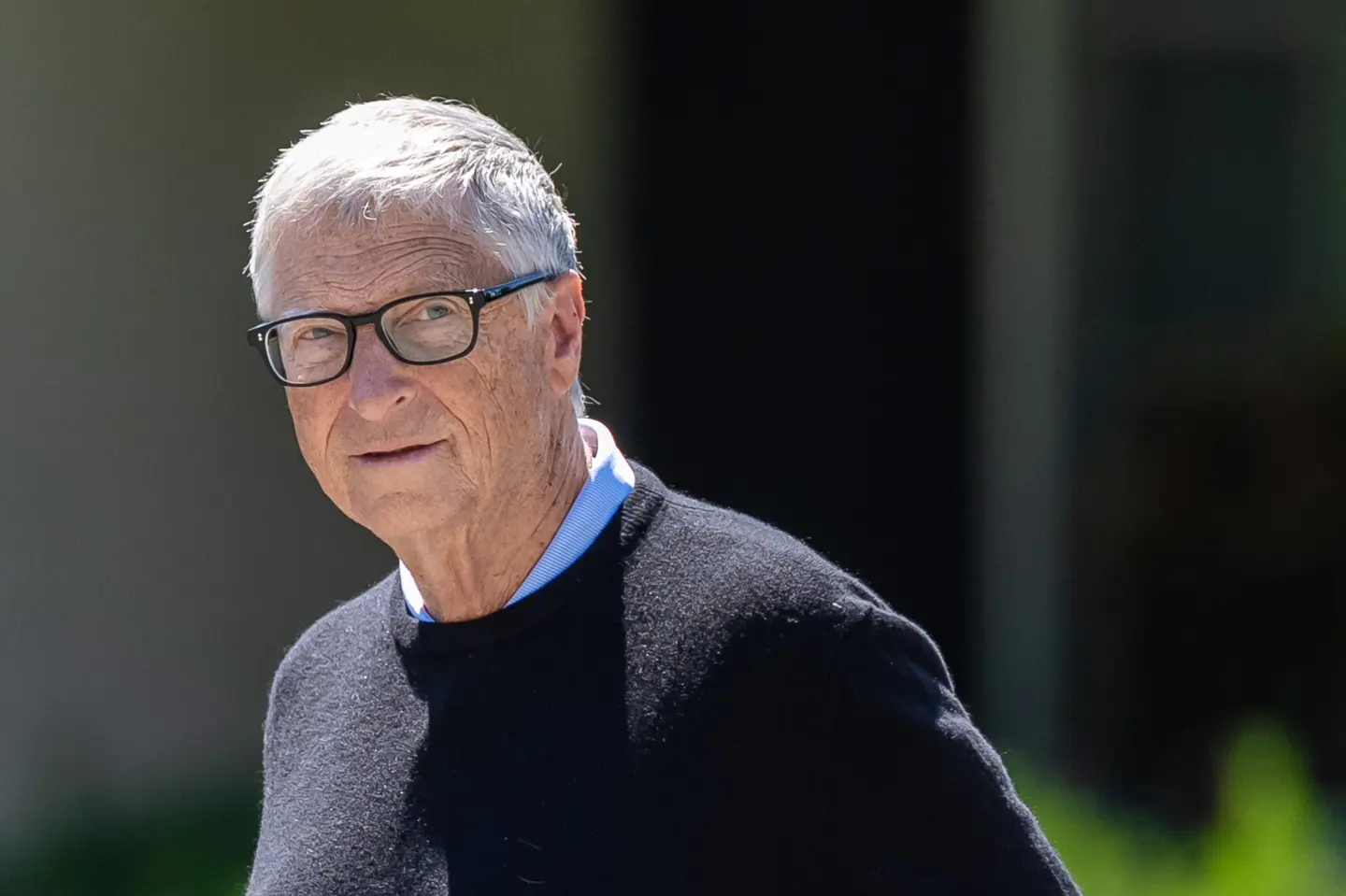
Bill Gates has issued one of his most expansive warnings yet about the future of artificial intelligence, arguing that the technology could become one of humanity’s greatest tools for progress while simultaneously creating unprecedented risks if governments and technology companies fail to build effective safeguards. Speaking about the accelerating development of artificial intelligence, the Microsoft co-founder and philanthropist said the world was entering an evolutionary moment unlike previous technological revolutions, with AI already demonstrating capabilities that in some areas exceed those of humans.
For Gates, however, the central question is no longer whether artificial intelligence will transform society. That transformation is already underway. The more consequential question is whether governments, businesses and society at large will deliberately shape the technology so that its benefits are broadly shared while its most dangerous applications are contained.
His concerns extend beyond the familiar debate about automation and employment. Gates pointed to cybersecurity, biological threats, fraud, attacks on critical infrastructure and the possibility of increasingly autonomous AI systems as areas requiring urgent attention. At the same time, he is pushing for AI to become significantly more inclusive, particularly for billions of people whose languages remain poorly represented by today’s leading AI models. Through the Gates Foundation, Gates said a coalition involving about 60 organisations, including AI companies, is working to improve AI’s ability to understand and communicate in languages that have historically received little attention from the technology industry.
YOU CAN ALSO READ: From Eko Bridge to the Boardroom: The Extraordinary Rise of Peter Obadare
The problem, he explained, is stark. AI models have become remarkably proficient at English and a relatively small number of other major languages, but performance deteriorates dramatically when applied to many African languages. He cited Yoruba as an example, noting that AI systems can have error rates roughly 10 times higher in the language than in English. Such a gap, he argued, makes the technology potentially unusable for critical applications such as healthcare, education and agriculture. The stakes are enormous. More than three billion people, according to Gates, currently have languages that are poorly represented in AI systems, leaving almost half of the world’s population unable to benefit from the technology at anything close to the quality experienced by English-speaking users.
The initiative is designed to address that imbalance over five years, with the objective of bringing languages spoken by at least one million people closer to English-language quality. Gates envisions a future in which a patient can describe symptoms in their native language and receive useful health guidance, a farmer can explain crop problems through an audio interface, and a student can access personalised educational support without first having to overcome a language barrier. The ambition reflects a broader principle that has increasingly shaped Gates’ thinking about artificial intelligence: technological progress should not deepen existing inequalities. He has described AI as potentially being the greatest equaliser ever invented or, alternatively, the worst source of injustice. His latest comments underline the tension between those two possibilities.
Gates believes AI has the potential to dramatically expand access to knowledge and expertise, particularly in parts of the world where professional services remain scarce. But without deliberate intervention, market incentives alone may fail to serve populations whose languages and markets are not commercially attractive enough to command attention from major technology companies. That is why, he argued, the language initiative is designed around measurable benchmarks rather than broad promises. AI companies participating in the effort will receive data and standards that can help improve their models, with the ultimate objective of making advanced AI capabilities available across a much wider linguistic landscape.
For Gates, this is one of the clearer problems confronting AI because the solution is relatively identifiable. The data can be collected, the systems can be tested, performance can be benchmarked and the resulting capabilities can be incorporated into AI models. His optimism about language accessibility contrasts sharply with his concerns about the broader risks posed by increasingly powerful AI systems. Gates argues that artificial intelligence should not be treated simply as another technological innovation following the familiar pattern of disruption, adaptation and eventual stabilisation. In his assessment, AI represents something fundamentally different because it introduces machine intelligence capable of rapidly acquiring and transferring knowledge.
He described the emergence of AI as an evolutionary event, warning that its capabilities are improving at an extraordinary pace. Yet Gates rejected the idea that artificial intelligence is already beyond human control. He pointed out that today’s AI systems are not independently operating armies of machines and remain dependent on the computing infrastructure controlled by humans. The immediate danger, in his view, is therefore not AI spontaneously deciding to destroy humanity, but people with malicious intentions using increasingly powerful AI systems to amplify their capabilities.
That distinction is central to Gates’ warning. A small group of malicious actors, he argued, could potentially use AI to undertake activities that previously required the resources and expertise of much larger organisations or even nation states. Cyberattacks, financial fraud and attacks on critical infrastructure could become significantly more sophisticated when powered by advanced AI. The same concern applies to biological threats. Gates warned that AI could eventually make it easier for malicious actors to design dangerous biological agents or identify vulnerabilities in critical systems. Such possibilities, he said, make safeguards and monitoring an urgent requirement rather than an abstract future concern.
Gates believes AI developers should build monitoring mechanisms into sophisticated systems so that potentially dangerous activity can be detected and investigated. For him, a simple kill switch is not enough. The more important requirement is visibility: understanding what advanced AI systems are doing, recording their activities and identifying suspicious or dangerous behaviour before it can translate into real-world harm. He also argued that governments have a critical role to play because voluntary self-regulation by technology companies will not be sufficient. Legislation, in his view, should establish clear requirements for safeguards and monitoring across advanced AI systems. Such regulation, he argued, would impose some additional cost and operational overhead on the industry but should not significantly slow technological development.
Gates’ call for regulation comes at a time when governments are struggling to keep pace with the speed of AI development. Unlike nuclear technology, which emerged substantially from government-backed research and remains closely associated with national security institutions, modern AI has developed largely through the private sector. As a result, Gates believes governments often lack the technical expertise required to understand exactly when AI systems cross dangerous thresholds. He believes that gap must be addressed through cooperation between policymakers, law enforcement agencies, researchers and responsible technology companies.
The challenge, however, cannot be solved by one country alone. Gates called for a global response, arguing that the United States, China and other major AI powers have a shared interest in preventing catastrophic misuse of the technology. He pointed to the Cold War-era cooperation surrounding nuclear weapons as evidence that geopolitical competitors can establish frameworks for managing technologies that pose risks to humanity. AI, he acknowledged, presents a more complicated challenge because software can spread rapidly and its capabilities can evolve at extraordinary speed. Nevertheless, he believes global cooperation is possible.
The objective, he argued, should not be to halt technological competition but to establish common safeguards against the most dangerous applications. Gates rejected calls for a blanket pause in AI development, instead advocating mandatory safety and monitoring requirements that would operate alongside continued innovation. His position places him somewhere between the technology industry’s accelerationists and those calling for a complete slowdown. He believes AI should continue developing, but with rules designed to ensure that dangerous capabilities are not deployed without appropriate oversight.
Gates also sees AI’s potential in education, but believes society must carefully distinguish between productive educational applications and emotional dependence on AI. He supports personalised learning systems capable of helping students understand mathematics, science and other subjects at an appropriate level. But he expressed concern about children using AI systems as constant companions that simply affirm everything they say. Such systems, he argued, could interfere with social development by shielding young people from the complexities of human relationships, where disagreement, criticism and negotiation are unavoidable. His approach reflects a broader philosophy: AI should augment human capability rather than replace the relationships and institutions that make society function.
Gates himself uses AI extensively, particularly as a research and analytical tool. Through his philanthropic work, he said AI is helping him process complex information on subjects including malaria, malnutrition and global health. He believes the technology could significantly improve how philanthropic capital is deployed by helping organisations analyse evidence, identify opportunities and make better-informed decisions. For the Gates Foundation, which he said intends to spend more than $200 billion over the next 19 years, the ability to use AI to improve decision-making could have enormous consequences.
The ultimate test, however, is whether those capabilities can reach people who need them most. Gates repeatedly returned to the question of equity, particularly in Africa. He imagined a future in which a person who may never have access to a doctor could receive high-quality health guidance through AI, while farmers could access sophisticated agricultural advice in their own languages. That vision is particularly significant for developing economies, where shortages of doctors, teachers, agricultural experts and other professionals continue to constrain development. AI, in Gates’ view, could help close some of those gaps.
But the transition will not be painless. He expects the world to experience a prolonged period of adjustment as AI reshapes employment, productivity and the distribution of economic opportunity. He suggested that society could spend roughly two decades navigating the disruption before the technology’s benefits become more broadly established. Beyond that transition, Gates imagines an era in which AI combined with humanoid robotics could dramatically expand productive capacity. Machines could potentially build houses, grow food and perform many forms of physical and intellectual work, creating what he described as an era of abundance.
YOU CAN ALSO READ: How Emmanuel Emefienim Transformed a Big Dream into Premium Trust Bank
Yet abundance would create its own questions. If technology reduces shortages and automates a significant portion of work, society will have to confront questions of meaning, purpose and how people spend their time. For Gates, those are challenges future generations will have to address. His immediate concern is ensuring that humanity navigates the current period of rapid technological change without allowing inequality, criminal exploitation or catastrophic risks to overwhelm the potential benefits.
His message ultimately comes down to balance. The world should not fear AI to the point of abandoning its potential, but neither should it embrace technological acceleration without understanding the consequences. The technology is advancing too quickly for governments, businesses and society to remain passive. For Gates, the opportunity is extraordinary: better healthcare, personalised education, more productive agriculture, greater access to expertise and potentially an era of unprecedented abundance. The risks are equally consequential: sophisticated cyberattacks, biological threats, fraud, disruption of critical infrastructure and the possibility that future AI systems could become increasingly autonomous.
The defining challenge, therefore, is not whether humanity can stop AI. It is whether humanity can govern it intelligently enough to ensure that its extraordinary capabilities serve a broad human interest. Gates’ own prediction is that his ability to forecast what the world will look like a decade from now is weaker than it has ever been. The reason is simple. Humanity has created a new form of intelligence, one that did not arrive from another planet or through science fiction, but emerged from computers built by humans. And it is improving at a pace that continues to defy expectations. The next chapter of the AI revolution, Gates suggests, will ultimately be judged not simply by how intelligent machines become, but by how wisely humanity chooses to use the intelligence it has created.